


Meet Lara, Larissa and Jelena, alumni
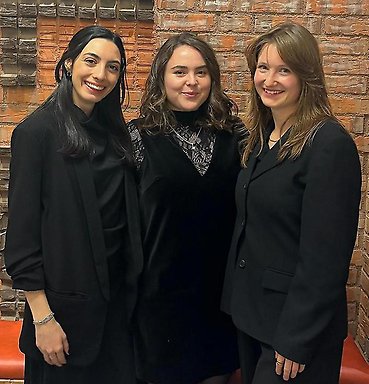
Lara, Larissa and Jelena are alumni.
%20(2)%20Msc%20NNEUO.jpeg)
Lara, Larissa and Jelena.
What made you choose the MSc in Neurochemistry with Molecular Neurobiology?
Larissa: My interest in Neuroscience began in high school and was strengthened during my bachelor’s in cellular and molecular biology. I applied to the master’s in Neurochemistry with Molecular Neurobiology at Stockholm University because it focused on fundamental research in neuroscience. I was looking for a programme that explores the inner workings of the brain and the nervous system: how neurons communicate in steady state and under stress, how environmental factors, drugs and diseases influence homeostasis and which underlying molecular mechanisms are involved.
Jelena: Before joining the program I completed a Bachelor's degree in (Biomedical) Chemistry and had only limited experience in molecular biology. However, the program allowed me to quickly catch up and I thoroughly enjoyed expanding my knowledge and skills in neuroscience. The interdisciplinary approach of the program brings together students from diverse academic backgrounds. I have always been fascinated by the complexity of the brain and this program offered an exceptional opportunity to explore neuroscience in depth. Additionally, I was eager to experience living abroad and studying in an international environment.
Lara: With a background in biochemistry with a biomedical focus, I wanted to better understand how the nervous system works and the molecular processes that shape human nature. The Master’s Programme in Neurochemistry and Molecular Neurobiology was the perfect opportunity to combine my interest in molecular biology with a deeper exploration of the nervous system in both health and disease.
What did you like most about the programme?
Jelena: Overall the program is great as it is a quite small class. You get to know your teachers closely and appreciate their passion for both their research and teaching. There are no boundaries when it comes to asking questions. I especially enjoyed the course in Advanced Neurochemistry, where we took a deep-dive into the nervous system during neurodevelopment, health and disease. One highlight was working with iPSCs in the lab and developing our own literature-based differentiation protocol. Another great advantage of the program is the opportunity to spend one year on your master's thesis. This allows you to gain extensive lab experience and work in a real-world scientific setting.
Lara: What I loved most about the program was how supportive and passionate the professors are, you really feel encouraged to grow as a researcher! The courses are engaging, and you get to work closely with people who are genuinely excited about research. Plus, the one-year master’s thesis is the perfect opportunity to dive into a project, learn more than any lecture could teach, and see if a research career is right for you. It’s a great environment for anyone curious and motivated to dive deeper into neuroscience.
Larissa: Looking back, I am very glad that I picked this programme, as it was exactly what I had hoped for. Besides its scientific focus, what stood out to me was the small-group teaching and the variety of seminars and teaching approaches. The programme is defined by an open and supportive learning atmosphere and offers the opportunity to connect with your classmates and lecturers. I believe the programme sharpened my critical thinking, taught me how to design experiments, establish project plans and gave me the confidence to pursue a doctoral degree.
Stockholm itself is a great city for scientific research. It is home to several leading universities and research institutes, meaning that you are surrounded by cutting-edge science and many international scientists from various research fields. This is reflected in the list of lecturers as well! Beyond science, Stockholm offers a stunningly green environment and exploring the archipelago is always a highlight. However, the city also offers a lot of cultural activities, from movies, ballets, operas and theatres to castles, museums, art galleries and concerts you will have a lot to explore.
What are you doing now, and how has the programme contributed to where you are today?
Lara: The program gave me not only a solid theoretical foundation but also hands-on experience and critical thinking skills that have prepared me for the next step in my academic journey — a PhD in Neurochemistry focused on studying Amyotrophic Lateral Sclerosis (ALS).
Jelena: Before starting the program, I had only a vague idea of what neuroscience really entailed. Now, after this experience, I am certain that I want to dedicate my career to understanding the brain and its complexity. Therefore, I am currently exploring PhD opportunities where I can apply the knowledge I've gained and continue contributing to science.
Larissa: For me, the Neurochemistry master’s paved the way to the PhD programme in Neurochemistry at Stockholm University, where I get to develop and lead a project trying to understand the motor neuron disease amyotrophic lateral sclerosis (ALS). If you look for a neuroscience master that focuses on fundamental research, taking you from the basics of how the neuronal network works to designing your own project plan and experiments, then this programme might be a great fit for you, too. Be ready for an intensive and rewarding journey.
Last updated: 2026-05-07
Source: Student Services