


Student projects
As their final examination, the Curating Art students produce a Master thesis and a curatorial project, e.g. an exhibition. The curatorial project is supervised by a professional curator. Over a period of 20 weeks, the student produces an individual project that is presented and examined at the University, although it might have another space as its main locus. It is empirically or thematically linked to the Master thesis that is produced parallel to the curatorial project.
2026
Ruby Henderson-Leconte: My Very Own Abyssal Archetype
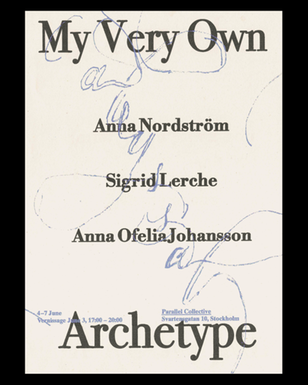
Vernissage: Wednesday 3 June 2026, 17:00-20:00, with a performance by Anna Ofelia Johansson at 18:30
Exhibition: 4–7 June 2026, 12:00 – 16:00
Location: Parallel Collective Gallery, Svartensgatan 10, Stockholm
Exhibition with Anna Nordström, Anna Ofelia Johansson, and Sigrid Lerche curated by Ruby Henderson-Leconte.
A haunting siren call.
A violently pastel sunset.
Aquatic light, aquatic refreshment.
An enigma in the water, slippery, and just beyond your reach.
Presented across two floors at Parallel Collective Gallery, My Very Own Abyssal Archetype is a musing on the mermaid. The exhibition brings together the works of artists Anna Nordström, Anna Ofelia Johansson, and Sigrid Lerche to rethink the mermaid, aesthetically and conceptually, into the present. Across textile, moving image, sculpture, and performance, the myth refracts its own history, finding new forms and evocative meanings in the contemporary condition.
𓇼 𓇼 𓇼
Anna Nordström (b. 1984, Sweden) is a Stockholm-based textile artist. She works with a wide range of techniques, namely patchwork, quilting, and embroidery, as well as expanding textile beyond its conventional frameworks. She holds an MFA and a BA in Textile from Konstfack, Stockholm, and has studied at MICA, Baltimore. Her work blends both past and present, drawing on themes such as archaeology, labour, femininity, and popular culture.
Anna Ofelia Johansson (b. 2003, Finland) grew up on the Åland Islands in the Finnish archipelago and is presently undertaking a BFA at Konstfack. She has also studied at the Weißensee Academy of Art in Berlin. Her work draws from marine and club environments, particularly their sonic aspects, as well as the shared logics and narratives embedded within them. This exploration has led to the development of Mermaids, a performance persona and DJ alias that manifests through human–fish hybrid forms, both digitally and IRL.
Sigrid Lerche (b. 1992, Denmark) is an artist based in Copenhagen, educated at the Bergen Academy of Fine Arts. She works at the intersection of performance art, scenography, and world-building, focusing on how objects and characters can create stories and experiences. Her practice explores mythology, stereotypes, and archetypes, and examines the boundaries between reality and fiction.
Lighting design by Iliana Totou, Ioanna Trikerioti Chatziioannou.
Graphic design by Einar Zotterman.
Michaela Yarmol-Matusiak: Reading/Viewing/Speculating

Duration: 10 – 31 May
Location: The Swedish Contemporary Art Foundation, Kungsbrostrand 19
Taking place within the context of the public programme for Agnė Jokšė’s REALITY CRACKS at Index, Reading/Viewing/Speculating, is a curatorial research project organised by Michaela Yarmol-Matusiak, with author Alvina Chamberland and her novel Love the World or Get Killed Trying (2024).
Call for Participants:
Introduction
Reading/Viewing/Speculating is focused on developing and testing a new method for co-reading-attending contemporary novels and contemporary art exhibitions. Through the thematic pairing of a novel and exhibition, the project offers a series of 3 workshops within a reading group, alongside a public presentation with Alvina Chamberland. Themes explored within the pairing relate to Jokšė’s and Chamberland’s works and practices, including auto-fiction, linguistics, and gender.
The project is aimed at those interested in experimental approaches to fiction, narrative, and contemporary art.
Sessions (at Index – The Swedish Contemporary Art Foundation)
- Introductory Workshop and Seminar: Sunday, May 10, 10:00 –12:00
Open to registered participants) - Alvina Chamberland’s Public Presentation: Saturday, May 23, 16:00 –18:00
(Open for all) - Closing Workshop and Reflection: Sunday, May 31, 10:00 –12:00
(Open to registered participants)
Participation Details and Registration
Through participating in the project, each participant receives the requisite workshop materials, including Chamberland’s novel. Participants are asked to read the novel and attend the exhibition within the methodological structures.
For registration in the workshops and/or questions, please email michaelayarmz@gmail.com by 30 April.
Agnė Jokšė is an artist and writer currently based in Vilnius. Using the tools characteristic to autoethnography, Jokšė tells stories in which personal experiences and past events related to contemplations of love, intimacy, relations and friendship intertwine with imaginative reflections. Works in the mediums of video and performative text often investigate questions concerning parallel histories, compassion, entangled relations, queerness and language. Jokšė has exhibited at Palais de Tokyo; E-flux Screening Room New York; Kogo Gallery; Cell Project Space; Editorial; Kunsthal Charlottenborg; Whitechapel Gallery; GIBCA and the Baltic Triennial.
Alvina Chamberland is a Swedish-American author of predominantly literary autofiction novels, residing in Athens. She has an MA in Gender Studies from Södertörn University. In 2015, she published her co-authored book Allt som ar Mitt: Våldtäkt, Stigmatisering och Upprättelse (All that is mine: Rape, Stigmatization and Reparation). In September 2018, her novel Utelast – Uppvaxt- nostalgi for freaks (Locked Out – A nostalgic account of growing up for freaks), a parody of the coming-of-age genre, was released. Her latest novel and English language debut Love the World or Get Killed Trying (2024), was a finalist for the Lambda Literary Award in Transgender Fiction and listed by the bookstore Shakespeare and Co., Paris, as one of the 121 best books of the 21st Century.
Ellen Klintenberg: Faculties
Faculties
5 – 6 June
Accelerator, Stockholm University
Bergsund, Djurgårdsstrand 2
Opening hours 5 June
Accelerator: 11:00–17:00
Bergsund: 16:00–19:00
Opening hours 6 June
Accelerator: 12:00–16:00
Bergsund: 16:00–19:00
Joakim Sandqvist, DJ Shadow, Dziga Vertov.
In 2018, a visit to Joakim Sandqvist’s studio in Malmö unexpectedly turned into an excursion to the city’s northern harbour area. Driving along desolate, oversized roads built for heavy trucks, the site unfolded as a kind of wasteland, a land reclamation area created by dumping demolition debris into the sea. We found ourselves on this excursion through a shared interest in trains and the visual culture surrounding the infrastructures and imaginaries of the post-industrial city. There is something about harbours. While they are nodes in a network, they also mark a border between land and sea, the fixed and the fluid, the known and the unknown.
There is a myth that Immanuel Kant rarely, if ever, left Königsberg, though he was said to enjoy walking down to the harbour to converse with sailors temporarily visiting the city. The sailors, in turn, were reputedly able to set their clocks by the regularity of his walks. Perhaps this story primarily mediates posterity’s image of the philosopher as, in his very person, an embodiment of Enlightenment ideals marked by rationality, discipline, and regularity. In the myth, the sailor functions iconographically as a rootless bearer of the world, yet in reality he is inextricably bound to a global maritime infrastructure.
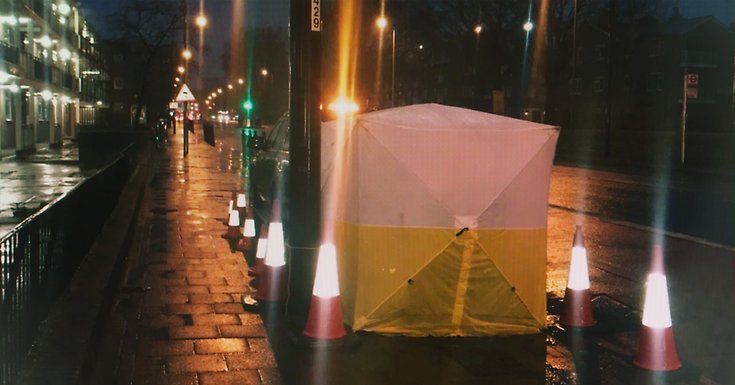
The basin outside Accelarator is in fact a remnant of obsolete research infrastructure, although I myself have always regarded it primarily as a spatiality. One characteristic of infrastructure is that it generally remains invisible so long as it functions as expected. It is only when a cable or pipe breaks, and the ground must be opened up, that we become aware of its existence. A large hole in the street, barriers erected all around it: this is how infrastructure makes itself felt. In such situations, a small tent is sometimes set up for protection against the weather. Hence, a spatiality is established through one of the oldest techniques we possess for creating space. Yet the tent functions not only as shelter; it is also an apparatus for organising bodies, gazes, and relations. As a condition of appearance, it may be understood as a medium insofar as it organises our perception.
Since the Middle Ages, the word faculty has been used to denote the collective body of expertise within a particular field organised by the university. It derives originally from the Latin facultas, meaning roughly ability, possibility, or capacity. Kant addresses the concept in both of these senses: both as the fundamental sensory faculties with which he believed every human being is born, faculties that order perception and thereby shape the way in which we apprehend the world; and as the university’s fields of knowledge and their internal ordering. In these senses, an interplay emerges between the mental and institutional forms of experience. Faculties are infrastructures of knowledge, and so are media.
Faculties is an exhibition that takes place at two locations; in a now-empty water basin that once functioned as a radiation shield for a particle accelerator at Stockholm University, and on a passenger ship docked at Djurgårdsstrand. The artist Joakim Sandqvist has created new works for these situations – works that have taken form as a large-scale outdoor installation, photographic images, and what might be described as a curatorial gesture, namely the decision to incorporate the film Man with a Movie Camera, made by the Soviet filmmaker Dziga Vertov in 1929, and the 1996 album Endtroducing… by the American music producer DJ Shadow.
Conceived as an exploration of research interests shared by Joakim Sandqvist and curator Ellen Klintenberg, Faculties is an open inquiry into human perception as formed by epistemological systems and mediating structures, with a particular focus on the conditions of modernity and post-Enlightenment Western culture.
Faculties is presented within the framework of the curatorial platform Peer, run by Klintenberg and Sandqvist together with Elias Kautsky.
Thanks to Accelerator, Jonas Lagerholm and Bergsund Rederi AB.
Verso: Uncovering the Konstakademien Collection
Artist Talk with Bella Rune, Runo Lagomarsino, and Max Book, accompanied by Head of Collections, Svante Tiren Moderated by Ruby Henderson-Leconte with contributions from Leif Holmstrand and Axel Lieber.
Date: 27 May
Time: 18:00–20:00
Location: The Royal Academy of Fine Arts Auditorium
The talk will be held in English.
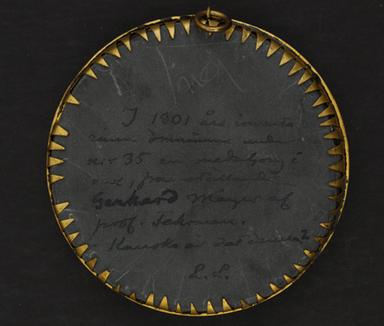
As a prelude to the launch of Konstakademien’s digital collection, this two-part intervention considers the backside, the verso, and the allure of the object from the back. Extending from an expansive, yet largely hidden collection made up of works gifted to the academy by new member artists, Verso: Uncovering the Konstakademien Collection consists of a visual installation and a public conversation to uncover the details of these reception pieces.
Verso aims to centre artists’ voices within institutional collections, through their responses and artistic contributions. The visual installation consists of a video tour taken within the collection spaces, alongside words from academy members Leif Holmstrand and Axel Lieber on their respective artworks in relation to their practice, the process, and the desired afterlife of the work within the collection. Accompanying the video tour into the closed storage areas are images from the digital catalogue documenting the back sides of the collection’s pieces – the side holding key historical details, notes, and unexpected clues.
On May 27th, from 18:00–20:00, the artist talk, with academy members Bella Rune, Runo Lagomarsino, and Max Book, in particular, seeks to understand the relationship between the artist and the artwork gifted to Konstakademien’s collection, bringing out the various personal narratives and choices behind this process.
The visual installation will be on view in the back entrance from Jakobsgatan at Konstakademien for two weeks.
About the Artists
Bella Rune (b. 1971) works with sculpture, including performative elements and experiments with different materials and techniques. She has been a member of the Academy since 2023.
Max Book (b. 1953) works with expressive, monumental painting, mixing collage, strange characters and contradictory objects. He has been a member of the Academy since 1996.
Runo Lagomarsino (b. 1977) works with a range of materials and mediums, such as installation, sculpture, drawing, performance, and action, exploring the politics and poetics of space and place. He has been a member of the Academy since 2024.
Leif Holmstrand (b. 1972) works with assemblage, collage, textile and crochet, exploring queer and trans experiences, and bodily subversion. Leif has been a member of the Academy since 2023. Axel Lieber (b. 1960) works with sculpture and public art, transforming everyday objects by rearranging them into new forms. He has been a member of the Academy since 2016.
Verso: Uncovering the Konstakademien Collection is curated by students Ruby Henderson-Leconte, Michaela Yarmol-Matusiak, Tyra Wihl, and Letian Lois Ding.
MAAPS (Mapping Asian Art Practices in Sweden)
.png)
Date: Wednesday 20 May 2026
Time: 10:00 - 12:00
Location: HAS – Helix Art Space, Torsplan 12, Stockholm
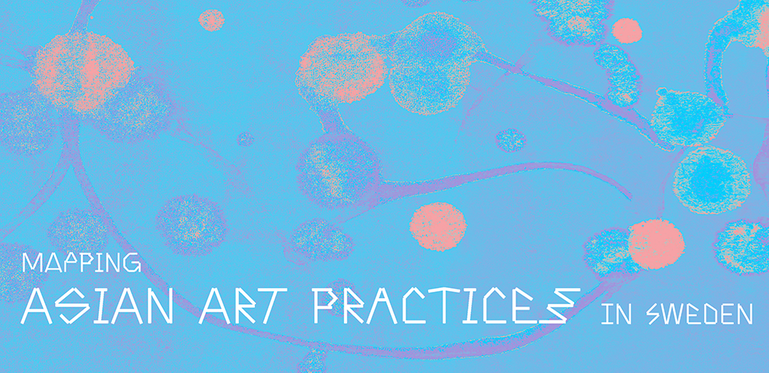
Mapping Asian Art Practices in Sweden (MAAPS) is an ongoing project and platform dedicated to bringing together the work and stories of art practitioners based in Sweden who are situated in relation to what is often broadly framed as “Asian.” It is initiated and run by four Stockholm-based curatorial practitioners with roots across Asia.
We are launching our website with a breakfast talk.
As a curatorial project, MAAPS steps away from Western ways of measuring, marking, and defining geographic frameworks. Through open dialogue, we explore Asian art practitioners’ experiences, perspectives, and the dilemmas they face. This process of mapping takes shape on the MAAPS website – a living archive and an open platform where anyone with interests can explore and engage, while practitioners can also document and share their art practices. Here, the project unfolds in public: accessible to all, and continuously shaped by those who are part of it. What has emerged is something both structural and organic – a dynamic network and a developing methodology of mapping, forming a community that is loosely yet closely connected.
Guest Speakers
Ting Wang is a Chinese-Swedish artist based in Stockholm. Her experience of relocating to a new cultural context has made displacement a recurring theme in her work. Ting creates interactive installations that merge sound, sculpture, film and mechanical structures.
筒 | tsu-tsu is a Japanese documentary actor. Trained in Japanese classical dance from the age of six, he developed a practice called “Documentary Acting,” rooted in the concept of tsutsu (筒, “hollow vessel”) a deep research and embodiment of real individuals.
Mansi Kashatria is currently completing her PhD at Linköping University, focusing on contemporary art institutions and curatorial practices. Her research examines how institutions attempt to “reimagine” society while navigating structural inequalities.
Jesper Bror Palmqvist is a multidisciplinary artist working with painting, installation, film, and sculpture. His practice explores queer and undefinable identities through personal narratives, materiality, and folklore, often challenging dominant social structures and binary ways of seeing the world.
Nanna Li was born in China. She moved to Luleå at age three. She left for the UK at eighteen and spent over ten years there. Nanna returned to Sweden in 2017. Nanna has worked in illustration, comics, and game development and is now finishing her MFA in Visual Communication at Konstfack.
MAAPS began as a graduation project of Letian Lois Ding, within the International Master's Programme in Curating Art at Stockholm University, and continues in collaboration with Ruoxi Gao and Close-enough (Yul Cho and Ifra Shariq). Visual identity by Nanna Li.
The Collective Embroidery Workshop
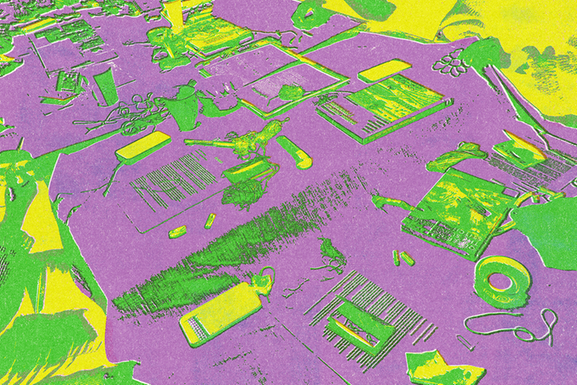
An open invitation to gather around crafting, conversation, and communal creativity. The event is hosted by artist Ebba Hägne and curated by Letian Ding, a student at the International Master's Programme in Curating Art at Stockholm University.
Date: Sunday 17 May 2026
Time: 13:00 - 15:00
Location: Accelerator Café, Frescativägen 26A
Free entry – no registration needed
The workshop will be held in English, with assistance available in Swedish and Chinese.
What does solidarity mean in your life, your body, your memory? The Collective Embroidery Workshop invites participants to reflect on this question through the act of making. With needle and thread, everyone is welcome to contribute stitches to a shared embroidery cloth that grows throughout the afternoon into a collective artwork. No prior experience is needed; the workshop moves at its own pace, where conversation and making happen alongside each other. What remains at the end is both an artwork and a trace of everyone who passed through and left something of themselves behind.
The embroidering takes place on the stickstol (embroidery chair), which is crafted by Ebba Hägne as a contemporary reimagining of a traditional form once used in both Sweden and China. The workshop is situated in dialogue with the current exhibitions by Linnéa Sjöberg and Olof Marsja, both of which engage with craft, material memory, and the knowledge carried in the hand. Embroidery is precisely a knowledge of hands, historically practised outside the structures that define what counts as legitimate art or recognised expertise, and one that belongs as much to collective memory as to individual skill.
The Artist
Ebba Hägne is a Swedish-Chinese multidisciplinary illustrator, graphic designer, artist, and art teacher based in Stockholm. She graduated from Konstfack in 2025 with a Master's degree in Fine Art, and her practice draws on family memories, diaspora identity, and the experience of living between China and Sweden. Her work holds traditional craft and contemporary expression in ongoing, productive tension, where the handmade and the designed, the inherited and the invented, sit close together.
Credits
Artist: Ebba Hägne
Curator: Letian Ding
Supervisor: Nina Øverli and Robin McGinley
Text: Letian Ding
Total Internal Reflection
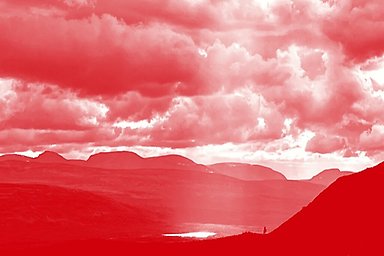
Malla, Enontekis. Photo: Minna Rombo Zetterlund, 2024. Editing: Klara Branting Paulsell with www.tooooools.app.
TOTAL INTERNAL REFLECTION is a convergence of memory and light. With glass sculpture and sound installation as their medium, artists Minna Rombo Zetterlund and Klara Branting Paulsell explore connection, reflection, and awe. Curated by Ceridwen Grady and Lukki Jokilehto.
This installation is part of the Master’s Programme's collaboration with exhibition hall Accelerator. The students create events in connection to themes that Accelerator wishes to highlight in the exhibition programme.
Location: Accelerator’s staircase and lift
Duration: 29 April – 10 May
Opening night: 29 April, 18:00–20:00, with durational light activations at 18:40 and 19:40
Free entry, no registration required.
For twelve days, visitors are invited to explore their connection to light through installations in the staircase and lift. The installation converses with Olof Marsja’s ongoing exhibition I din röst bor anden till ett språk. Where his exhibition explores wind as a force that carries language, TOTAL INTERNAL REFLECTION turns to rays of light as a shared connection across generations.
Everyone who has ever lived has stood under the same sky. Have you ever paused to stare in wonder at the rays of light breaking through the clouds? These rays of light defy borders and reach across time, connecting people and offering a momentary space for rest in a constantly moving world. Inspired by fibre optics, the installation continues this journey, guiding light through thin glass strings, creating never-ending reflections that invite visitors to follow them inwards. Through their work, Rombo Zetterlund and Branting Paulsell want to light a path for rest and reflection held in a moment of awe.
About the artists
Minna Rombo Zetterlund (b. 1990, Sweden) is an artist based in Stockholm. Holding a BFA (2015) and MFA (2025) in Glass from Konstfack University of Arts, Crafts and Design, Minna works primarily with glass and light, sometimes in dialogue with other materials. Their practice is guided by curiosity and a sensitivity to the emotional capacities of material, and—through a process rooted in wonder—they explore how fleeting moments of awe, attention, and presence, might be shared.
Klara Branting Paulsell (b. 1997, USA) is based between Stockholm and Berlin, Germany, and holds a BFA from the Design Academy Eindhoven (NL, 2023). They mostly work with the written language and collective practices and all they really have ever cared about are dialogues and people-watching and learning how to live together in anticapitalism.
Rombo Zetterlund and Branting Paulsell have been collaborating on workshops, performances, and exhibitions since 2018. They see their collective process as an investigation into coaction, where the subject meets and is met constantly. Their work often centers around nature, conversation, and mapping.
Artworks
Beam
Minna Rombo Zetterlund
Glass
Trajectory is Easy
Minna Rombo Zetterlund, Klara Branting Paulsell
Words and sound
Credits
Artists: Minna Rombo Zetterlund and Klara Branting Paulsell
Curators: Ceridwen Grady and Lukki Jokilehto
Supervisors: Nina Øverli and Robin McGinley
Graphic Design: Klara Branting Paulsell
Lighting Design: Efstathios Gavriilidis and Pol Vallès Ventura
Text: Ceridwen Grady and Lukki Jokilehto
Tell Me About Home
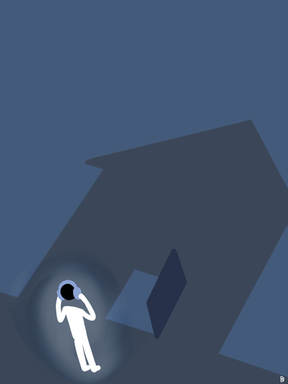
Graphic Illustration Tell Me About Home, Daniela Kugler
Installation: 21 – 28 April
Workshop: 21 April, 17:00 – 19:00
Location: Sergels torg, Kulturhuset: Lava, floor 4
Where is home? What is home? Where can one make a home, find a home, build a home?
Tell Me About Home is a sound artwork exploring the meanings of home, a concept familiar to all of us with interpretations as many as there are us. The sound artwork by the Finnish artist Thea Piisu Heino invites each guest to listen in on her story through different stages of life. While often associated with a house or an apartment, sometimes a home is found in the backseat of a car, a digital space, or nowhere at all. Whether its current location is known or not, the artwork creates a space for its listeners to sit down and let their thoughts wander towards home.
Thea Piisu Heino is a queer musician and an audio artist from Tampere, Finland. She has a decade long background in working with music and audio and is currently studying Music & Audio production at Tampere university of applied sciences. Heino thrives on working with broken and distorted audio, often utilizing audio degradation in her work. On this work, she says:
“Tell Me About Home seeks to reconstruct how the places where I felt at home sounded, with the hope that others might relate to my experiences and find themselves appreciating the homes they have made.”
The headphone-based sound artwork is installed at Lava, a youth space at Stockholm’s Kulturhuset for people aged 14 to 25. It is accompanied by a collage workshop arranged by the installation’s curator Lukki Jokilehto. He is a Finnish curator with a background in film and media with a focus on screenwriting and directing. Jokilehto’s current practice focuses on experience design, Nordic collaborations, and working with emerging artists between multiple artforms. Tell Me About Home is his final degree project within Curating Art, International Master’s Programme..
Artist: Thea Piisu Heino
Curator: Lukki Jokilehto
Graphic Illustrations: Daniela Kugler
Duration of the artwork: 4 minutes 52 seconds
Self-ish
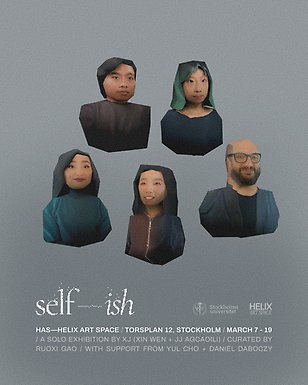
Start date: Saturday 7 March 2026
Time: 18:00
End date: Thursday 19 March 2026
Time: 17:00
Location: HAS – Helix Art Space, Torsplan 12, Stockholm
Self–ish is curated by Ruoxi Gao, co-developed with Yul Cho and Daniel Daboczy.
Vernissage: 7 March, 18:00–21:00
Artist Guided Tour: 7 March, 19:00–19:30
In an era defined by digital surplus, our sense of self is increasingly fragmented and recomposed into data traces through platforms designed to surveil. Self–ish, the first major solo exhibition by artist duo XJ (Xin Wen and JJ Agcaoili), explores how the subjective self is constructed, compressed, and now mimicked by the technologies we inhabit.
Notable for their methodology of working in between the physical and the digital, XJ brings together five works across projection-mapped installation, moving image, and kinetic sculpture. Moving between physical interaction and algorithmic abstraction, these works embody how the self is both turned inward and constantly exposed.
The title Self–ish captures this tension: it evokes the introspection of being alone with oneself, but also the way our personal gestures are always observed, recorded, and interpreted by external forces to grasp at an approximation of personhood. The infrastructures that promise agency are shaped by selfishness and technological determinism: forces that extract from the very selves they appear to empower.
Self–ish reflects the ambiguous space of the digital self, where solitude, self-expression, and exposure coexist, and where identity is both something we claim and something that is claimed for us. What happens to our sense of self when identity becomes a performance, existence requires maintenance, and the real becomes eclipsed by the artificial?
This project has been made possible through the generosity, trust, and collaboration of many individuals and institutions. My sincere thanks to Daniel Daboczy and HAS - Helix Art Space for their collaboration, support, and for trusting me with this project. I am deeply grateful to the artist duo XJ, Xin Wen and JJ Agcaoili, for their artistic generosity and commitment. A heartfelt thank you to Nina Øverli and Isabella Tjäder, my supervisor, for your invaluable guidance and thoughtful support throughout the process. I would also like to warmly thank all those who have so generously contributed to this project through dialogue, insight, and thoughtful critique: Camilla Larsson, Carina Hundsdahl, Elvira K. Wikman, Isa Van den Wouwer, Jonatan Habib Engqvist, Magdalena Holdar, Nicole Bood, Noël Inggs, Robin McGinley, Unn Faleide and Yul Cho. Credits: Delta Consulting, Ebba Lindgren Jirdén, Jennifer Gummesson, Thom Mattson, and Tower Helix.
Artist name:
XJ (Xin Wen and JJ Agcaoili)
Web:
manyprojects.co
Artist bio/statement:
XJ (Xin Wen and JJ Agcaoili) is a Chinese-American and Filipino artistic duo grown out of London, now working internationally. Their award-winning practice reckons with the human subject in collision with the material and digital structures that manipulate contemporary life. This fascination with the physical-digital is embodied in media-expansive work across experimental video, kinetic sculpture, and immersive installation. They have exhibited globally in major cities such as San Francisco, Taiwan, Linz, Singapore, and London.
Anyone know this club?

A collaborative exhibition by André Córdova Rudstedt and Ingeborg Kraft Fermin. Curated by the students of the class 2027 in the International Master's programme in Curating, including Art, Management and Law in collaboration with Flat Octopus.
20 February – 21 February 2026
Location: Döbelnsgatan 39, Stockholm
Vernissage: 20 February, 19:00-22:00
Previously a gentlemen’s club, the basement of Döbelnsgatan 39 has lain dormant for years, dust collecting in its corners. What remains is a mirrored bathroom, gaping holes in the ceiling, broken speakers, and wallpaper – faded, peeling, and barely clinging to the walls.
Through sound and light, this immersive installation reanimates and reconceptualises the site’s layered history. Pulling from the remaining architectural elements of the space, the artists merge memory with fiction. Echoes collide with the trickling of the plumbing and the hum of cars outside. Shadows emerge and recede along the floors and walls like fragmented ghosts of the past.
Before the space is wiped clean, the artists explore its liminal and in-between nature. The
exhibition invites the visitor to the making of an artificial memory that is so enthralling, it may just be true.
André Córdova Rudstedt (b. 1991) works with moving images and installation, using AI-based
voice cloning and animation to explore power structures, collective behavior, and societal norms. His practice moves between humor and discomfort, where satire serves as a critical tool to highlight the absurdities of contemporary life.
IG: @andrecorud
andrecorud.cargo.site
Ingeborg Kraft Fermin (b. 1993) examines mediated reality through personal narrative, tracing how desire, memory, and attention are shaped as everyday life is constantly filtered and
documented. Working mainly with video and multimedia installations, she produces works that spark curiosity about the larger systems that inform the contemporary experience of her
generation.
IG: @ingeborg.3000
ingeborgfermin.com
This project is realised as a part of Flat Octopus annual programme. Flat Octopus is an
international artist and curator-run collective in Stockholm, started in 2019. The collective
organises apartment exhibitions, collaborations, and local and international exchanges. Since
2024, Flat Octopus has organised an artist-in-residence programme in Edsbruck in a rural part of Sweden.
Flat Octopus is supported by Stockholms stad, Kulturrådet, and Region Stockholm.
For further information, please visit:
The Strangest Longing in a Lover

Image: Matilda Lövgren
In a site-specific sculptural intervention, artist Matilda Lövgren makes her mark on shiny surfaces with two new artworks that seep into the architecture of Accelerator. The Strangest Longing in a Lover is presented by the International Master’s Programme in Curating Art, in partnership with Accelerator, and is curated by Tyra Wihl.
To leave an imprint is to mark a surface by pressing something hard into it, leaving a lasting impression. There are physical imprints, those that indicate the previous presence of a body, such as footsteps, fingerprints, bruises, or wrinkled sheets in an unmade bed. An imprint can also be psychological, the process of fixing something firmly in someone’s memory. It is in this vein that Lövgren’s artworks interfere with the cloakroom and public bathroom at Accelerator; an attempt to connect with herself and with you.
Lövgren’s practice involves an ongoing process of sourcing and collecting materials from her own body, including hair, saliva and sebum. Here, her fascination with self-referentiality is intertwined with the myth of Narcissus, who pined for and desperately pursued his own image as it appeared before him in the reflective surface of a spring. As Narcissus leans over the pond, refusing to break eye contact, Lövgren’s artworks speak of a similar need to examine what appears in the reflection.
This project is curated in relation to Accelerator’s ongoing exhibition Vera Was Here, and the conceptual bridge to it is twofold. Lövgren experiments with the theme of indexical representation in her own visceral way, rendering the artworks a material trace of her DNA. Additionally, like Bitsy Knox’s series of artworks referencing the veil of Saint Veronica, this project is grounded in a myth that, in turn, explores the difficult relationship between the subject and his image.
Exhibition: 21 January – 29 January
Opening: Wednesday, 21 January
Time: 17:30 – 20:00
Free entry, no registration necessary.
On the same evening, Accelerator hosts a curator-led tour of the exhibitions Gravity, Be My Friend and Vera Was Here.
Artworks
Älskar, älskar inte
Un peu, beaucoup, passionnément,
à la folie, pas du tout (2025)
Mirror, sebum, Nivea cream
Still life lingers (2025)
Silicone, human hair, still life installation
Credits
Artist: Matilda Lövgren
Curator: Tyra Wihl
Graphic design: Emma Annell
Supervisors: Nina Øverli and Robin McGinley
2025
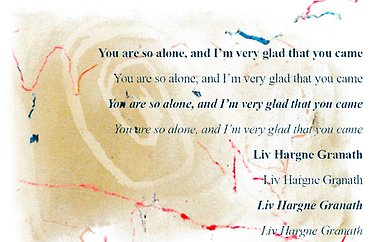
Michaela Yarmol-Matusiak and Ruby Henderson-Leconte: You are so alone, and I’m very glad that you came
Graphic design: Marion Sanson
Exhibition: 12 – 26 November
Opening: Wednesday, 12 November
Time: 18:30 – 20:00
Free entry, no registration required
You are so alone, and I’m very glad that you came is a site-responsive sound installation written and narrated by actor Liv Hargne Granath, exploring vulnerability, loneliness, and friendship.
Created in response to Pipilotti Rist’s practice and visual language, Hargne Granath presents a new body of work which inhabits the corners, stairwells, and landings of Accelerator. Echoing throughout transitional spaces, the sound installation presents a fragmented narration of a character seeking a listener and a confidante – a character who is, indeed, all of us.
You are so alone, and I’m very glad that you came employs confession and surreal imagery to explore fantastical yearning and the boundaries of the self. Through secrets and speculation, Hargne Granath crafts the best friend we wish to confide in. The accompanying publication, including the printed script and a curatorial essay, provides an additional, tangible dimension to the installation.
The opening takes place between 18:30 and 20:00 on 12 November, with an introductory speech at 19:00. All are invited to listen and daydream collectively, and are welcome to experience the current exhibitions in relation to Hargne Granath’s narration.
You are so alone, and I’m very glad that you came will remain on view for two weeks, aligning with Accelerator’s opening hours, until 26 November.
Free entry, no registration required.
Artwork
Liv Hargne Granath, You are so alone, and I’m very glad that you came, 2025, four-channel sound installation.
Credits
Actor and Writer: Liv Hargne Granath
Curators: Michaela Yarmol-Matusiak and Ruby Henderson-Leconte
Supervisors: Nina Øverli and Robin McGinley
Graphic Design: Marion Sanson
With special thanks to Puya Yekerusta for assistance with sound and recording.
Elvira K. Wikman: rein in
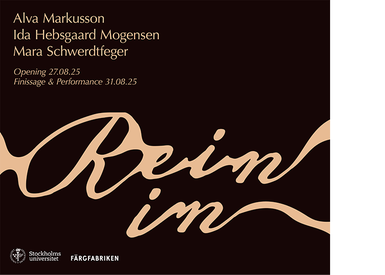
Exhibition 27 – 31 August
Opening reception 27 August 16:00 – 18:00
Artist talk 30 August 14:30 – 15:10
Finissage performance 31 August 14:00 – 15:00
Imagine laying down in a honey-filled bathtub. The honey sticks to the body, like a second layer of skin. Sticky and slimy. The joy of sweet nectar is suddenly erased by the panic caused by a sense of entrapment. This sticky feeling can arise from other sources too; a clingy lover, a shameful memory, or a trauma. Sticky objects, experiences, and people cling to us, and challenge our sense of autonomy. It is an experience of an outer invasion of the self.
This exhibition brings together the artistic practices of Alva Markusson (SE), Ida Hebsgaard Mogensen (DK), and Mara Schwerdtfeger (AU) and investigates sticky feelings as an impulse that simultaneously call for control and surrender; for reining in and letting go. rein in moves within a dynamic field of tension between discomfort and desire, between the urge to control and release. This oscillation forms a space where emotions rub up against the body, where something feels off, uncomfortable, unresolved – sticky.
Through her sculptures, Alva Markusson investigates themes of desire through materiality: horse hair, textile, metal, leather, and concrete. She sees these materials as carriers of a symbolic language, each with its own message. Her sculptures serve as phenomenological investigations of our inner and outer landscapes, tracing the subtle ways in which texture, form, and space affect body and mind. On the occasion of this exhibition, she will present sculptures as part of a new body of work.
In the performance HUDLØS, dancer Ida Hebsgaard Mogensen, examines the boundary between interior and exterior, where the body – the flesh – serves as the border between self and other. Through her artistic practice she explores the limits of the body; the grotesque and the sublime. HUDLØS is a forty-five minute long solo piece created by Hebsgaard Mogensen in 2025.
As part of HUDLØS, Mara Schwerdtfeger’s sound piece Code Switch will be exhibited. Schwerdtfeger is a composer and curator who plays the viola and collaborates with her laptop to create live performances as well as recorded pieces for film, performance, and dance. Her practice is guided by the shifts of perspective and interaction of rhythms and beings within environments.
Code Switch is a sonic image of the subsurface. Made solely of digitally manipulated contact microphone recordings of surfaces like tree trunks, stones, and throat the piece aims to amplify a perspective that sits within the ground. The title refers to the change of body and verbal language that occurs when in different cultural or social settings and places this terminology onto our relationship with the Earth.
Elvira K. Wikman is a curator based in Stockholm, Sweden. Rooted in contemporary art, her work explores the fragility of existence, often dwelling on themes of metamorphosis, relationality, and the uncanny. She holds a BSc in International Relations and a BA in Art History. She is currently enrolled in the International Master’s Programme in Curating at Stockholm University. She is 50% of the curatorial collaboration Spitbucket.
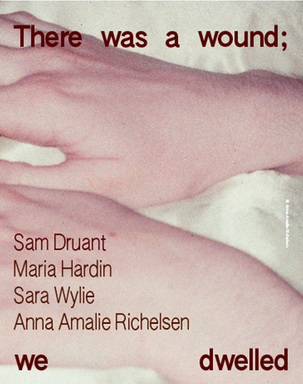
Isa Van den Wouwer: There was a wound; we dwelled
%20Tere%20was%20a%20wound.png)
Graphic design: Katrín Guðrún Helgadóttir.
Vernissage: 4 September, 17:00 – 19:00.
Collective reading: 6 September, 13:00 – 15:00.
Hosted by Sam Druant and Maria Hardin.
“Ill feelings make you both impressionable and hard. To stop yourself feeling suddenly diffuse, as if you are disintegrating, you make yourself small and solid – impenetrable. You appear self-contained because you spend most of your energy trying to hold all the parts of yourself together.”
Alice Hattrick, Ill Feelings, 2021
There was a wound; we dwelled brings together the multidisciplinary practices of Sam Druant, Maria Hardin, Anna Amalie Richelsen, and Sara Wylie, laying bare invisible female pain and neglected wounds. As a visitor, you are invited to encounter how existing in crip time means relating to temporality, linearity, and productivity in radically different terms. As such, new rhythms conform to the body's condition, rather than the other way around. Within this exhibition, the discourse of bodily failures and interior unrest faces the body’s potential. The artists draw on iconographic motifs and symbolism to contemplate the mourning of the body we once knew, as we embrace its reimagined version.
Female wounds take many shapes: they may lie dormant, carry the weight of guilt, or remain undiagnosed. The title of the exhibition There was a wound; we dwelled, drawn from Leslie Jamison’s essay Grand Unified Theory of Female Pain, gestures toward the shame projected onto female sick bodies, cast as monstrous or hysterical, both in past and present. This sense of otherness, within a sphere where health is the norm, seeps into us - rendering women to feel distorted, bypassed, undesirable. The works in the exhibition relate to a persistent tension within the body, wavering between sickness and health, in search of a language to express the felt ambiguities and wounds.
Our bodies are porous, relational, entangled. Far from isolated, they are shaped by an inherent relationality that lies at the centre of the exhibition. Druant, Hardin, Richelsen and Wylie present their artistic practice as a manifesto to introduce new structures of being and caring. By constructing a web of relationships rooted in collectivity and empathy, bodies may move beyond individualism. There was a wound; we dwelled welcomes visitors to encounter, stay, rest, and dwell – in whatever capacity that may be.
A collective reading, hosted by Sam Druant and Maria Hardin, will complement the exhibition on Saturday 6th of September. The gathering will take place from 13.00 – 15:00, and becomes a site for collectively questioning the ways our bodies exist in their relationality – towards the world we inhabit, healing, labor, rest, and the capitalist systems we navigate.
Feel free to bring a piece of your own writing or the writing of someone you love to share (max. 500 words). The reading will start at 13:30h. The artists will be present for 2 hours. You are welcome to stay at a pace that resonates with you. The venue is wheelchair accessible, with seating options for all.
Join, linger, contribute
Carina Hundsdahl: Sacred Tensions
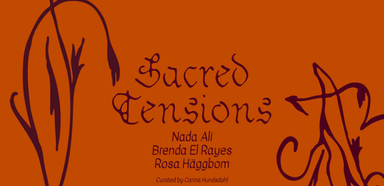
Featuring works by Rosa Häggbom, Nada Ali, and Brenda El Rayes, this exhibition explores the role of religion in contemporary art.
Exhibition: 22 May – 14 June
Vernissage: 22 May, at 16:30 – 19:00
Artist talk: 3 June, at 17:30
What does it mean to speak of religion in contemporary art?
In Sacred Tensions, religion is not treated as a theme to be decoded or distanced, but as a living, complex presence within contemporary artistic practice. The exhibition challenges the secular norms that often render religious and spiritual expression invisible in art spaces. Instead of reducing sacred content to metaphor or psychology, Sacred Tensions invites visitors to encounter the religious on its own terms — with attentiveness, care, and openness.
Featuring a group of artists whose works are shaped by ritual, belief, theological thought, and metaphysical inquiry, the exhibition explores how religion continues to shape cultural life. These practices do not illustrate religion; they perform, question, and transform it — refusing easy separations between the sacred and the contemporary.
In a time of shifting worldviews, Sacred Tensions proposes that the sacred is not a relic of the past, but a vital part of the present. It holds space for both faith and doubt, for inherited forms and new rituals, for devotion and critique — not as opposites, but as forces in relation.
Curated from a post-secular perspective, the exhibition invites viewers into the tensions between the sacred and the secular, offering a space where religion is not translated, but felt.
Noël Platts: Check the temperature. Hemma är wherever me da la regalada gana!
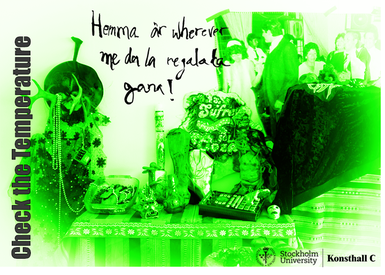
© Noël Patts
Date: Saturday 24 May 2025
Time: 15:00 – 17:00
Location: Konsthall C, Cigarrvägen 14 in Hökarängen
"Hemma är wherever me da la regalada gana!" – "Home is wherever I goddamn feel like it! is a compelling sound art intervention by Rossana Mercado-Rojas. A sequel to Home is Where the Heart is (2019). The work features a spoken word by Princess Jiménez Beltré. (La Dekoloniala org). Curated by Noël Platts as part of a degree project.
The title blends three -European- languages the artist currently navigates by choice or necessity. Loosely translated, the phrase in Abya Yala Spanish, “Home is wherever I goddamn feel like it!” becomes an empowering statement, a playful act of refusal.
Using a combination of sound, installation, and image projection, Mercado-Rojas creates a space where individuals are invited to feel at home – at least temporarily. Her practice reclaims agency by filling the space with empowering visual and auditory expressions drawn from her own Andean cultural practices and experiences, creating new symbols from the old while preserving their essence. People can connect through a range of sensory and symbolic elements: sound, color, symbols, words, tone, and repetition – evoking the rhythm of a mantra, a prayer, or a call. These elements create a shared emotional and spiritual atmosphere. Fabrics and objects of personal significance – such as a handwoven textile from the artist’s great-grandmother, or a glass printed with her grandfather’s face and name, a memento from his passing – are arranged in altar-like structures that evoke ritual-like experiences.
With participants at its core, the work summons energy to consecrate the space as a sanctuary – where community is felt, not forced, and where the relentless machinery of coloniality is held at bay. Shaped by a specific political and social context, the work challenges traditional notions of what it means to belong somewhere.
Unn Faleide: DANCEWORK – An exhibition of dances and work(s)
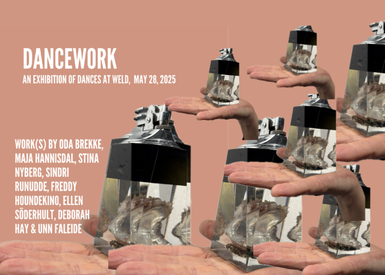
Date: Wednesday 28 May 2025
Time: 19.00 – 21.00
Location: Weld, Norrtullsgatan 7 in Stockholm
DANCEWORK is a group exhibition of dances. It looks at the conditions under which dance is made and shared. It looks at value, labour, and precarity as structural conditions shaping the lives of artists and the art.
Identity is fickle. So is value. Still, we find ourselves drawn to practices that are barely recognized, underpaid, and often invisible. We become choreographers, dancers, producers, curators – sometimes all at once – and we take on the invisible work behind those roles. But what is this work, really?
It might be lying awake at night thinking about speculative futures and unlikely gatherings; it might be making something out of nothing or working with near-zero budgets. It is driven by a willingness to work work work work work (Rihanna), often in the face of uncertainty, in order to make something else—something different, something which might create space for other ways of thinking and being. This is the kind of work that begins in hope, moves through doubt, bitterness, stubbornness, rejection, moments of surrender; and never really ends.
After fifteen years of working as a dancer, Unn Faleide, the dancer and curator of the exhibition, began studying curating. This shift opened up a space to reflect on how precarity not only surrounds artistic work but often becomes embedded in the work itself: shaping its rhythms, aesthetics, and limits. It also gave rise to a curiosity about how choreographic and curatorial strategies might speak to and challenge each other. What happens when practices from the visual arts meet the embodied, processual temporality of dance? What new formats, tensions, or freedoms arise?
Given a modest budget but a desire to realize a large-scale group exhibition, the idea developed of a project where roles blur, where the dancer takes on the curatorial and precarity becomes both content and framework. Rather than assigning tasks or requesting new works, seven choreographers were invited to contribute a dance to the exhibition on their own terms—by giving, lending, selling, donating, or creating a piece specifically for DANCEWORK, the exhibition.
DANCEWORK features contributions from Oda Brekke, Sindri Runudde, Maja Hannisdal, Stina Nyberg, Ellen Söderhult, Deborah Hay, and Freddy Houndekindo.
These choreographers were invited not only for their artistic brilliance, but also because they were part of the curator’s immediate surroundings—people encountered in passing or already in conversation. The project recognizes that one of the things artists gain or “earn”, is community and friendship. DANCEWORK is as much about these relationships as it is about the works themselves.
Each artist was offered a symbolic fee of 999 SEK, regardless of whether they contributed a recycled score, a second-hand choreography, or a custom dance. They were asked to track their time – emails, rehearsals, or thinking – and were free to work as much or as little as they wished. All accepted. Most chose to work physically in the studio. All invested more time than the budget allowed, knowingly and with care. The project became a mirror of the economy of attention and labour underpinning much of artistic production – especially in dance.
DANCEWORK is performed by one body who embodies multiple choreographies and curates the exhibition in real time, through lived presence at Weld. The dancing body becomes a site of convergence, where artistic voices meet, diverge, and transform. The curatorial becomes relational, vulnerable, and political: it questions how people are brought together, and what conditions are created for artistic work to occur. What does it mean to purchase a dance; to loan it; to shape it collaboratively? These are not just legal questions, but artistic and ethical ones. They challenge existing models of working and what a “work” really is.
Throughout the process, authorship was neither assumed nor imposed. In some works, the dancer operates as an interpretive vessel; in others, their contribution is intrinsic to the work’s existence. Where relevant, co-authorship was acknowledged contractually. More than resolving questions of credit, the project asked what each person brings into the collaboration, because ultimately art is collective.
In the end, DANCEWORK is an excuse to dance – to keep working with people and practices that inspire. It is personal. It is an offering, an experiment, and simply, a way to keep moving.
Work(s) by:
Oda Brekke
Unn Faleide
Maja Hannisdal
Deborah Hay
Freddy Houndekindo
Stina Nyberg
Sindri Runudde
Ellen Söderhult
Curated by: Unn Faleide
Light and sound: Patsy Lassbo
With support from: Stockholm University and Weld
Heartfelt thanks to Nina Øverli, Anna Koch, and the Curating Art class for their generous mentorship and support throughout the process. Deep gratitude also goes to all the artists who have dedicated their time and energy to making this evening possible.
ODA BREKKE
is a dance artist based in Stockholm. In her practice she takes on roles as choreographer, performer and writer with an interest in experimenting with performative frameworks and forms. She is active at höjden studio where she often organises study groups and talks.
UNN FALEIDE
is a dance artist, producer and curator whose work explores precarious conditions, alternative structures in dance and the decolonial potential of curatorial practices.
MAJA HANNISDAL
is a dance artist and videographer based in Oslo, whose work moves between the beautiful and the grotesque, exploring value through the overlooked or seemingly irrelevant.
DEBORAH HAY
is a significant postmodern choreographer whose groundbreaking solo and group works continue to reshape the relationship between body, perception and presence in dance.
FREDDY HOUNDEKINDO
is an interdisciplinary artist and dancer working with dance, film, fashion and music, with roots in street dance and a practice grounded in movement research.
PATSY LASSBO
is a composer, theatre maker and performer working with theatre, dance and live music, focusing on technical and sensory dramaturgies.
STINA NYBERG
is a Stockholm-based choreographer whose conceptual, collaborative practice uses choreography to explore everything from electricity to gossip, often with humour, curiosity and feminist critique.
SINDRI RUNUDDE
is a choreographer and performer working at the intersection of dance, sound and storytelling, with queer, somatic and accessibility-centred perspectives in poetic, multi-sensory performances.
ELLEN SÖDERHULT
is a dancer and choreographer based in Stockholm. Her choreographic works have often taken on the collective as protagonist but also explored monstrous emotions and textures in sweet-bitter love and the ghostly in the relationship between dancer and dance. With a background in choral singing and sports, she often works with voice, immersive soundscapes and big leaps.
Noël Platts and Ruoxi Gao: NAMAK
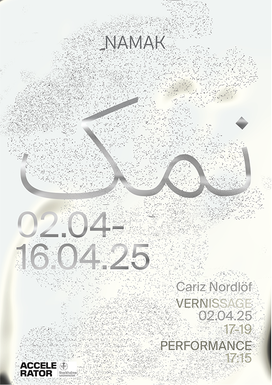
2 April – 16 April, 2025
Opening: April 2nd, 17-19
Performance: start 17:15
Artist: Cariz Nordlöf
Curated by Noël Platts and Ruoxi Gao
Graphic designer: Maja Godek
NAMAK (نمک) is a collaborative exhibition presented by the International Master’s Programme, in partnership with Accelerator. The installation and performance artwork draws on research into the environmental degradation of the Karun River in Iran, as well as the historical context of the Accelerator pool.
Iran's longest river, Karun, is suffering from severe environmental degradation. It has faced significant ecological damages. Industries and agriculture on non-fertile soil have led to increased salinization of the river. Salt plays a central role in NAMAK. Nordlöf uses the corrosive properties of salt as a way to artistically manipulate aluminium pieces. With saltiness, the work seeks to draw a connection to our memories of salt and thirst, as well as the vulnerable body made fragile through prolonged exposure to contamination. Its saltiness also parallels the concerns addressed in Goldin and Senneby’s Flare-Up exhibition at Accelerator, such as biochemical imbalance and its effect on life forms.
The Karun River is indeed thirsty much like the pool at Accelerator. In its former days, when the building was a laboratory, the pool was filled with water to prevent potential fire outbreak. Now it stands empty, thirsty and yearning for both past and future. Set in the hollow depths of the Accelerator pool, Cariz performs a heartfelt homage to salt and water. Encircled by glimmering aluminium sheets, washed in salt water, hammered and hung. NAMAK offers a glimpse of salty memories – such as sand dunes glistening with salt crystals, a dry voice whispering for water, and an aluminium cup tucked into a pocket. What are your salty memories?
Cariz Nordlöf (b.1992, Uppsala and Karaj, Iran) is studying Fine Art at Konstfack, Stockholm. She has a multilingual practice and creates sculptures, sound pieces, performances and installations. Current topics in her practice focus on listening and expressing the narratives of water, time traveling, memories and sorrows. She approaches the themes by combining research with a highly presence of intuitivity in the process.
On the opening night, the artist will perform in the pool outside Accelerator. Starting at 17:15, adding a short auditory dimension to the visual experience. After the opening night the artwork can be viewed, during Accelerator opening hours from the 2–16 of April.
The curators would like to thank everyone who contributed to the project's production. A special thanks to Accelerator and to the SU curating art programme team for their professional advice and guidance. A huge appreciation is owed to the graphic designer Maja Godek for her salty printed visual. Thank you, Cariz Nordlöf, for the dedication and collaboration in bringing this event to life, and to those at Konstfack who supported Nordlöf during the production of NAMAK.
The installation is on view during the following hours.
Mon – Tues 10:30–15:00
Wed 10:30–19:00
Thurs – Fri 10:30–17:00
Sat – Sun 12:00–16:00
Elvira K. Wikman, Isa Van den Wouwer, and Unn Faleide: THE FLESH REMEMBERS
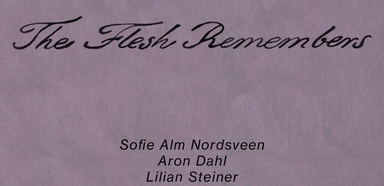
THE FLESH REMEMBERS is an intervention taking place in the staircase of Accelerator and stems from a collaboration between the International Master’s Programme and Accelerator. The intervention unites the artistic practices of Sofie Alm Nordsveen, Aron Dahl, and Lilian Steiner.
For four days, THE FLESH REMEMBERS will transform the staircase into a swampy, slimy, and fleshy site to explore the skin and its intricate connection to identity, memory, and time. The event creates a conceptual bridge to Sin Wai Kin’s ongoing exhibition The Time of Our Lives, where transforming identity and the shedding of skin are intimately bound, each caught in a process of change.
The skin is the largest organ of the human body. It encapsulates our inner selves: our guts, blood, flesh, and bones, as well as our identities. Skin is porous, soft and flexible. At the same time, it is armour, an enfleshed barrier between the inner and outer world. It ages with us, wrinkles up, and loosens around our bones. Through the skin, we can trace the trajectory of our lives, from birth to death. Each year is marked by a new bruise, scar, wrinkle, rash or memory of a lover’s touch; skin holds memories of pleasure and pain.
Our skin is in a continuous flux of shedding and renewing. It’s new and old, dead and alive, armour-like and soft. The skin is a liminal matter, filled with ambiguity. Our skin teaches us that the strongest border is permeable and soft; what moves in you also enters me.
30 January – 2 February
The opening takes place on Thursday, 30 January, and includes a one-time durational performance by Lilian Steiner. The performance will commence at 17:00 and end at 20:00. The artworks by Sofie Alm Nordsveen and Aron Dahl will be exhibited throughout the intervention period in the staircase of Accelerator. One of the curators will be present daily to engage in conversations and answer any questions the audience might have.
On this occasion, a publication has been created in collaboration with Elina Ulén, offering an archival and material interpretation of the curatorial concept of THE FLESH REMEMBERS. It serves as an extension for further exploration – an enduring body of work that lives on.
THE FLESH REMEMBERS is curated by Elvira K. Wikman, Isa Van den Wouwer, and Unn Faleide. We would like to extend our heartfelt gratitude to our mentor, Nina Øverli, and the team at Accelerator for their support and collaboration. Additionally, we are grateful to graphic designer Elina Ulén for her contributions.
Artworks
Durational performance (2024) by Lilian Steiner
Center of the flesh (2018) directed by Aron Dahl and Barbara Bohr, video and sound, 7 min 12 seconds
Music: Aron Dahl
Vocals, EWI, synths: Aron Dahl
Text: Allen Ginsberg
Mix and master: Andreas Pallisgaard
Music production by: Andreas Pallisgaard and Aron Dahl
Snail: Frances
Carpet: Freya Sif Hestnes
Kjøttet minnes alt jeg ikke vil huske (2022) by Sofie Alm Nordsveen
Silk, cotton, nylon, beads, meat hook, chain, various dimensions
Participants
Artists
Aron Dahl
Lilian Steiner
Sofie Alm Nordsveen
Curators
Elvira K. Wikman
Isa Van den Wouwer
Unn Faleide
2024
Nathalie Viruly: Lucky number 1 9 5 3 0 2 0 8 Jens Maismov
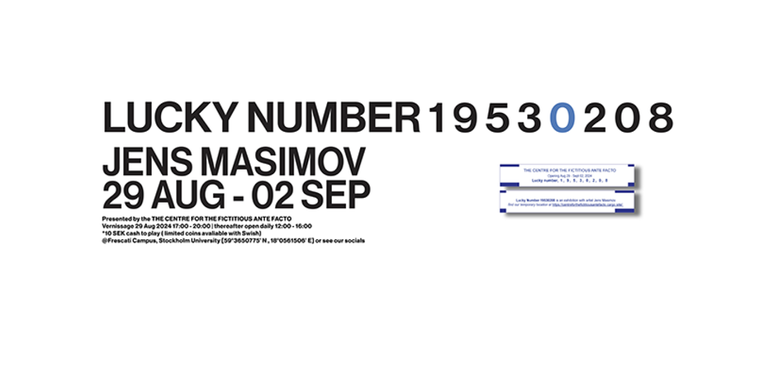
The Centre for the Fictitious Ante Facto proudly presents its first exhibition: Lucky Number 1 9 5 3 0 2 0 8, with artist Jens Masimov.
29 August – 2 September
Welcome to the Vernissage on 29 August, 17:00 – 20:00.
Free viewing, 10 SEK coins to play
(limited coins available for purchase through Swish)
Lucky Number 1 9 5 3 0 2 0 8 is a prompt. It's a question about how objects become lucky to us and whether this quality is transferable. Some will call luck skill, and others will favour determinism over randomness, certainty over probability, and anecdotes over causality. This choice unravels something about how we interact with the uncertainty of every day and perhaps what superstition means to the individual.
Numbers are a kind of language at this boundary – a compression toward order and control but also divinely coded as an expression of unchoked desire and value. There is Pythagoras, who found a sense of harmony in numbers and the fact that ten is arguably the most perfect of them all. There is also the devil’s triple and the lack of thirteens in stairwells. These numerical coincidences are folklore reinstated again and again with no fact but rather stories lost to memory. The Lotto. The Bingo. The Jackpot.
Jens Masimov presents eight numerical sculptures made in glass, carbon fibre, wood, and wax, to name but a few of the materials. The sequence is an heirloom from his father, who rearranged the numbers to wage bets on equine beasts with names like Capitalism At Risk, Don’task Don’ttell, Life in Shambles, Lion N Cheatin and Stealin’ Gasoline. Masimov is generous in his work with the Centre for the Fictitious Ante Facto, as sculptures can be won with a combination of luck + skill + a 10 SEK coin. So what guides your choices and strategy for winning here and beyond? Is it sentimentality, logic, material, value, or weight? Is playing enough? Red, black, and roulette. And if you win, will a number mean something more?
Pick a number
1 9 5 3 0 2 0 8
Jens Masimov (b. 1993 in Hedemora, Sweden) is a multidisciplinary artist based in Stockholm. Through immersive and entangled installations, he explores the core idea of ritualistic distortion, wherein sculptural renditions of visual and cultural anchor points act as frameworks for social gatherings. Masimov has previously exhibited works at Galleri Passagen, Årjäng (2023); Bonniers Konsthall, Stockholm (2023); Norberg Festival, Norberg (2023); Podium, Oslo (2022), as well as various independent exhibitions such as High Score Win Win (2024) and GROGGENHEIM (2023).
The Centre for the Fictitious Ante Facto is a fully functional para-institution and avant-garde white cube space based at Stockholm University. The Centre invites winner and loser situations. It celebrates public participation, hosts quarterly shows in experimental formats, and occasionally publishes. It is a part of Nathalie Viruly’s final degree project within Curating Art, International Master’s Programme at the Department of Culture and Aesthetics, Stockholm University. Viruly is a curator and writer from Cape Town, South Africa. Her practice centres on manifestations of the curatorial and editorial, the absurd, and situational.
(w) https://centreforthefictitiousantefacto.cargo.site
(ig) @fictitious_ante_facto
(fb) https://www.facebook.com/events/1185749022661129
(e) fictitiousantefacto@gmail.com
Credits
Artist: Jens Masimov
Curator: Nathalie Viruly
Supervision: Martí Manen
Ester Maria d’Avossa: Transitive Axiom – Sara Elggren and Muiredach O'Riain
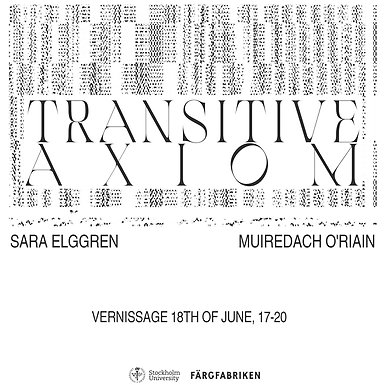
Welcome to the Opening 18 June, 17.00–20.00! Live performance 18.00.
Free admission.
Venue: Project room, Färgfabriken, Lövholmsbrinken 1 (Metro stop Liljeholmen).
Curator: Ester Maria d’Avossa.
In the exhibition titled Transitive Axiom themes of translation and passing down of information are explored through the mediums of weaving and sound art. The transitive axiom, a fundamental mathematical principle, signifies that if two quantities are each equal to a third, they are equal to one other. As a non-mathematical concept, this relation can be exemplified by the wording “is an ancestor of.” Thus, beyond mathematics, this idea resonates in human relationships, highlighting interconnectedness and continuity across time.
Within this context, tacit knowledge exchange, akin to ancestral wisdom transmission, relates and exemplifies this axiom, particularly in creative practices such as weaving and musical composition. However, transmission involves translation, risking loss and transformation of information over time.
This exhibition merges the works of Sara Elggren, Swedish weaving artist, and Muiredach O’Riain, Irish composer, prompting viewers to reconsider boundaries between virtual and tangible, visual and auditory, past and present. Elggren’s tapestries, alongside O’Riain’s sound composition based on her weaving notations, illustrate the artists’ dialogue, with digital elements juxtaposed with their analogue counterparts, echoing themes of translation, transition and transformation.
Participants
Sara Elggren (b. 1986), visual and textile artist based in Stockholm, specializes in woven objects and spatial installations. Her artistic work is distinguished by a penchant for repetition and extensive series that delve into themes of technology, code, and the interplay between fabric and interface, as well as mathematical thinking. The artist explores how these elements shape the fabric’s essence, whether as a fluid image or a meticulously structured system containing specific data, through her digital notations. Through meticulous craftsmanship, Elggren transforms this strict order into something altogether new and profound.
Muiredach O’Riain (b. 1996) is an Irish musician, composer, and programmer based in Stockholm. In 2023 he obtained a Master’s degree in electroacoustic composition at Kungliga Musikhögskolan in Stockholm. His work delves into the evolving dynamics between humanity and advancing technologies such as AI and quantum computing, viewing them as potential tools for creative expression. Through his compositions, O’Riain directly engages with these technologies, crafting complex computer-generated soundscapes that blur the lines between organic and artificial sounds aiming thereby to analyse and redefine the boundaries of posthuman musical expression.
Ester Maria d’Avossa (b. 1997) is an Italian-Danish curator and exhibition producer based in Stockholm, Sweden. She is currently enrolled in the International Master’s in Curating and Art Management. With a background in art history and cultural heritage studies, d’Avossa’s curatorial work explores the evolution of heritage and knowledge exchange within the context of contemporary art. Her current research revolves around the duality of craft and art, with a particular focus on textile art.
Jonas van Kappel: Echoes of Visions
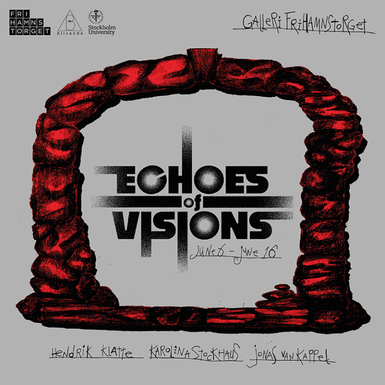
In times of ecological and geopolitical crises, the world seems to spin faster. If we close our eyes, can we escape? Can we experience time passing by so slowly that it fades away, stretched into an endless, echoing infinity until it stops ticking? Can we dissolve into the eternal, like an ocean of waiting along the riverbank?
Echoes of Visions is a site-specific art installation at the edge of the city, disconnected from the day-to-day, exploring multisensory perception, eternal aspects of the earth and universe, memory, waiting and the experience of time. A fusion between a smellscape and a soundscape in a former sea container, transformed into a darkened non-visual space, sharpens our senses. Visitors are invited to look inwards instead of outwards, to take off their shoes and enter a cavernous borderland where time is slowed down and the enduring present seems to triumph.
The sound work was created by Berlin-based researcher and artist Hendrik Klatte (b. 1988), who explores experimental soundscapes for natural processes, ideas and emotions. Since 2022, he has studied at the Institute for Music and Media (RSH Düsseldorf) in the Master’s program Klang & Realität [Sound & Reality]. In addition to his artistic endeavours, he publishes international sound artists in thematic compilations of scientific fields on his platform and music label re:natura.
The olfactory work was developed in a collaborative process with Karolina Stockhaus (b. 1981), an independent fragrance creator, consultant and educator. Working with scent as art, she was a finalist in the Art and Olfaction Awards 2023 in Los Angeles (USA), in the category for experimental work with scent. This commissioned scent is based on curatorial, poetic exercises in automatic writing and philosophical conversations about perception, slowing down time, and eternal elements of nature to cherish.
Location: Galleri Frihamnstorget, Frihamnen
Opening event: June 6, 17:00 – 20:00
Exhibition and programme: June 6 – June 16
See the website of Frihamnstorget for opening hours and more information about Echoes of Visions, including an artist talk [opening night], and a ‘sc(i)entific’ poetry workshop [June 15].
Please note that the rear area is completely darkened.
Take off your shoes in the space and hold the walls for extra support.
Credits
Sound artist: Hendrik Klatte
Fragrance creator: Karolina Stockhaus
Graphic design: Hannes Schievink
Curator and Educator: Jonas van Kappel
Mentor: Nina Øverli
Echoes of Visions is a degree project by Jonas van Kappel within Curating Art, International Master’s Programme at the Department of Culture and Aesthetics, Stockholm University. With a diverse background in art history, language studies and theatre, his interests and experiences lie in multi-sensory, queer and experiential approaches to contemporary art, collection research, and theatre education.
Thanks to Index Foundation and Moderna Museet for their generous contribution of materials.
Programming
Echoes of Visions presents an artist talk and a poetry workshop.
6 June
17:30 Artist Talk. Berlin-based sound artist Hendrik Klatte (b. 1988) talks about his music and re:natura: a label and platform for experimental music inspired by both nature and science.
14 June
19:00 – 20:30 Sc(i)entific Poetry Workshop. Olfactory perception is such an inscrutable, fluid experience that we, as human beings, often struggle to put it into words. How do scents and sounds affect our ability to associate, and evoke memories, thoughts and emotions? How can we write about scent and sound abstractly and poetically? In this workshop by curator Jonas van Kappel, we will write poetry in an automatic and associative way after a breathing exercise and a visit to Echoes of Visions, using our senses and art as sources of inspiration. What happens if we trust our intuition and if we are not allowed to judge the outcome?
Ester Maria d’Avossa: DIVE, hosted by Skin Mutts
DIVE is a two-part event consisting of a publication launch and a workshop, hosted by Skin Mutts. The event is curated by Ester Maria d’Avossa.
The publication titled DIVE is a project built to explore the Swedish artistic scene through the eyes of nine Stockholm-based artists and curators. Within each of their practices, the exploration of themes such as personal identity and belonging takes centre stage. DIVE is made in collaboration with Skin Mutts, a Brussels-based platform that focuses on redesigning the conversations on mixed cultural identities. Through firsthand accounts and narratives, Skin Mutts brings a comprehensive understanding of the Swedish art landscape from a variety of perspectives. By shedding light onto the diverse fabric composing this artistic community, we gain valuable insights into how it is shaped, perceived, and experienced by those involved in its evolution. Throughout the evening you will have the chance to deepen your understanding of the topic with the workshop Through Words. Through Words is a conversational workshop to break the ice. Think about a speed-date, but instead of yourself, the questions are focused on community, belonging and society’s perception of our identities. Join us on June 13 at Accelerator for the launch event of the publication, to dive into unique stories of belonging in between worlds.
The publication launch and workshop will be held in English.
Credits
Curator: Ester Maria d’Avossa
Skin Mutts Team: Olivia Lopez Calderon and Lisa Mei Eeraerts
Graphic Designer: Hanna Torseke
Project Supervisor: Nina Øverli
The Master’s Programme in Curating Art has a collaboration with the exhibition hall Accelerator. The students create events in connection to themes that Accelerator wishes to highlight in the exhibition programme.
Hannah Ingvoldstad: Waulking (Òrain Luaidh)
Presented in the library of Bonniers Konsthall, the exhibition Waulking muses on the Gaelic Scottish tradition by the same name – the final stage in the creation of tweed in which women would gather to soften the woolen fabric. The process was accompanied by song and rhythmically hitting the textile, washing it with stale urine and soap. The songs would ease the brutal labour, while also providing coordination for the team. Waulking became a forum for sharing stories of love and loss through song and community. A song-less web (cló bodaich) was considered unlucky – thereby, the process of waulking transforms the fabric into a holder of stories inaccessible.
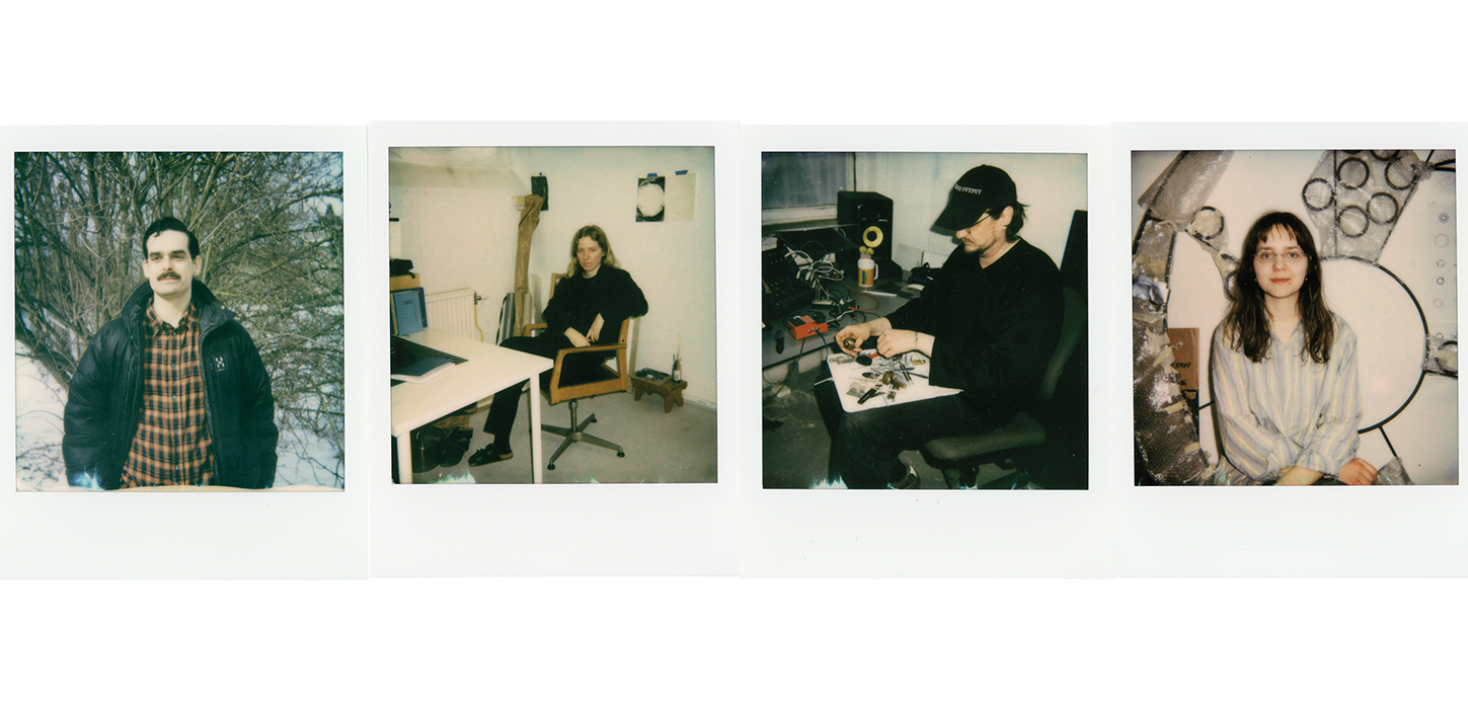
The exhibition presents the work and practice of Hedvig Bergman (b.1988) and Isabelle Sahba (b.1994). Bound together by an interest in the inherent potentiality of materiality and its ability to expand on narratives of belonging, tradition and creation. The exhibition arose through conversations between the curator and artists regarding subjects similar to those discussed in waulking song. The exhibition is presented therefore as a talisman of probings of artistic intention, the familial, love and loss.
Hedvig Bergman is an artist deeply reliant on her intuition and impulse as the driving force of her work. Each sculpture is simultaneously independent and deeply connected to the previous. One of the sculptures exhibited Tick Tock, Tick Tock (2024) is inspired by the tactility of the brush and brush binding. In the creation of brushes, the eye becomes redundant as the rhythm dictates the movement – similar to waulking. As part of her research into brush binding techniques, Bergman visited the brush bindery Iris Handtverk in Enskede, Stockholm. All of the craftsmen are visually impaired – the binding driven by tactile knowledge. The brush-like sculpture exhibited is made of black oak that has been underwater for over 3400 years and horsehair bought from the last remaining horsehair wholesaler in Europe. The artist has also tied 600 strands of her own hair into the sculpture, working while cradling her newborn.
The work and process of Isabelle Sahba is less impulsive – driven by meticulous research and a considerate exploration of the depths of the material. The work Bildstorm (2022) is an intertwined probing of Sahba’s familial history and materiality. Inspired by a stamp found on an old letter addressed to her father in Sweden from a relative overseas. The artist reckons with the power of symbolism by creating a new stamp with remnants of the old. The artist chews the stamp, breaking down the fibers of the paper, spitting it out, pressing and drying the paper to create a new stamp. The image of the found stamp is no longer accessible – but exists as a phantom in the material along with the artist’s own genetic constitution.
Waulking is an exhibition that takes the audience on a journey through materiality and facilitates an investigation of the stories that lie within, as well as the ghosts of its creation. Through the narrative of waulking, the exhibition explores presence – just as much as absence by highlighting the process and labour as just as crucial as the final work exhibited.
Hedvig Bergman (b. 1988, Stockholm) is an artist working with sculpture and installation. Her work is characterized by an enchantment for traditions and the bodily, the volatile, and the eternal. Bergman earned her MFA at Konstfack in 2023, and a BFA from the Academy of Fine Arts in Trondheim, Norway. She has exhibited her work in Sweden and internationally including in Norway, France and Japan and has received both public and private awards and grants for her work. Recent exhibitions include Intuition at Hand, Silvermuseet Arjeplog, Within & Against, Nobel Week Lights, Kungsbro Strand and Slow Stretch, Occasional Gallery.
Isabelle Sahba (b. 1994) is an artist and architect from Stockholm. She holds a BSc in Architecture from the Royal Institute of Technology (2018) and currently studying a BFA in Fine Art at Konstfack. Her practice is characterized by a research-oriented and material-based approach, incorporating element such as text, sculpture, and spatial compositions. Central to her work is the concept of belonging, as she delves into questions surrounding identity, heritage, and connection to place. Recent exhibitions include Afterlife, Hägerstensåsens Medborgarhus and Within & Against, Nobel Week Lights, Kungsbro Strand.
Exhibition dates
Opening: Wednesday 5 June, 17:00 – 20:00
Thursday 6 June
Friday 7 June
Artist talk: 8 June, 14:00 – 15:00
Sunday 9 June
Artists: Hedvig Bergman and Isabelle Sahba
Curator: Hannah Ingvoldstad
Supervisor: Yuvinka Medina
Linnea Wästfelt: Våg Brus: A series of radio exhibitions broadcast on 88.9 FM
25 April – 5 May
The radio wave moves through time and space without human recognition. The invisible waves exist everywhere, and we move through and with them all the time. Some suggest that soundwaves are constant and never stop existing once created. The radio wave is able to carry soundwaves from transmitter to receiver. In these exhibitions on frequency 88.9 FM, the radio wave creates our exhibition space.
Våg Brus presents an exhibition series broadcast from the local radio station transmitting from Hägerstensåsens medborgarhus. The broadcast houses the artworks, allowing the audience to explore them throughout the duration, when the transmission stops the exhibition closes. Thereafter, the artworks become a memory – never to be revisited in full again.
Våg Brus welcomes everyone, and the exhibition stretches all over Stockholm. Tune in from home, your car, the office, the kiosk, or join us for collective listening sessions at Hägerstensåsens medborgarhus this spring.
25 April 17.30-18 Jesper Vesterlund presents the work Of ghosts and memories
28 April 15-15.30 Rebecca Larsson presents the work SYRINX
3 May 17.30-18 Theodore Trottner presents the work Våta Slingor
5 May 15.00-15.30 Mari Mattsson presents the work Tre hörn av minnet
We welcome you to listen, reflect, and enjoy the exhibitions on 88.9 FM, or through the webradio:
https://www.radiosydvast.se/lyssna-pa-webbradio/
About the artists
Mari Mattsson holds an MA in fine arts from the Royal Institute of Art in Stockholm, Sweden. She often creates site-specific installations that emphasize the visitors movement. Recurring themes explored in her practice are perception, imagination and the concept of time through sound, text and scores.
Rebecca Larsson holds an MA in fine arts from Malmö Art Academy and explores in her practice different techniques and materials, often with language as a starting point. Finding subject matters in literature and often inspired by myths and metaphysics she brings these stories to life.
Jesper Vesterlund holds an MA in fine art from the Royal Institute of Art in Stockholm and works mainly with unheard sounds. Exploring tales and myths of modern times through sounds, he presents histories of the unknown.
Theodore Trottner holds an MA in fine arts from the Royal Institute of Art and an MA in sound art from Stockholm Academy of Dramatic Arts. His practice evolves around exploring sounds as ephemeral works of art. Working with site-specific installations and new methods of presentation he provides the visitor an immersive experience, exploring sound as a unique practice of attentive listening.
About the project
Hägerstensåsens Medborgarhus is a people’s house located in the south of Stockholm. The house hosts a local radio station, a cinema, exhibition spaces and a library. Medborgarhuset is daily used by hundreds of people from different communities. Their ambition is to create an ecosystem of social, artistic and pedagogical practice that enable conversations, reflection and a democratization of the local area and the city at large. The radio operated within the house usually broadcast local radio focusing on communities active in the nearby area. More information about the house can be found on their website:
Wave Noise is a degree project for the MA in Curating Art at Stockholm University. It is curated by Linnea Wästfelt who, in her curatorial practice, works research-based, often with interventions in the public space and alternative methods of presentation. She holds a BA in fine art photography from Glasgow School of Art and is co-founder of Vava Art Collective. She is currently based in Stockholm
After Life: Mapping The Unknown
This exhibition is a collaboration between Fine Art students at Konstfack and MA Curating Art students, year one.
The old world is dying, and the new world struggles to be born.Antonio Gramsci
The exhibition is developed in the context of a course initiated by Lina Selander for students at Konstfack. The research and work leading up to the exhibition has been generously supported by the Swedish Museum of Natural History and Hägerstensåsens Medborgarhus.
You are invited to embark on a journey exploring the fluid intersections between the spiritual realm, reality, and existence. Throughout the various spaces of Medborgarhuset, the artists invite us to reevaluate our relationship with the unknown. Spirituality, dreaming, and contemplation intertwine, challenging the understanding of our wavering consciousness.
Free entry, no pre-registration required.
Thursday 11 April 18:00 – 22:00 – Vernissage “The Funeral” an evening where we look at the very beginning stages of grief and symbolically say farewell to the world as we know it.
Welcome speech at 18:30
Ritual and speech by Dan Siedell at 18:40
Performance by Cariz Nordlöf at 19:00
Performance by Ib Zakarias at 20:00
Friday 12 April – Movement class by Veronica Bergan “Åsen Skakar” at 15:00 (150/100kr).
Take part in this class at Medborgarhuset which is focused on finding presence and pleasure through movement and begin moving through a sense of absence towards realms of possibility. The class is for everyone regardless of condition or previous experience.
Saturday 13 April – Join us on a somatic walk
A meditative gathering is held by Unn Faleide at 14.00 in the foyer at Medborgarhuset. How can we collectively experience the After Life exhibition in a meditative state?
Sunday 14 April – An artist talk between the artists Cariz Nordlöf, Inês Varandas, Isabelle Sahba and curators Elvira and Carina on the nature of After Life and how it ties into their different artistic practices.
Wednesday 17 April – Finissage “Renewal” at 18.00. In order to close off After Life we gather around water and new life.
The participating artists are Alva Cederholm, Ib Zakarias Knigge, Agnes Magnusson, Cariz Nordlöf, Lovie Peoples, Inês Varandas Pereira, Ljubomir Popovic, Isabella Sahba and Sanna Svensson. The exhibition is co-curated by Unn Faleide, Ruoxi Gao, Carina Hundsdahl, Noel Platts, Elvira K. Wikman and Isa Van den Wouwer.
Charlotte Keegan and Nathalie Viruly: Admits One
'Admits One' is a circus. It has three acts – the launch of a limited edition artist booklet, a reading by pierrette Charlotte Keegan, and a film screening of 'Heterotopias' (2022) by artists Anna Heisterkamp and Isaac Tomkin Clarke. Conceptually, it offers a multiplicity of readings into othered spaces – things that exist where they “shouldn’t”; without regard and often as sites of pain. Here is a point of connection with Accelerator’s current exhibition 'Dodge and/or Burn' by Lisa Tan. For Keegan, this is an exploration of a chronic pain condition called endometriosis, while Heisterkamp and Tomkin Clarke explore veins of Foucault’s concept of the same name. Thus 'Admits One' connects these secrets, sanitoriums and the spectacle; for their admittance and in turn concealment.
The event is part of the ongoing collaboration between the International Master’s Programme in Curating Art and the exhibition hall Accelerator. The students create events in connection to themes that Accelerator wishes to highlight in the exhibition programme.
Please join this event on 30 Jan 2024, from 17:00, in the amphitheater of Accelerator Café. The performance by Keegan begins at 17:30 followed by the screening of Heterotopias (2022). 'Admits One' invites viewers to contemplate the intricate interplay between interior and exterior worlds, mirroring the unruly cells of endometriosis and diverse spaces of inhabitance. The booklets are free and wine is for sale at the Cafe.
Credits
Curators: Charlotte Keegan and Nathalie Viruly
Artists: Anna Heisterkamp and Charlotte Keegan
Sound design: Isaac Tomkin Clarke
Mentor: Nina Øverli
2023
Ninhursag Tadaros: BeLonging: Michael Rakowitz and the Mesopotamian Collection

Exhibition: 30 September 2023 – 14 January 2024
Location: Bagdad Café, Museum of Mediterranean and Near Eastern Antiquities, Fredsgatan 2, Stockholm
The invisible enemy should not exist (2007–ongoing) by artist Michael Rakowitz is an ongoing commitment to recuperate objects looted from the National Museum of Iraq after the US-led invasion in 2003. The material he uses – contemporary Middle Eastern food packaging – references cooking as a symbol of survival, resistance and joy. Through the material the ‘reappeared’ sculptures also become placeholders for Iraqi lives lost during the war.
In the video work The Ballad of Special Ops Cody (2017), the artist reflects on the human and cultural costs of war during the U.S. invasion of Iraq.
For the first time in Sweden, Michael Rakowitz’s works are shown together with other displaced Mesopotamian artifacts in the collection of the Museum of Mediterranean and Near Eastern Antiquities. Together they reflect shared experiences of place, longing, and belonging from antiquity until today.
Mesopotamia was among the first places where people began to settle, around 12 000 BCE. The people living in the area spoke Sumerian and Akkadian and one of the earliest writing systems – cuneiform writing – was developed in the region (ca. 3500 BCE).
The Museum of Mediterranean and Near Eastern Antiquities is the only museum in Sweden with a significant collection of objects from Mesopotamia. Even so, these have not been contextualized in exhibitions in many years. Neither ancient nor modern Iraq, Syria, Turkey, Lebanon, or Iran is represented in their main exhibitions.
This exhibition is therefore an opportunity to widen the representational scope of the museum and the narratives mediated about the historical and contemporary Middle East in Swedish museums.
Michael Rakowitz (b. 1973) is a Chicago-based Iraqi-American artist. He describes his work as an intersection between problem-solving and troublemaking. Known for his installations, sculptures and multimedia projects where he weaves together complex histories, he shines light on the tense relation between the Global West and the Middle East. Rakowitz highlights both the loss of Middle Eastern cultural heritage and the human suffering imposed by war, political upheaval, and foreign occupation. He strives to complicate the current narrative around cultural heritage, ongoing forces of colonization, as well as colonial- and postcolonial discourses. He touches upon the fraught relationship between preservation and destruction in modern archaeology and cultural heritage work.
Ninhursag Tadaros (b. 1989) is a curator and museum educator based in Sweden. Her academic background is in ancient Near Eastern- and cuneiform studies and heritage management. In her master’s thesis she investigated the possibilities, challenges, and implications of exhibiting ancient artifacts together with contemporary art in museum displays. The exhibition degree project within Curating Art, International Master’s Programme, Stockholm University and made possible with the support of the National Museums of World Culture and Stockholm University.
Maria Dahlström (b. 1975) is a curator at the National Museums of World Culture (NMWC) in Sweden. Since 2008 she has worked with the collections of the four museums that is the NMWC. Now, she is focusing on questions relating to the illicit trafficking of cultural property as well as provenance research and repatriation. Maria Dahlström has an MA in archaeology with focus on classical and East African archaeology.
Nathalie Besèr (b. 1972) is a Swedish journalist and Middle East expert. She has worked as a reporter and Middle East correspondent and is former senior advisor at the Swedish Institute of International Affairs and foreign correspondent at TT News Agency.
Ester d'Avossa, Jeanette Gunnarsson and Nathalie Viruly: Intuition at Hand
The exhibition presents work by artists Jordana Loeb, Hedvig Bergman and Tomas Sjögren, together with objects from the Silver Museum’s collection.
It opens this Saturday (September 23), at the Silver Museum in Arjeplog.
Programme:
10:00–14:00 → Opening
12:00 → Performance by Jordana Loeb
Accessibility: The main entrance of the Silver Museum is accessible via a ramp. Elevators provide access to all floors, and there are adapted restrooms on the entrance and basement levels.
The exhibition runs 23 September – 2 December.
With support from: Kulturrådet, Resurscentrum Konst Norrbotten, Folkrörelsernas Konstfrämjande och Region Norrbotten.

Hannah Ingvoldstad: Occupied

Occupied is a curatorial project and event curated by Hannah Ingvoldstad and developed in connection to Lisa Tan’s exhibition Dodge and/or Burn. The project presented the commissioned work flisbelagt tilfluktsrom (tiled harbour) by LNUA on 25 October. The work will be on view until 15 November as a part of Accelerator’s public programme.
Occupied came to fruition through a series of conversations between the curator and artist about the isolating experience of burnout and overworking. In response to these conversations, the artist created the immersive soundscape flisbelagt tilfluktsrom. The series of atmospheric shifts in the soundscape explores the multifaceted relationship to work and bathroom as site.
The bathroom is one of the most intimate spaces of daily life. At the same time, it is often a shared one. The intertwining of the public and private resonates with subjective and societal experience of burnout. In moments of stress, the bathroom often becomes a refuge – a place of rest. The site transforms to a place to cry – to text – to sit. Through the individual exploration of the sound installation, Occupied wants to open the conversation of overwork and rest.
The opening on the 25th invites visitors to explore the soundscape. The site of rest expands to the Accelerator Café – allowing visitors to rest in unity. At 18:30 there will be an introduction by the curator Hannah Ingvoldstad. The café will be open to purchase something to eat or drink.
LNUA (NO) is the moniker of Oslo-based experimental musician and sound artist Luna Storeide. Through her music, LNUA explores the ever-changing nature of life, using sample manipulation and sound synthesis to create sonic landscapes that reflect the fluidity and chaos of our experiences. Drawing inspiration from a diverse range of genres including ambient, noise, and club music, LNUA’s compositions are immersive and engaging, seamlessly blending atmospheric textures with abrasive, high-energy passages.
Free entry, no registration required.
Credits
Artist: LNUA (NO)
Curator: Hannah Ingvoldstad
Mentor: Nina Øverli
Graphic Design: Sebastian Pandonis
Linnea Wästfelt and Jonas van Kappel: Fragments of Forests

This is a Fragments of Forests is a site-specific exhibition with artists Linnea Lindberg and Mari Mattsson focusing on notions of subjective memory, time and fortune-telling, perception and traces of human presence through acts of breathing and lyric poetry.
The International Master’s Programme in Curating Art has a collaboration with Accelerator. The students create events in connection to themes that Accelerator wishes to highlight in the exhibition programme. This event is curated by Linnea Wästfelt and Jonas van Kappel and developed in connection to Lisa Tan’s exhibition Dodge and/or Burn. Fragments of Forests is a site-specific exhibition focused on notions of subjective memory, time and fortune-telling, perception and traces of human presence through acts of breathing and lyric poetry. After the event on 4 October, traces of both works will be on view until mid-December as part of Accelerator’s public programme.
Intrigued by solitary remains of forests as well as iconic ancestors of lyricism such as Sappho, whose work has stood the test of time only in fragmentary form, Fragments of Forests approaches the forest as a non-linear labyrinth to both get lost and find solace within; as a physical manifestation of an inner world. For this evening, the artists Linnea Lindberg and Mari Mattsson have created sound-based and textual works that in different ways convey strategies to deal with the past, present and future, with uncertainty, forgetfulness, fragility, memories and hopeful wishes.
Linnea Lindberg is an artist working with fragmented poetry, clay, images and drawings with charcoal. For this event, she will present the new work IN LOVING MEMORY: a text-based installation on amnesia and longing, exploring the mind as a haunted house. She holds an MFA from the Royal Institute of Arts, Stockholm.
Mari Mattsson explores concepts such as time, technology and nature through installation, sound and scores. During this event, she will present a new sound piece based on breathing exercises and the folkloric history of the cuckoo bird as a fortune-teller. She graduated in 2023 with an MFA at the Royal Institute of Arts, Stockholm.
The event starts at 18:00 by the entrance of Accelerator with a duration of approximately 30 minutes. After a short introduction, we will move towards the site in a 5-minute joint procession.
Free, no registration required.
Credits
Curators: Linnea Wästfelt and Jonas van Kappel
Artists: Linnea Lindberg and Mari Mattsson
Mentor: Nina Øverli
Joel Albinsson, Hanna Mara Noor Bargheer, Jonas van Kappel, Victoria McCarthy,: Reshaping Boundaries

Artist: Anna Zingmark
2 September five Curating art students from Stockholm University curate the making of a collaborative art installation in soapstone, together with artist Anna Zingmark in Kiruna.
This art installation is a part of the Curera project's collaboration programe Learnings. The students recently developed a proposal for the relocation of Kiruna’s public art to the new city park.
Together with the artist Anna Zingmark (b.1990, Gällivare) the area where the future park is being built will be explored, tracing its contours, marking its boundaries and imagining its future possibilities. The manifestation aims to create a sense of collective ownership of Kiruna’s new city park as a space for art, and thus the public is invited to actively participate in this ceremonial inauguration.
Arranged by Konstfrämjandet Norrbotten and Curating Art at the Department of Culture and Aesthetics together with Kiruna Municipality.
Participating artist
Anna Zingmark
Participating curators
Joel Albinsson is a Stockholm based curator whose work engages with the temporal and spatial qualities of sounding art, as well as with questions regarding democracy, urbanities, and the power over the city.
Hanna Mara Noor Bargheer is a curator working between Sweden and Germany. She aims to combine art and politics in her work, thinking about the ways in which we have meaningful and democratic access to culture and our cities.
Jonas van Kappel is a curator and art historian from the Netherlands, Amsterdam. His work centers around multisensory and associative art experiences, site specificity and audience perspectives by combining social issues with philosophical questions.
Victoria McCarthy is an Argentinian visual arts curator and producer specialised in contemporary art. She is currently looking into the intersection of art and lithium extraction, focusing on neoextractivism and the ‘green’ transition.
Linnea Wästfelt is a curator and artist based in Stockholm. She holds a degree in fine art photography from Glasgow school of art and is mainly focusing on audience participation and involving the local community in projects.
Victoria McCarthy Seeing Lithium. Countering the Myth of ‘Green’ Transition through Contemporary Art

A film programme and seminar at Färgfabriken.
Film programme: 4 – 7 May 2023, 11:00 – 16:00
Seminar: 6 May 2023, 14:00 – 16:00
This programme is free and does not require RSVP. Both the film screening and the seminar will be held in English.
Lithium, ‘white gold’, ‘oil of the 21st century’ are some of the names used to designate the soft, silvery-white metal at the heart of the future ‘green’ energetic transition. In a time where countries in the Global North make deals and agreements to transition away from fossil fuels towards renewable energies, lithium’s relevance is increasing.
The artworld’s interest in lithium has grown in the last years, with cultural projects and exhibitions on lithium taking place in different parts of the world. Artists are starting to show a profound interest in the intersection between lithium and contemporary art, researching its origin in the Big Bang, the consequences of lithium mining activities in extractive zones, supply chains, Indigenous creation stories, the effects of lithium in human and non-human bodies, or the supposed intangibility of our virtual world. Many of the artworks produced in this context facilitate insights and, in some cases, provide resistance into the geopolitics of ecology, by countering the dominant narrative of the ‘green’ transition.
Seeing Lithium is divided in two parts. Firstly, a film programme that brings together five short video works created by Unknown Fields, Juan Arturo García, Alejandra Prieto, LiCo (David Habets, Cameron Hu, and Stefan Schäfer), and Grupo de Investigação Territorial. The selected videos explore lithium’s current and future extraction sites in the Global North and the Global South, its impact on our states of mind, its origin in the beginning of everything, and the socio-political conflicts it brings forward.
The second part of this programme consists of a seminar, where contemporary artist David Larsson, sustainability researcher and professor Henrik Ernstson, and visual arts curator Victoria McCarthy present different approaches and considerations about the current state of affairs of lithium, its extraction, and its intersection with contemporary art.
Film programme participants:
Unknown Fields is a nomadic art- and design research studio founded in 2009 by Australian in-dependent designer, architect and curator Liam Young, and British artist, architect and writer Katie Davies. Their practice seeks to show the shadows cast by contemporary cities, venturing into expeditions in remote sites of the world. They use primarily film and animation to create chronicles of narratives embedded in global systems and supply chains, shedding light on the consequences of emerging environmental and technological scenarios.
Juan Arturo García is a Mexican contemporary artist, currently a resident at the Rijksakademie van Beeldende Kunsten in Amsterdam. His practice explores accented ways of living, their biopolitical affordances, and tactics for their representation. His latest research studies the production of scientific knowledge in Latin America throughout history, with a particular focus on how complex intertwinings of technical, cultural, mystical, and political desires have been deployed – and how to understand their consequences.
Alejandra Prieto is a Chilean contemporary artist who uses paintings, videos, sculptures, and installations as her media. She studied a BA in Arts in the Catholic University of Chile, and an MA in Visual Arts at Chile University. She has exhibited her works in many art spaces in Chile, and in several international venues and events, such as the La Habana Biennial, Saatchi Gallery (London), SIART Biennial (La Paz), Palais de Tokyo (Paris), and Sala de Arte Público Siqueiros (Mexico City).
LiCo is a research-based art collective which produces fictions, films, and installations on the choreography of mental and environmental life. The collective is composed of physicist, landscape architect and artist David Habets, anthropologist of technoscience Cameron Hu, and political theorist and researcher Stefan Schäfer.
Grupo de Investigação Territorial (Territorial Research Group) is an action-research collective focused on ecological and socio-environmental struggles, composed of researchers and architects Antonio del Giudice, Godofredo Enes Pereira, Jacob Bolton, Mingxin Li, and Tiago Patatas. The group first came together to shed light on the implications of the planned mining projects in the Barroso region, in the North of Portugal.
Seminar participants:
David Larsson is a Swedish contemporary artist based in Jordbro and Stockholm. He works with long-term artistic investigations, focusing on issues of social development and modernity, political events, natural resources, and collecting/archives. These results of these investigations are continuously presented through installations and exhibitions. Alongside artists Hanna Ljungh and Gideonsson/Londré, he initiated the exhibition Litiumtiden at Haninge Konsthall (2022) and the Litiumfestivalen on the island of Utö (2022), where they explored a multitude of perspectives on lithium.
Henrik Ernstson is a Strategic Sustainability researcher and professor, currently working at KTH. He is developing a situated approach to urban political ecology with a special focus on southern and postcolonial urbanism, and, at the same time, a film-based research practice, that uses cinematic ethnography, montage and essay film to engage in the texture, embodiment, and situatedness of political and environmental practices, knowledges and politics. He has published the books Grounding Urban Natures: Histories and Futures of Urban Ecologies (MIT Press, 2019), and Urban Political Ecology in the Anthropo-Obscene: Interruptions and Possibilities (Routledge, 2019).
Victoria McCarthy is an Argentinian visual arts curator and producer. She worked as an exhibition producer and education coordinator at the Centro Cultural Kirchner in Buenos Aires, the largest cultural centre in Latin America. In 2021, she relocated to Sweden in pursuit of an International Masters in Curating Art at Stockholm University. She co-curated with Yul Cho the performance piece How to Draw a Voice, by artists Heidi Edström and Feronia Wennborg for Accelerator; and coordinated the IASPIS Open Studios Autumn 2022. Her current curatorial research explores the intersection between lithium extraction and contemporary art.
This project was made possible thanks to the support of the Department of Culture and Aesthetics, Stockholm University, and Färgfabriken.
Joel Albinsson: empty space / enclosed dissolved

A site-specific public sound installation in the covered terrace by Malmskillnadsgatan 47 / Tunnelgatan 2.
18 May – 1 June
Audible between 07:00 – 22:00
Opening May 18, 18:00
The installation is inaugurated with an introduction by Ellen Arkbro and Joel Albinsson, followed by a communal listening to the sound work.
In the middle of the city, at the point where Tunnelgatan and Malmskillnadsgatan meet, a brick building gives way to an occluded passage, a covered terrace. This place is a stone’s throw away from the district’s main street, immediately adjacent to the infamous stairs that Olof Palme’s killer used to make their escape, and above popular Brunkebergstunneln. These sites, though their significance vary greatly in character, all hold a strong place in the public consciousness of the city as sites of transit and commerce, of memory, and the melding of striking architecture and historic feats of engineering.
In contrast, the terrace itself is insignificant to most. Designed to fit a one-way escalator and a lift, it is a space of pure function which provides the city with much needed accessibility. It serves this purpose but does little else. There is no monumentality, no grandeur, no weight of history. It is next to, near, but ultimately a passive bystander to things bigger than itself. Still, it operates as a part in a vital system designed to ferry people up and down Brunkebergsåsen, the steep ridge that cuts across northern Stockholm.
Here the terrace lies, tucked away. Appearing as a hole in the cityscape, not immediately visible unless you know where to look or if you approach it with purpose. The enclosed emptiness calls out for something to fill it and give it shape: to mark it, amending function with form. To prompt the city’s inhabitants to stop and consider what the city is made up of. The holes and pockets, the places that exist next to or in-between, the spaces that still serve a purpose and those that have been made into appendixes, traces of past functions.
Ellen Arkbro responds to the call with a sonic intervention which alters our perception of this otherwise unremarkable space. As the work fills the passage, the space is at once condensed and expanded. The sound melds with the mechanical rhythmic beating of the escalator and the constant thrum of traffic from outside while providing an alternative, embodied mode of listening. The terrace is thus remade into sculptural form which unfolds and changes as one moves through it. The sound seeps through the cracks, flowing out in a suggestive invitation to come and discover, and to exist in this place for a while.
Ellen Arkbro (b.1990, Stockholm) is a Berlin-based composer, musician and sound artist working with harmony and intonation. Her work includes compositions for ensembles and orchestras as well as sustained chordal sculptures presented in installation form.
She has presented her work at Barbican in London, Munch museum in Oslo, Blank Forms in New York, GRM in Paris and the Kölner Philharmonie in Cologne among other places. She is currently an artist in residence at La Becque in Switzerland.
Joel Albinsson (b.1997, Örebro) is a Stockholm-based curator whose work engages with the temporal and spatial qualities of sounding art, as well as with questions regarding urbanities and the power over the city.
Albinsson is currently finishing his master’s degree in curating art at Stockholm University. Recent curatorial work includes the performance piece En Kör Möter at Accelerator in Stockholm with co-curator Hanna Bargheer, and the publication Humanitet for Folkrörelsernas konstfrämjande.
Sarah Rodrigues: Art Curators Day

Graphic Design: Thomas Bush
Join us for a day of celebrating and supporting art curators! Whether you work at an institution or independently, you know how challenging and rewarding curating can be. You also know how important it is to connect with your peers and share your experiences. Curated by Sarah Rodrigues.
On Saturday 27 May, at Slipvillan, you are invited to a full-day programme with discussions on the working realities of curators, workshops for knowledge exchange, and space for care and support. Don’t miss “LULL”, a massage and live piano experience, nor the Speed-dating for Curators & Collaborators, where you can meet potential partners for your future projects (open to all art professionals).
Space is limited, so book your tickets now for each of the activities you want to take part in. We look forward to seeing you!
Yul Cho and Ifra Shariq: How to Navigate Art Institutions

Ifra Shariq and Yul Cho collaborated to curate a series of workshops for their curatorial degree project. This collaboration birthed ‘close-enough,’ a curatorial initiative driven by their shared experiences, concerns, and reflections on the Swedish art world. Through candid conversations, they recognized the need to bridge the gap between art institutions and underrepresented communities, fostering engagement and inclusivity for all. The name ‘close-enough’ playfully alludes to the distance art institutions sometimes maintain from their audiences, hinting at an invisible line that people are afraid to cross for fear of getting too close to or touching the art.
Their collective experiences under this initiative culminated in the publication titled “How to Navigate Art Institutions,” which is the outcome of a highly process-based exploration grounded in Shariq and Cho’s interactions with diverse individuals and groups. Through “How to Navigate Art Institutions,” Shariq and Cho delve into the dynamics of exclusion present in Swedish art institutions and strive to identify barriers both within and around them. Each chapter contributes to a cumulative summary of the insights and discoveries as they conducted research, held discussions, and experimented with different methods to overcome these challenges.
The launch will include a presentation by the curators and space for book discussions.
2022
Ingrid Svahn: Movement Patterns

Picture of Study for a Monument I, Jellified Carrara Marble, 2021. Photo: Chiara Bugatti.
Opening 9 June, 17:00-19:00 (open to all)
Opening hours:
Wednesday-Friday 13:00–18:00
Saturday 12:00–16:00
Movement Patterns explores the meeting between the body and the monument, the fragile and the eternal, movement and stillness, history and memory. In her artistic practice, Chiara Bugatti examines materials that seems to have lost their main function. Through three works of sculpture, installation and video, she explores the memory of materials, their historical associations and narrative possibilities, such as allowing marble to break down to then re-emerge in perishable room installations, or possibly eternal forms. The works goes into dialogue with the premises of Mint they now engage in, in the house of ABF (Workers' Educational Association), located in neighborhoods colored by Swedish political and cultural history.
About the artist
Chiara Bugatti (b.1991, IT) is a visual artist based in Stockholm. Bugatti holds a BFA from the Accademia di Belle Arti di Venezia (IT, 2014), an MFA from Umeå Academy of Fine Arts (SE, 2016) and a Postmaster from the Royal Institute of Art in Stockholm (SE, 2021). She was recently a grant holder at IASPIS and fellow at Akademie Schloss Solitude in Stuttgart. She is part of the current exhibition Släpljus at the Carl Eldh studio museum, as well as the 15th Trienniale Kleinplastik Fellbach in Germany and her work has been exhibited in institutions across Europe. In one of the works in the exhibition, Bugatti collaborates with German artist Sebastian Moske, choreographer Alessandro Giaquinto and a group of dancers from the Stuttgart Ballet (DE).
About the curator
Ingrid Svahn is a freelance curator and student in the international master’s programme in Curating Art at Stockholm University. The exhibition is made as part of her graduation project and made possible with the support of Mint and Stockholm University.
Project supervision
Emily Fahlén
Sona Stepanyan: Flowing grounds Stockholm. Tracing a sensory map

Opening 15 June, 18:00–21:00, open to all
Exhibition period: 16–29 June
Opening Hours: 12:00–16:00
Gabey Tjon a Tham (1988) is a multidisciplinary artist working and living in the Hague, The Netherlands. For her first solo exhibition in Stockholm, the artist transforms a yellow sea container into a site-specific sensory experience reflecting on ever-changing urban landscapes and complex properties between man-made, technology, and nature. The immersive installation consisting of kinetic light sculptures, a two-channel video, and a sound composition focuses on the harbor area and the water as a vibrant system with its own temporality where all agents have to adapt to different laws of nowadays unsteadiness.
About the curator
Sona Stepanyan (1987, Armenia) is a freelance curator based in Stockholm and a student of the International Master’s Programme in Curating Art at Stockholm University. The exhibition is made as part of her degree project.
2020
Agnès Biro, Sarah Rodrigues: Overflow - Art Exhibiton

A four-day art exhibition showcasing the works of artists Jo Andersson, Sissela Jensen and Alexey Layfurov. Curated by Agnès Biro and Sarah Rodrigues, students at the International Master’s Programme in Curating at the Department of Culture and Aesthetics at Stockholm University. 24-27 September.
In this year 2020, we have been a part of a worldwide pandemic which has brought most of us under forced isolation.
We are still experiencing the effects of this unprecedented global phenomenon and the resulting destabilization.
In this exhibition, we invite you to explore this state of imposed introspection and to look within (some)one’s intimate spaces.
Due to Covid-19 and for curatorial choices, only groups of 4 people will be allowed per 20 min slot.
Artists
Sissela Jensen
I aim to make striking images that balance the very familiar with the alien and the mundane with the extraordinary. With a strong interest for human perception I explore the limit for visual information and want to recreate my own fascination for the world.
Sissela Jensen born 1988, recently graduated from Master programme in Visual Communication at Konstfack.
@sisselajensen
Jo Andersson
I am interested in energy and its various forms, particularly light. Using glass as my main material of exploration I experiment with creating environments which help to bring the viewer to the present moment.
I received my Masters in Ceramics and Glass from Konstfack in Stockholm, Sweden in June of 2020. I am currently located in Stockholm.
@jojosunbear
Alexey Layfurov
I am working on the intersection between film and graphic design. By balancing between these two disciplines I am trying to address such gigantic concepts as globalisation and make an attempt to visualise them. I am mainly focused on the visual dramaturgy of an image.
I recently graduated from the MFA program in visual communication at Konstfack and I am currently based in Stockholm.
@Layfurov
Curators
Agnès Biro
Agnès Biro is a freelance curator and a Master student in Curating Arts at Stockholm University. While following a Bachelor's degree in Fine Art, she gained interest in challenging the relation between audiences and time. Her curatorial practice explores interruption as a way to influence the visitor’s experience.
Sarah Rodrigues
Sarah Rodrigues is a freelance curator and is currently pursuing the Curating Arts Master’s program at Stockholm University. With a background in Environmental Studies, Anthropology, and Philosophy, she is interested in the intersection of arts, sciences and research with regards to understanding the Self and the Environment.
Elias Kautsky: tide pool

A VR exhibition released online 11 June. Curated by Elias Kautsky as part of a degree project within Curating Art, International Master’s Programme at Stockholm University.
Tide pools are bodies of seawater that form on the shore during low tide. They are at this time cut off from the sea, and what can be observed is a habitat with animals and plants that are especially adapted to these conditions. In the planning of this project, social tide pools where forming all over the world due to the ongoing pandemic. Gatherings, in exhibition spaces and elsewhere, were no longer possible and the constant flux of people in physical spaces halted. The habitat changed from sea to tide pool.
Tide Pool is an exhibition with five artists set in a virtual space, accessed by physical means. The works are all made to be experienced with 360-degree technology, and while physical space is at times referenced, it is sparsely represented. Instead the spaces that the visitor will encounter are created by the minds of the artists, and then inhabited by the mind of the visitor. The touch of the hand, and the presence of a fellow visitor may at first seem absent during low tide, but when the immediate surroundings are cut off, for a moment, you are immersed in Tide Pool.
Artists
Adel Akram Alameddine
Karolina Brobäck
Jacob Broms Engblom
Valentine Isaeus-Berlin
Anna Nordström
Silvia Thomackenstein: Att uppleva konst hemifrån - Sara Nielsen Bonde

The exhibition was open on weekends from 12pm to 5pm and during the week from 1pm to 6pm.
Home is the place where we feel safe, spend time with our loved ones, and refuel our energy.
How does our perception of home change, when we are now asked to spend more time in our own space?
We visit art institutions, go to galleries, travel for exhibitions, and meet like-minded people who share a passion for art and exhibitions.
How does our perception of art change when we are now asked to refrain from visiting exhibitions?
Art brings us together, helps us exchanging ideas, and addresses the needs and circumstances of our society and the world.
How does our perception of both, art and home, change when we exhibit art at home, live with it for a while, and open our home to visitors?
In the exhibition Att uppleva konst hemifrån, curator Silvia Thomackenstein asks herself these questions and exhibits the works of artist Sara Nielsen Bonde in her private garden. In these tricky times, she wants to make a physical visit to an exhibition possible and therefore works site-specific allowing the visitor to perceive art in the curator’s home.
Bonde plays with the interpretation and perspectives of different materials and our expectations of them in her mostly sculptural work. She is interested in the perception of trees, wood, bark, in particular, as something living and decaying. For her, the exhibition project is an opportunity to position the works in an outdoor environment.
About the artist
Sara Nielsen Bonde (b. 1992 Denmark) graduated from the Royal Institute of Art in Stockholm in 2019. In the same year she received the Fredrik Roos Art Grant and exhibited at the konsthall Artipelag in the Stockholm archipelago. Today, the artist lives and works in Gothenburg.
How to participate
In order to protect the curator’s private sphere and thus remain true to the curatorial concept, you are asked to send a short message to +46 76 911 24 27 about your intention to visit the exhibition. You will receive a confirmation and the exact address in reply. This also guarantees that the recommended minimum distance to residents and other visitors can be maintained. The private garden can be entered without any interaction with the residents of the house, but the curator will, of course, be there and will be happy to engage in dialogue.
Live-event on June 11
As part of the exhibition, the host will broadcast a live-event on June 11, 18:30. In order to spark a conversation about wood, curator Silvia Thomackenstein invites you to a round table talk as part of the exhibition, where different perspectives on wood meet, overlap and complement each other - which can create a completely new view of wood. You are invited to experience how complex the material wood can be – or become, how detailed you can work with it, how you can change its structure or even how to draw inspiration from it. The guests of this talk are Andreas Nobel (Interior designer), Céline Montanari (scientist), Max Jacob Falk (cabinetmaker) and Sara Nielsen Bonde (artist).
Anne Vigeland: Pre-Launch: Letters to Process

Detail of the cover of the anthology Letters to Process. Design: Abudi Alsaleh.
The book gathers personal thoughts and reflections from 15 artists working within a broad array of practices, with the aim of expanding public perceptions of what comprises artistic work – from an open, speculative and affective viewpoint.
Pre-launched June 6
A public launch event was been postponed to the autumn, 2020, but Letters to Process was pre-launched on June 6, 2020. It will then be possible to acquire a free copy at Index – The Swedish Contemporary Art Foundation (Stockholm) during their regular opening hours, or to place a postal order by sending an email to: letterstoprocess@gmail.com (the book is free, but you will be asked to reimburse the postal costs).
The catalyst behind Letters to Process is a solo piece by dancer and choreographer Linda Blomqvist titled Selma (2019). During the process of creating the piece, Linda wrote numerous letters to and for Selma, as if Selma was a subject – a fictive someone to lean on, dance with and write to. The collection of letters Linda wrote during the process mirror the emotional bond that arose and developed between the artist and her work over time.
In Letters to Process, Linda and Selma are in the company of 14 other artists who have been invited to engage in a similiar writing practice. They have written letters to artistic processes of their own, and treated those processes as subjects. Collectively, the letters make up a diverse archive of observations and meditations on practice and process; unravelling the relational and affective commitments that constitute artistic work.
Participating artists
Diana Agunbiade-Kolawole
Liza Baliasnaja
Linda Blomqvist
Tim Høibjerg
Inez Jönsson
Rebecca Lindsmyr
Theo Livesey
Natasja Mabesoone
Stina Nyberg
pavleheidler
Pontus Pettersson
Nicklas Randau
Adam Seid Tahir
Eirik Senje
Elinor Tollerz Bratteby
Curator/Editor
Anne Vigeland
Graphic Design
Abudi Alsaleh
Project Supervisor
Anna Efraimsson
Yuying Hu: Navigating Across Borders

Still from video trailer for Jennifer Hayashida’s book A Machine Wrote This Song. Image credit: Jennifer Hayashida and Benj Gerdes.
Navigating Across Borders is a collaboration between the exhibition space Accelerator and the International Master’s Programme in Curating Art at the Department of Culture and Aesthetics at Stockholm University. Curator for this live streamed event is Yuying Hu.
Accelerator has a collaboration with the International Master’s Programme in Curating Art at Stockholm University. The students create events in connection to themes that Accelerator wishes to highlight in the exhibition programme. Curator for this event is Yuying Hu. In connection with Accelerator’s current exhibition, she will present a talk that centers around multilingualism, the interrelationship between language and society, and linguistic practices that initiate diverse societal changes.
This conversation is an online only event that will be broadcasted live on Accelerator’s Facebook page. The event lasts approximately 60 mins, it is recorded and will be available in Accelerator’s podcast and YouTube channel.
Johanna Gustafsson Fürst has in her exhibition Graft the Words, Whip My Tongue been concerned with themes such as monolingualism and its normative oppression, as well as multilingualism and its enriching potentiality. Borders between different languages embody a complex of power relations that are entangled with social, political, economic, and cultural realities in contemporary societal settings. The following questions will be discussed during the talk: How could we approach such existing power relations? What does it entail to be a bilingual/multilingual subject when navigating across these borders, for example, in the process of translation? In relation to that, translator Jennifer Hayashida and Associate Professor in Spanish Johan Järlehed will discuss how language in a broad sense interacts with social change processes, and how translation practice can be interpreted as an intervention towards the current monolingual reality.
Credits:
Yuying Hu, curator
Jennifer Hayashida, poet, translator and visual artist
Johan Järlehed, Associate Professor in Spanish
Yuying Hu, Elias Kautsky, Silvia Thomackenstein, Anne Vigeland: Survival of the fittest

Swedish Museum of Natural History, the collection of mammals at Westman Palace 1897.
The project takes the Swedish Museum of Natural History as a starting point for a dialogue about artistic and curatorial practices in the context of natural science and ideology in the present environmental situation. The museum can be seen as a container, raising questions about cultural heritage, colonialism, posthumanities, evolution and species extinction.
The project, which is led by guest professor Lina Selander from the Royal Institute of Art, began with seminars and guided tours at the Swedish Museum of Natural History. Researchers and invited lecturers shared their perspectives on the historical and contemporary role of natural history museums, with a focus on notions of collecting and systematizing. Drawing from these experiences, the students of the Royal Institute of Art have developed research methods using archival material and other historical sources, leading up to newly produced works that will be presented at Accelerator in close collaboration with students from the Master’s Programme in Curating Art. The geographical and contextual area shared between Accelerator, the Swedish Museum of Natural History and Stockholm University, creates a foundation for further explorations of the connections between art and science.
Time and place:
Guided tours everyday at 13:00, beginning in the reception at Accelerator.
14–16 February, 12:00–18:00.
Credits:
Initiator and project leader: Lina Selander
Artists:
Mattias Andersson, Tobias Bradford, Karolina Brobäck, Sara Ekholm Eriksson, Simon Ferner, Lior Nønne Malue Hansen, Tim Høibjerg, Valentine Isæus-Berlin, Newsha Khadivi, Johanna Kindahl, Linnea Lindberg, Lina Lundquist, Georg Nordmark, Emilie Palmelund, Sixten Sandra, Klara Zetterholm
Curators:
Yuying Hu, Elias Kautsky, Silvia Thomackenstein, Anne Vigeland
Ellen Klintenberg Gedda, Onur Çimen: My Mother's Language

Sophie Vuković Shapeshifters (2017). Still from film.
My Mother’s Language was a collaboration between the exhibition space Accelerator and the International Master’s Programme in Curating Art at the Department of Culture and Aesthetics at Stockholm University. 29 January, 2020.
Accelerator collaborates with the International Master’s Programme in Curating Art at the Department of Culture and Aesthetics. The students create events in connection to themes that Accelerator wishes to highlight in the exhibition programme.
My Mother’s Language is curated by Ellen Klintenberg Gedda and Onur Çimen. Taking Johanna Gustafsson Fürst’s interest in social, political and emotional aspects of language as a starting point, they present an evening that focuses on multilingualism in relation to identity and power.
“My mother’s language cuts against my mouth, as though my mouth remembers how ashamed I used to be of speaking our language in front of others. Now that I’d like to bring it back into my mouth, my mouth won’t let me”, the narrator says in Serbocroatian. Experiences of the role that language plays in shaping one’s own identity and the political and structural conditions of that process, as illustrated in Shapeshifters, is the focus of the evening, discussed through the lens of art as well as the current research in the field.
The evening begins with a conversation between artist Sophie Vuković and Carla Jonsson, Associate Professor at the Department of Swedish Language and Multilingualism at Stockholm University, followed by a screening of Shapeshifters (85 min). The film serves as a point of departure for the conversation as it portrays a sense of belonging beyond national borders by using language both as material and subject matter.
Credits
Ellen Klintenberg Gedda, Curator
Onur Çimen, Co-Curator
Sophie Vuković, Artist
Carla Jonsson, Professor, Department of Swedish Language and Multilingualism, Stockholm University
2019
Onur Çimen, Ellen Klintenberg Gedda, Yuying Hu: Objects Through Time

Stone scraper found in archaeological excavations at Lao Pako, Lao PDR, November 1995 Photo: Anna Källén
Objects Through Time is a collaboration between the exhibition space Accelerator and the International Master’s Programme in Curating Art.
Accelerator has a collaboration with the International Master’s Programme in Curating Art at Stockholm University. The students create events in connection to themes that Accelerator wishes to highlight in the exhibition programme. Curators for Curating Art’s fourth event is Onur Çimen, Ellen Klintenberg Gedda and Yuying Hu. They will present an evening that focuses on historical material and cultural heritage in connection to Cyprien Gaillard’s exhibition.
In his exhibition Overburden, Cyprien Gaillard critically addresses concepts of decay, renewal and reconstruction – bringing forth questions concerning the presence and certain usagesof historical objects in current times. In relation to Gaillard’s exhibition, artist Burçak Bingöl and Associate Professor in Archaeology Anna Källén will have a conversation about cultural heritage and the temporal qualities of historical matter. The talk will revolve around current roles and conditions of objects of the past in today’s society – especially in contemporary artistic practices. What stories and perspectives become invisible when we address historical objects from a contemporary point of view – and what layers of interpretation are added?
About Burçak Bingöl
Artist Burçak Bingöl is based in Turkey and explores notions of belonging, cultural heritage, identity, decoration and failure. Working with various mediums such as ceramics, drawing, video and installation, Bingöl’s works can be seen as psychological landscapes that hover between abstraction and representation, rejection and preservation – both embracing and disregarding Eastern and Western traditions. Bingöl is one of the current residencies of IASPIS.
About Anna Källén
Anna Källén is an Associate Professor in Archeology at the Department of Culture and Aesthetics at Stockholm University. Her research focuses on the contemporary usage of archaeological sites, objects and narratives – mainly in Europe and Southeast Asia.
Credits:
Onur Çimen, Curator
Ellen Klintenberg Gedda and Yuying Hu, Co-Curators
Burçak Bingöl, Artist
Anna Källén, Associate Professor in Archeology
Jasmina Šarić: „The Sea as a Common Place“

Duška Boban, The Way Home, still from the video work.
Exhibition and discursive programme taking place on Viking Line ship Amorella, during the cruise between Stockholm an Turku, in May 2019. The project is curated by Jasmina Šarić as part of a degree project within Curating Art, International Master’s Programme.
Programme
Exhibition
Route: Stockholm-Turku-Stockholm
25.05. 17:00-21:00
26.05. 10:00-17:00
m/s Amorella
presented in three cabins on the deck 7, next to duty free shop
Screening of the film „Amorella“ by Lordan Zafranović (20')
Route: Stockholm-Mariehamn-Turku
25.05. 21:30
m/s Amorella
Panorama Bar on the deck 9
Artist talk
Route: Stockholm-Mariehamn-Turku
25.05. 22:00
m/s Amorella
Panorama Bar on the deck 9
Urban locations, impregnated with a meaningful history, current ambiguity and the feeling of future non-existence - for more than a decade, Croatian artist Duška Boban has been trying, through the photography, to awaken repressed memories and stimulate different potentialities in the development of urban life. Her last art project thematizes maritime identity of the city, its workers and travel, with a particular focus on ships that were built in her hometown Split and are still sailing around the world. One of them is Amorella, whose launch in 1988 is remembered by generations as one of the highest achievements of once internationally respectable shipbuilding industry of Split. Since then, and for thirty years now, Amorella has been sailing on the same route between Turku, Mariehamn and Stockholm.
In return for the exhibition and a book entitled “Amorella – a Floating City” recently presented in Split, Amorella honours the place where she was born and hosts an exhibition of earlier works by Duška Boban: The Way Home, Dinner Invitation and Modern City. Through the sea as a connecting point, the exhibition tells us a story about the memory, place and belonging - for what is common – being in the Baltic, Meditarenean, or any other place on the Earth.
About the artist
Duška Boban graduated from the Academy of Fine Arts, University of Zagreb in 2000. In 2013, she completed the postgraduate study in visual communications, Academy of Fine Arts and Design in Ljubljana, Slovenia, where she conducted a research on urban identity which resulted in the final master’s degree thesis entitled “Public space and civic participation: Activism and Cultural Practices in Split during the last decade”. She works as a teacher of Photography, Video and Media Projects in School for Design, Graphics and Sustainable Building in Split.
More on her artwork you can find on: www.duskaboban.net
This project is supported by Viking Line and the Embassy of the Rupublic of Croatia in Sweden.
Sofie Jonsson: TIME FRAME – AN EXHIBITION IN FOUR ACTS
.jpg)
Parser Building by Philip Ullman (2019)
Welcome to a window in time and a doing exhibition. The project is curated by Sofia Jonsson as part of a degree project within Curating Art, International Master’s Programme.
The exhibition deals with how to frame exhibition performativity and asks; what temporal forms are there to experience art? It will take place in a display window for one evening. Performance remains of the exhibition will be on display until 7 May.
Artwork schedule
17.00–18.00 Helrenoverad, 2018, Konrad Lidén
18.00–18.15 Parser Building, 2019, by Philip Ullman
18.15–19.00 The Gaze, 2018, Salad Hilowle
19.00–20.00 Fatima Moallim
Interim Igor Blomberg Tranæus
Lauren Johnson: Black Moon

Detail of poster by Victor Svedberg.
Welcome to an exhibition with artists David Åberg, Linda Pedersen and LIDIJA. The project is curated by Lauren Johnson as part of a degree project within Curating Art, International Master’s Programme.
Programme
13 April: 15:00 - Special performance by LIDIJA w/ refreshments
14 April: 15:00 - Artist Talk w/ refreshments
About the exhibition
Black Moon is a fantasy world created as an attempt to address pressing existential concerns: What is the meaning of Being? Who are we? How do we belong to the world? At a time when normative guides such as ritual or religion - traditional responses to these questions - have lost popular credibility, what will we turn to? Black Moon is one suggestion. A cult not of deception, but illusion, an homage to our imaginative ability to fill fictional worlds with meaning and live in them. A two-day exhibition, Black Moon brings together artists David Åberg, Linda Pedersen and LIDIJA.
Vigeland, Kautsky, Klintenberg Gedda, Brigo, Mayr, Çimen, Thomackenstein, Hu: Body of care and control

Exhibition curated by the first year's students from the International Master's Programme in Curating Art.
Participating artists:
Anna-Karin Rasmusson, Anna Ting Möller, Izabel Lind Färnstrand, Lode Kuylenstierna, Malin Westin, Rebecca Lindsmyr, Snežana Vučetić Bohm
Exhibition
26/1 - 10/2 2019
When Köttinspektionen opened in 1930, originally titled Köttbesiktningsbyrån (Meat Inspection Agency), it was with the purpose of providing a governmental institution for the inspection of slaughtered animals. The building was erected in a neoclassical style as a way of elevating the activity of executing control over Swedish meat distribution in and around the city of Uppsala. The original purpose of the building however, also points towards a historical development of governmental care-taking related to public issues of health and wellbeing.
About the exhibition
The exhibition “Body of Care and Control” takes this history as a starting point in order to examine how notions of bodily inspection are treated through a selection of artistic practices today. The artists participating in this exhibition work within a range of media and techniques, but share a common interest in the body as a concept of enquiry. In a contemporary environment where bodies are considered a constant target for exploitation, surveillance and judgement, little room is left open for both mental and physical fragility, deficiency and incapacity. The perception of a healthy body means the perception of an optimized body, obsessed with efficiency and vitality.
The exhibition presents a manifold of ways of executing both care and control over bodies, as well as where, when and how such acts touch upon one another. By presenting artistic work that openly explores inspection and care-taking, what would otherwise take place behind closed doors in the domestic or institutional domains, “Body of Care and Control” aims to broaden the public image of the repressed experiences and obscure actions that constitute being a body today.
Curators
The exhibition is curated by the first year's students from the International Master's Programme in Curating Art at Stockholm University: Anne Vigeland, Elias Kautsky, Ellen Klintenberg Gedda, Federica Brigo, Helen-Sophie Mayr, Onur Çimen, Silvia Thomackenstein, Yuying Hu.
2018
Alice Clayton: Re 404.21ppm*

Welcome to a performative enquiry into memory, access and climate change. The project is curated by Alice Clayton as part of a degree project within Curating Art, International Master’s Programme.
Lydia Touliatou // Miia Mäkilä // Konstantinos Glynos // Alice Clayton
What slight difference can cause real change? Do we resist denial, boredom and apathy, those conditions which support a systemic disconnection from our natural atmospheres? Can repeated action and routine provide us with tools to forge intrinsic understanding of the climate crisis faced today? How can we – humans – investigate the Anthropocenic psyche?
Re 404.21ppm explores human/climate cognition through the mediums of motion, sound and light. Two dancers perform symbiotically with a musician. At points they act in resistance, sometimes they compound. Reflecting, struggling and collaborating, they invite you to engage with an enquiry into an intangible yet present situation, supporting physical and psychological access into ways we think about our changing planet
*CO2 in atmosphere in parts per million, mean average, 2016. As according to NOAA ERSL Data, Mauna Loa CO2 Records.
Lydia Touliatou // Choreography
Lydia recently graduated from Trinity Laban Conservatoire of Music and Dance, London. Her choreography is situated in cross disciplinary collaboration, site specific performance and the synthesis of contemporary technique with tradition. Her training consists of Classical Indian Dance (Bharatanatyam), ballet and release technique, and these have formed the basis for projects including A Response to Abstract Expressionism, part of the Next Choreography Festival at the Siobhan Davies Studio (2017) and Assemblies, as part of Resolution 2017 Dance Festival. Lydia completed a work placement with Batsheva Dance Company in Tel Aviv, Israel in 2016, and she has collaborated with the choreographers Marina Collard, Stephanie Schober and has worked on Diagonal of Yvonne Rainer by Sara Wookey. In June, she will be performing in two multidisciplinary projects which involve music composition, visual art and drawing in collaboration with students from Trinity Laban and UAL respectively. Sara Wookey. In June, she will be performing in two multidisciplinary projects which involve music composition, visual art and drawing in collaboration with students from Trinity Laban and UAL respectively.
Konstantinos Glynos // Instrumental
Konstantinos Glynos is a Greek London-based musician, playing the Turkish Kanun. He has performed in Athens and London with a repertoire consisting largely of traditional Greek and classical Ottoman music. Over the last two years as a student at Goldsmiths University, London, he has explored experimental approaches to his instrument, transcribing numerous compositions towards creating a Baroque repertoire for the Turkish Kanun. He plays with Eastern Mediterranean, Middle Eastern and Greek experimental and traditional collectives. He has also participated in the first two Rebetiko Carnivals and collaborated with choreographer Lydia Touliatou across several pieces.
Miia Mäkilä // Dance
Finnish-born Miia started dancing at the age of 4 at a local ballet school. She trained in different dance styles until she found contemporary dance and moved to London. Miia graduated from Trinity Laban in 2017 with a first class honours degree. During her studies she worked with choreographers such as Sara Wookey, Lizzi Kew-Ross and Ben Wright amongst others, and was invited to a work placement with Batsheva Young Ensemble in Tel Aviv, Israel. She is currently working with Sadler’s Wells Young Associate artist Wilhelmina Ojanen for a premiere in October and a dance company called Meta4dance for a performance in July. In addition, she has recently completed a placement with Anna Watkins.
Alice Clayton // Curation
Alice is a facilitator of creative endeavours which critically engage with perception, learning mechanisms and notions of change. She has worked principally with artists exploring social and environmental change, previously as coordinator of the O N C A Gallery in Brighton and then through her MA studies in Curating, Arts Management and Law at Stockholm University. Currently, Alice is exploring emergent community arts and outreach for a new London-based charity, whilst producing exhibitions and events in Brighton, London and Stockholm. For Alice, the Arts represent ongoing enquiries into systemic change, and her work aims to support the artists driving it.
Marianna Feher: Sensory Futures #1: The work to end all labor

Welcome to a performative and critical gathering, organized by Marianna Feher as part of a degree project within Curating Art.
We recently celebrated the revolutionary legacy of both 1968 and 1917 – two recurring references in history, politically as well as artistically. But what do we have to celebrate today? On the one hand, we are demonstrating for the right to fully integrate ourselves as subjects in the economic system of capitalist modes of production (the right to work, equal rights, equal wages). On the other hand, we are drifting more towards a situation where humanity itself becomes superfluous when it is no longer necessary for the reproduction of capitalist society (unemployed, migrants, people without papers). Therefore, the revolutionary energies seem to remain captive in the menagerie. In a current state of rising xenophobia, fascism, nationalist fronts, neoliberal depression and climate destruction to name a few – the bleak reality of modernity tells us nothing else than to urgently stress new formulations and reinventions of emancipatory politics. Is it therefore time to abandon previous revolutionary legacies...or perhaps, are they even more relevant today?
Art as a counterpower to state politics has been central to many 20th-century avant-gardes. From constructivism, dadaism, surrealism, and to the boom of artistic movements of the 1960’s such as happenings, situations, performances, and fluxus; art has been considered a political standpoint that remains influential to approaching social issues and crisis through aesthetics and critique. If we reflect on the legacy of political and artistic interventions in revolutionary terms, how are we to understand art in late capitalism?
Together with artists, writers and theorists, who all address or reflect upon these notions in their work – this one-day session aims to approach these questions through a hybrid format including talks, discussions, performances and screenings. This is an attempt to, in various ways, address and conceptualize critical aspects on (art)work, value-criticism, and revolutionary legacies – in order to put forward notions of critical thinking across and beyond capitalist modes of production, and to cross-think some (im)possible future directions.
Participants
Olivia Berkowicz, Rasmus Fleischer, Astrid Grelz, Alice Håkansson, Julia Kouneski, Mattin, Max Ronnersjö, Frida Sandström and Karl Sjölund.
Niki Kralli Anell:109 Words 7 Days 3 Dioramas and one stride

Welcome to a a workshop based art project by language introductory high school students and R A K E T A. Curated by Niki Kralli Anell, as a degree project.
One map and a collective stride will take us to alternative cityscapes in Södertälje city. Welcome to join!
Geography
γη (earth) and γράφω (write, describe)
109 Words 7 Days 3 Dioramas and one stride is an ongoing investigation of the city of Södertälje, its geography and its scenery. A project experimenting with narration strategies and printing methods.
New associations, descriptions and meetings – parallel geographies – to Södertälje city have formulated through investigations in photography, sound and text sessions. The workshop based art project 109 Words 7 Days 3 Dioramas and one stride finalizes in three exhibitions spaces, 3 dioramas, where the participants work have landed, intersecting with its urban surroundings.
Edit Fándly: In(form) – a Live Archive

In(form) – a Live Archive activates the archive of previous degree projects that have been realized within the International Master Programme in Curating Art. The initiative is set in motion by Edit Fándly as a degree project within the Curating Art Programme.
Archive opening
18:00-18:10 – Introduction by Edit Fándly
18:10-18:40 – Discussion with Anneli Bäckman and Tova Mozard about the CC7 Biennial – a degree project realized in 2007, as a collective expression by Stina Barkow, Katrin Behdjou Arshi, Alexander Benz, Anneli Bäckman, Nathaniel Howe, Sarah Kim and Bettina Schultz in collaboration with artist Tova Mozard.
The opening includes the screening of Tova Mozard’s video work, Jack of all Trades (2007) commissioned for the CC7 Biennial. The piece will be only displayed during the archive opening.
Archive closing
Friday, 25 May / 18:00 – 20:00
18:00 – 18:30 – Discussion with curators Elena Jarl and Iliane Kiefer about their curatorial final project, Rethinking Flânerie (2016, participating artists: Nisrine Boukhari, Santiago Mostyn and Johanna Steindorf).
19:00 – Launch of the zine Intimate from Time to Time - a project on intimacy, community and collaborative practice by Rosa and Alen from School in Common and friends.
The archive is open on Tuesday, Thursday, Friday (22, 24, 25 May) / 11:00-18:00 and Wednesday (23 May) / 11:00–15:00.
About the project
By placing archival materials of a few selected previous degree projects in the curator students’ lecture room and through an event series, In(form) – a Live Archive imagined as a platform, one possible method to be inspired by what has been done by our fellows in recent past. To make live, visible and accessible the unseen.
The main objective of this initiative is accumulated around the questions how and what can we learn from each other: from a peer curator, from artist(s), from our numerous approaches, a multitude of views, working procedures and aims.
With many thanks to the curators of the activated previous degree projects for their kind assistance: Stina Barkow, Katrin Behdjou Arshi, Alexander Benz, Anneli Bäckman, Nathaniel Howe, Sarah Kim and Bettina Schultz (CC7 Biennial, 2007) ▪ Heather Jones and Sally Müller (Let’s Pretend We Live Here, 2013) ▪ Olga Krzeszowiec Malmsten and Mirja Majevski (Coming Across - Researching / Notes on Intercultural Translation, 2014-2015) ▪ Rado Ištok and Yvonique Wellen (Rethinking Education and Decolonizing Knowledge, 2015-2016) ▪ Elena Jarl and Iliane Kiefer (Rethinking Flânerie, 2016).
Last updated: 2026-06-08
Source: Department of Culture and Aesthetics