


Expedition Arctic Ocean 2026, blog post 10: Getting Roughness & The singing ship
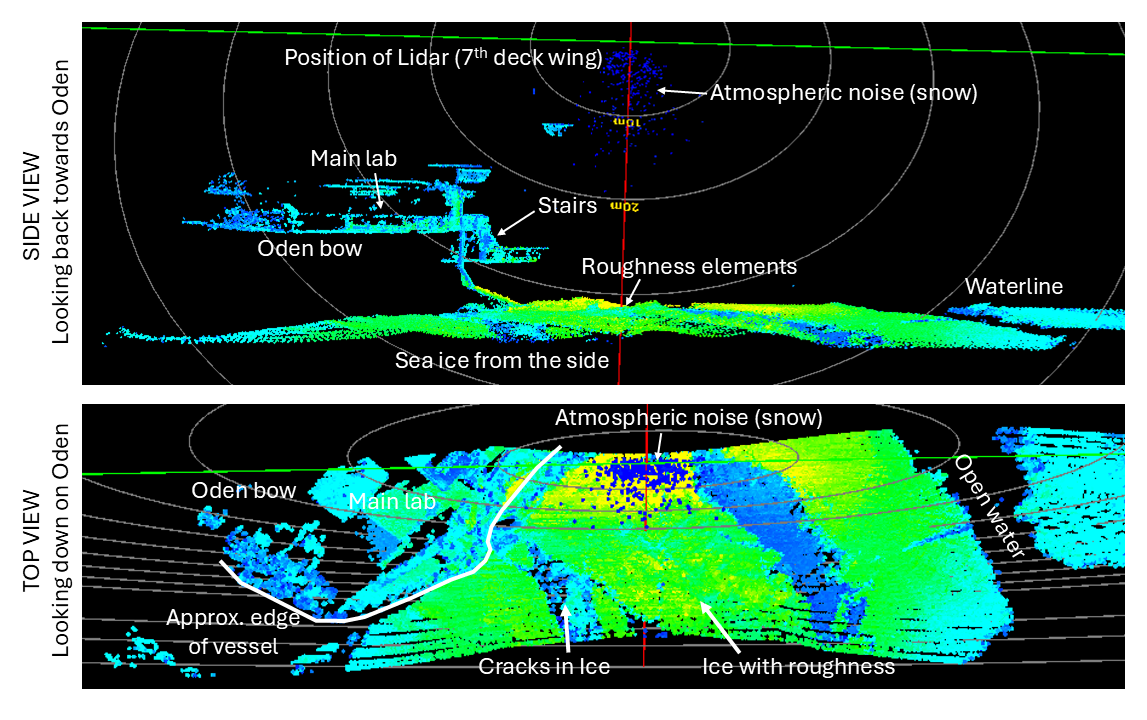
Caption: Scanning lidar images of the sea ice surface next to Oden.
One of my main scientific interests in the Central Arctic is the interaction between the atmosphere and surface. Surface exchanges of heat, moisture, movement, gases, and particles are very important for the Arctic and the global systems.
For example, the heat coming from the atmosphere to the surface in summer contributes to melting sea ice, and the uptake of carbon dioxide by the ocean waters is an integral part of the global carbon cycle. Many processes modulate the rate of exchange of different entities, one of which is the so-called “surface roughness.” This is a technical term, with a technical definition, but it is basically related to the variation of the surface height and effectively defines the frictional relationship between the atmosphere and the surface. A rougher surface leads to more friction, and generally more transfer. To quantify some important exchange processes, we need to know the surface roughness.
The lidar: is mounted high on Oden in a position that its elliptical scan pattern can observe some of Oden’s front deck and the surface adjacent to Oden. Both images are “point clouds” of locations where the scanning laser light reflected from a surface back to the lidar. The top image is visualized as if the viewer were off to the side of Oden looking back towards the vessel. The bottom image is oriented as if viewed looking down on Oden and the surface around it. It these views it is possible to see variations in the sea ice near Oden.
There’s not a lot of data on surface roughness over sea ice. This motivated me to bring a small lidar system that scans a laser very rapidly across an elliptical domain, returning the distance to the point that reflects the laser beam. 400,000 points per second! These systems are the kind of thing that is used by cars to detect their surroundings or by robots to navigate through a factory. But here, it will be used to look at the sea ice surface.
I’ve now pointed this device off the side of Oden to monitor the sea ice as it passes by, collecting “point clouds” of range measurements that we hope to turn into a distribution of the surface height. It’s an exciting new measurement to add to our suite out here.
And even better, we are now planning to fly such a system on the helicopter to potentially get much longer transects of data along the sea ice away from Oden. These observations will be very exciting for both the meteorological team and the sea ice team as the surface roughness determines how effectively atmospheric winds transfer momentum to the sea ice, leading to ice movement and breakup.
/Matthew Shupe, August 26
Oden, the Singing Ship
Oden is a powerful ship. As we make our way through the Arctic, she pushes and breaks her way through the pack ice. There is the constant rumble of the engines, mixed with the pounding and scraping of ice against the hull. Life onboard is rarely quiet.
But Oden also sings.
Every now and then, a deep humming sound travels through the ship. A low, steady tone that almost sounds like a whale singing somewhere in the distance. It comes and goes, filling the cabins and corridors with a surprisingly soothing sound.
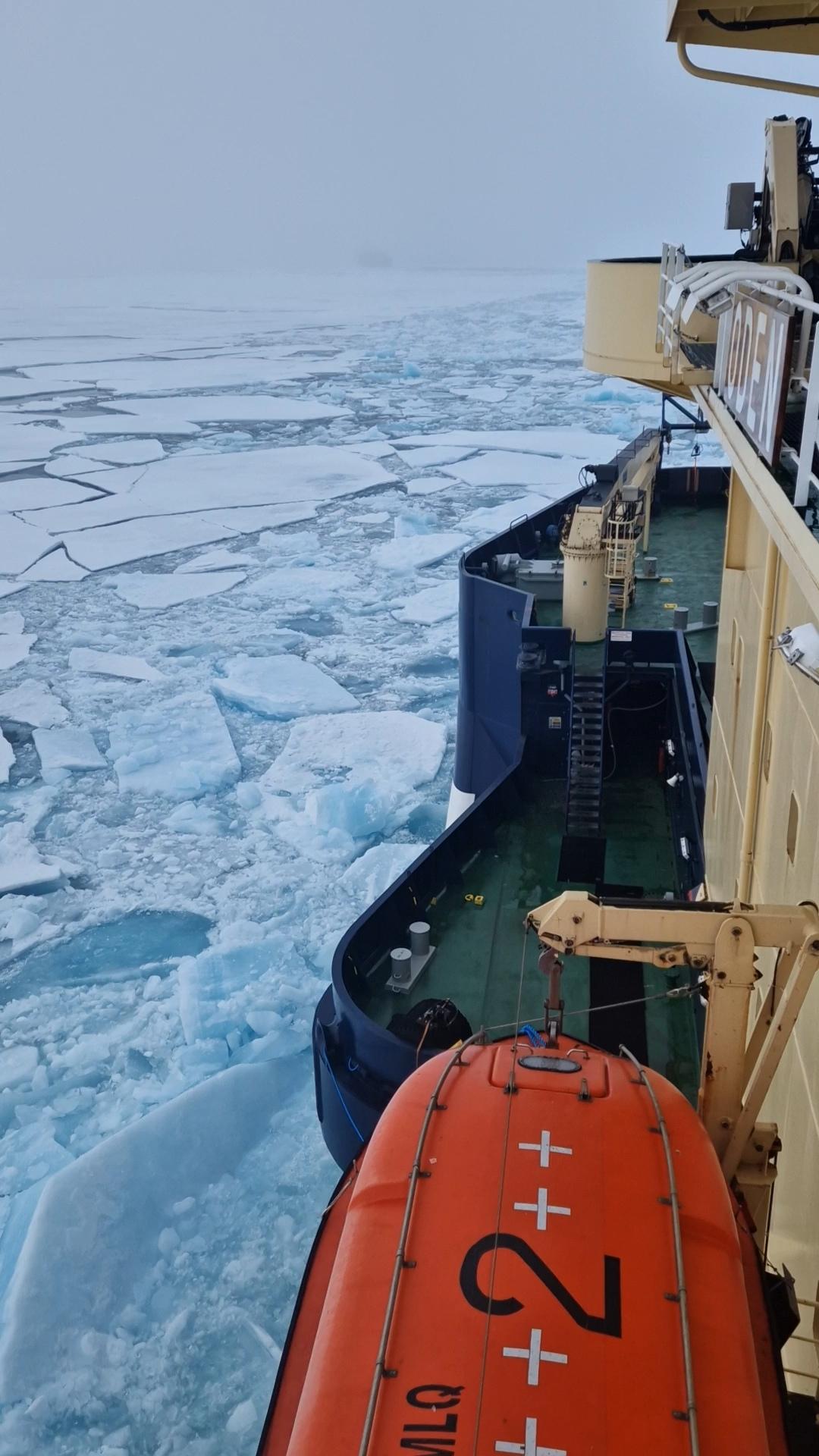
Caption: Side view of Oden.
The singing has a very practical explanation. To help Oden make her way through heavy pack ice, water is pumped from one side of the ship to the other. This makes the entire ship slowly rock from side to side, helping to loosen her from the surrounding ice and continue forward.
But lying in my cabin at night, the mechanics behind it feel far away. Instead, there is just the gentle rocking of the ship and that deep humming sound travelling through the hull. Outside, Oden is working her way through the Arctic ice. Inside, her song makes for the perfect lullaby.
Another day in the Arctic comes to an end. Thank you, Oden, for carrying us a little further through the Arctic today. And good night.
//Hanna Winge, 2026-08-26
Last updated: 2026-09-02
Source: MISU