


A new objective for fisheries management: avoid stock collapses?
It is time to start talking more openly about risks and implicit trade-offs in fisheries management, writes Charles Berkow, advocacy and analysis officer at Stockholm University’s Baltic Sea Centre.
.jpeg)
What risks do we want to take that commercially important fish stocks collapse?
Given developments in Baltic fisheries management, the question is not academic (in the sense of being of no practical importance), but unfortunately highly relevant.
There is, of course, also a question of how to define a stock as “collapsed”. In an unpublished study, Yletyinen et. al (2018) found around 20 different definitions in the scientific literature, and proposed another. Some criteria for defining a ”collapse” were baselines, amount of decline, time frames and data availability. There is also discussion of if the term ”collapse” is unnecessarily dramatic, and if it is not better to discuss in terms of, say, ”seriously depleted”.
Defining collapse
Although there can be disagreement as to how to classify a stock as “collapsed”, it seems clear enough that stocks do collapse, also in our region, also in recent times. And in management, it is important to discuss avoiding collapses.
Perhaps, for the sake of discussion, one could class a fish stock as ”collapsed” when catches, or landings, are 90 percent or more below a five-year average in a not too distant period. While not based on biological assessments, this measure is relevant from an industry and management perspective, and uses readily available data.
By that measure, the cod in the Kattegat collapsed in 2007, compared with the 1996-2000 average landings. The western Baltic cod collapsed in 2021, compared with the 2005-2009 average landings. The western Baltic spring spawning herring collapsed in 2022, compared with 2005-2009 average landing. (See figure 1-3).
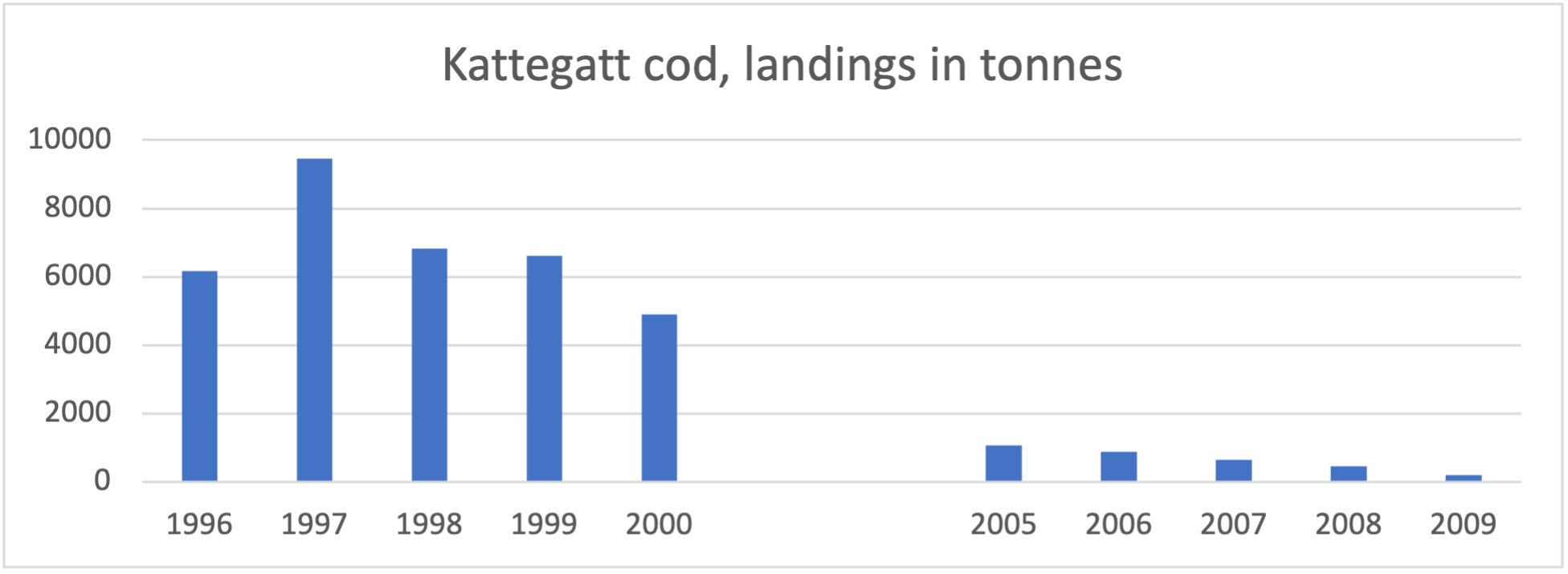
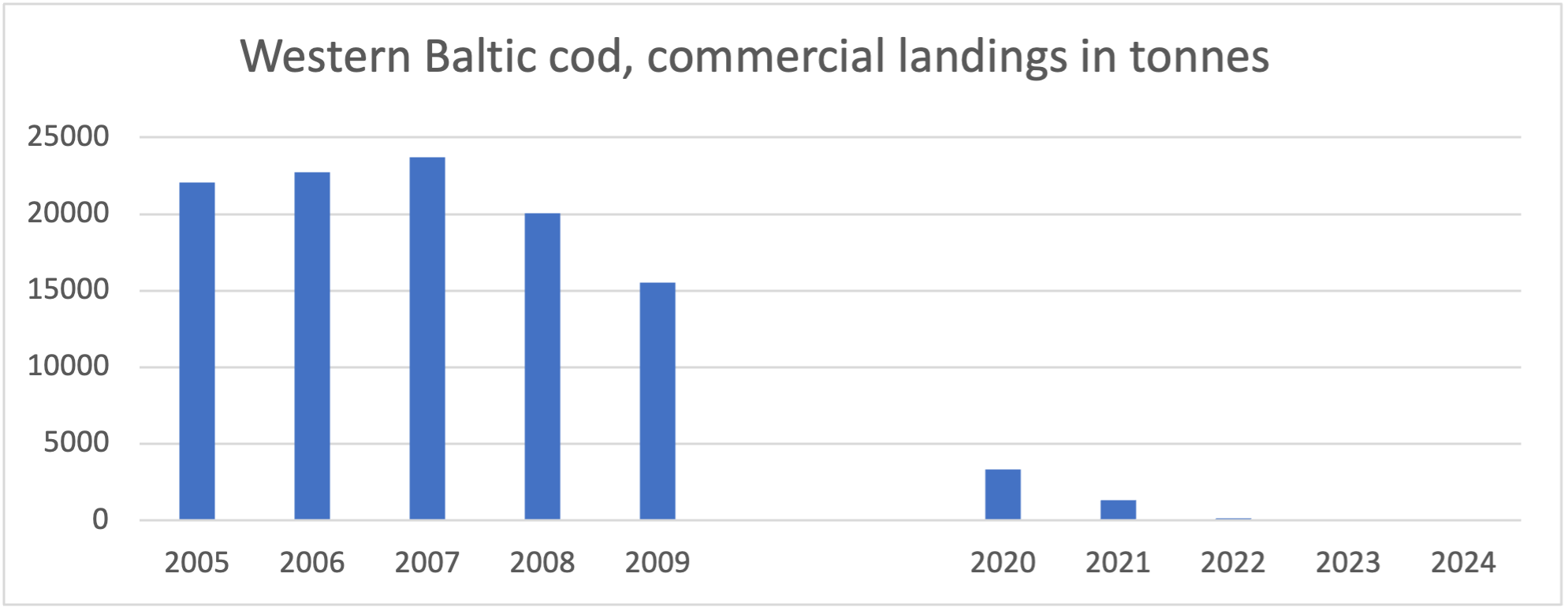
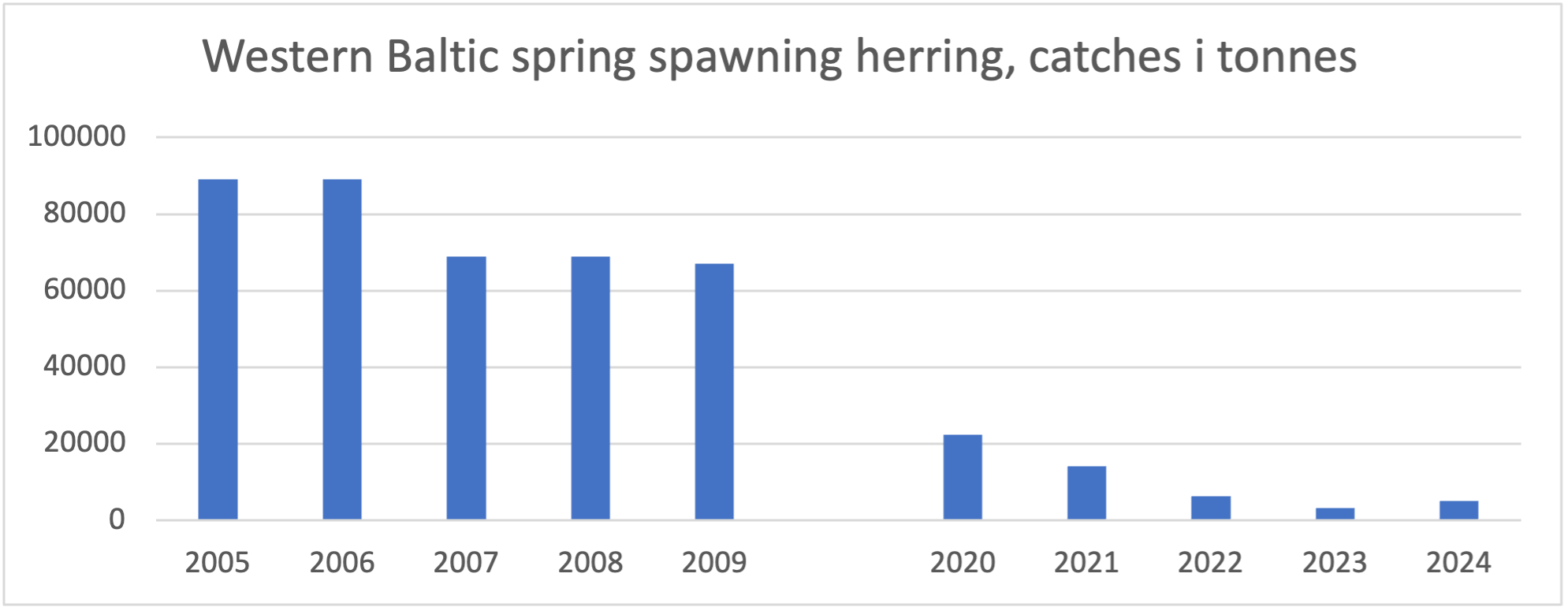
Landings, commercial landings or catches, respectively of Kattegat cod, western Baltic cod and western Baltic spring spawning herring as reported by ICES.
Still no recovery
Another way to class a stock as ”collapsed” is when the forecast from the scientists with International Council for Exploration of the Sea (ICES), for a catch that in a narrow sense is sustainable, is for a 0 catch. This measure is relevant for managers and also based on readily available data. By that measure, the cod in the Kattegat collapsed already in 2001, the western Baltic cod collapsed in 2025 and the western Baltic spring spawning herring collapsed in 2019.
However it is measured, the point is that three fish stocks, that had been commercially important for Swedish fisheries, are no longer commercially available. They have collapsed in the past 25 years or so; two of those in the past 10 years. Importantly, they have not recovered.
Everyone wants fish in the sea, but…
It might seem that avoiding a stock collapse should an imperative goal of fisheries management. Such an objective would be far below the stated objective of the EU’s Common Fisheries Policy of restoring and maintaining fish stocks above levels capable of producing the maximum sustainable yield (technically, according to some leading scientists, above Bmsy; in current practise in the EU above MSYBtrigger).
One can sometimes hear politicians say that robust fish stocks are a condition for fisheries and the industries and communities that benefit from them. Some fishers and lobbyists protest that of course they want fish in the sea in the future, so their children and grandchildren can fish as their fathers and grandfathers before them. The implication is that it goes without saying that no one wants to risk a stock collapse.
Then another problem arises: it is difficult or even impossible to predict when a stock will collapse. And there are other kinds of risks. The risk for a business to take a loss the next year. The risk that some people might lose their livelihoods the next year in countries with a weak social safety net the next. The risk that a processing plant, perhaps built with public support as a prestige project for the government might not get as much raw materials as they need the next year. The risk that the politician may lose their position at the next election and not be around to reap the future fruits of more prudent fisheries management.
Decision-makers rarely admit to taking risks
And so different risks have to be balanced against each other. There are trade-offs. But seldom if ever would one hear a decision-maker explain that they are taking an increased risk with a stock collapse as a trade-off with other risks. But this can be read between the lines when head of the EU’s fisheries council at the end of a long negotiation says things like “[t]his agreement is a viable solution forward for fishermen and fishery resources in the Baltic Sea. It is an agreement that strengthens our efforts to sustain and help stocks recover while ensuring activities for fishermen”, as stated by the German representative in October 2020, the year before the western Baltic cod collapsed in 2021.
Or “[t]oday’s agreement strikes a balance between supporting EU fishermen and women and ensuring the long-term sustainability of fish stocks in the Baltic region. It is based on sound scientific advice and reflects the Council’s commitment to upholding the objectives of the Common Fisheries Policy while also addressing environmental concerns,” as the Slovenian minister said at the end of the negotiations in October 2021, before the western Baltic herring collapsed in 2022.
The risks with the fish stocks taken by the ministers in these and other council decisions turned out to give unfortunate results for the fishermen.
To their defence, it might be said that the ministers need to take their decisions under various uncertainties. Scientific uncertainties that may be larger than the politicians understand. An uncertain risk that the stock may collapse at some point in the future has to be weighed against a more tangible risk for certain companies and fishers in the next year.
A call for caution
The stated objective of the EU fisheries policy and the Baltic multiannual plan to restore and maintain fish stocks above the levels that can produce the maximum sustainable yield could be seen as implying an objective to definitely avoid fish stock collapse. A continuum of decisions inadequate to meet that objective could be interpreted as an acceptance of a higher level of risk.
In explaining the Commission’s position in advance of last year’s Baltic fisheries negotiations, fisheries commissioner Costas Kadis said at the Our Baltic Conference in Stockholm in September 2025 that ”[t]he central question is – how much risk are we willing to take? For the Commission proposal for fishing opportunities for 2026, the starting point has been that the Baltic Sea ecosystem is not in a good state. This alone calls for increased caution because fragile fish stocks are far less likely to recover in an ecosystem that is not intact, than in a healthy ecosystem”.
The guardrail politicians hoped would never be used
In 2016, when they adopted the multiannual management plan for key Baltic commercial fish stocks, the Council of Ministers and the European Parliament in essence set a highest acceptable risk for stock collapse. Under Article 4.6, catch limits should in any event be set such that the estimated probability of a stock falling below a limit value called Blim should be less than 5 percent.
There are major uncertainties in estimating this probability. There are observational uncertainties (the difficulty in estimating the size of a fish stock). And there are model uncertainties: it is difficult to assess where Blim is. From that perspective, it might seem ludicrous to try to estimate a 5 percent probability. Anyway, for a stock to fall below Blim does not necessarily mean that it has collapsed by either of the measures mentioned above.
Still, the decision by the politicians in the Council and the Parliament back in 2016 might be interpreted as an indication that they prioritised avoiding a stock collapse, with all the long term environmental, social and economic costs that would entail.
The 5 percent guardrail under Article 4.6 is like a best available proxy, an attempt by the Council and the Parliament to offset the temptation to prioritize other kinds of risks in the annual decision-making. As at the same politicians had also adopted an objective of restoring and maintaining stocks at much higher levels, they might have assumed that there was little risk of the stocks ever falling to those levels.
Unfortunately, a series of optimistic decisions of the fisheries ministers since then have led to some stocks collapsing and others being in the risk zone. A fisheries management fixated on keeping catch limits within the ICES forecasts of fishing levels in a narrow sense sustainable, while ignoring ICES’ warnings about uncertainties, risks and low probability of reaching stock targets, has not delivered.
The new normal
Sometime after a fish stock has collapsed the degraded state of the sea can be perceived as the new normal. If asked, probably no one would like to see another commercially significant fish stock collapse in the Baltic. Perhaps it is time to speak out about imperative objectives that go without saying, to talk openly about risks and implicit trade-offs.
The measures proposed in the report on the multiannual plan for the Baltic Sea and ways forward (recently adopted by the European Parliament) can be interpreted as not only being intended to create better conditions for the collapsed fish stocks in the Baltic Sea to recover, but also to reduce the risk of further fish stocks collapsing.
Text: Charles Berkow
Last updated: 2026-06-09
Source: Stockholm University Baltic Sea Centre