


Crisis of trust in schools when AI tools emerged
When generative AI swept across the world, many students felt they had been left to fend for themselves. They received no guidance on how the tools could be used, and the trust between teachers and students took a serious knock.

Mattias W Hugerth’s research captures students’ perspectives on the technological shift that AI development represents. And his proximity to the subject of study couldn’t be better: as a teacher at an upper secondary school, Hugerth was able to follow the changes in real time.
“Originally, my doctoral project was intended to focus on data analysis and visualisation supporting students’ self-regulation and metacognitive skills. In February 2022, I submitted the first research plan,” he recalls.
But later that same year, generative AI tools such as Chat GPT and Dall-e burst onto the scene with enormous impact. Mattias W Hugerth saw the opportunity for a compelling research topic and quickly changed course.
“It felt natural to follow the AI thread. My students started talking about Chat GPT and how it supported them in their studies. I also heard the conversations amongst my teacher colleagues,” says Mattias W Hugerth.
Students began using AI tools based on large language models
He mentions Max Tegmark’s dystopian summer talk on Swedish radio in 2023, and notes that discussions in schools were fairly anxious as well. What should you study if you want to get a job in the future? How will the role of teachers change? And what will happen to education more broadly?
“Students began using AI tools based on large language models of their own accord. I wanted to investigate what problems they encountered and how we could support them.”
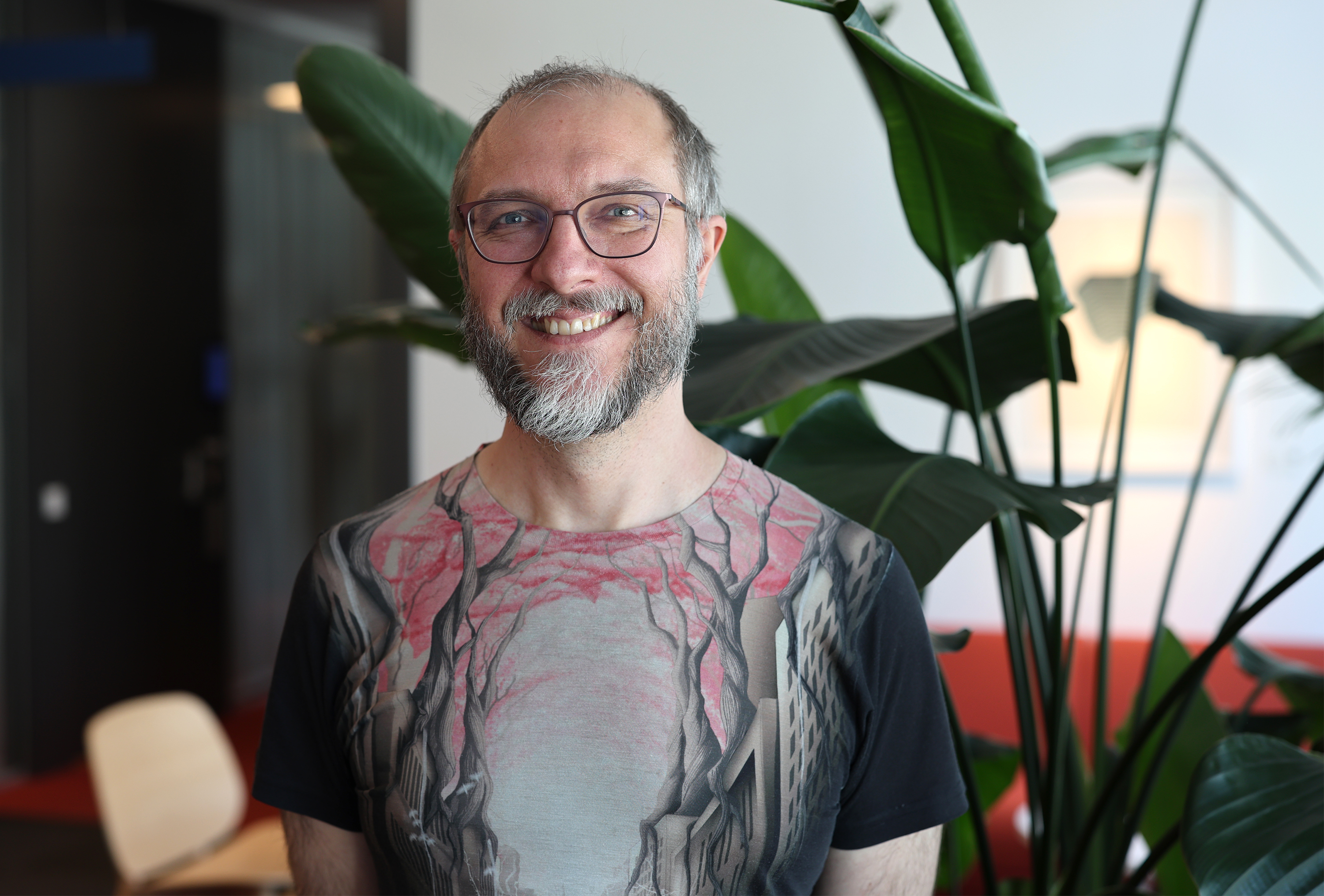
Language teacher Mattias W Hugerth is interested in how upper secondary students deal with generative AI.
In an initial qualitative study, Hugerth asked Swedish upper secondary students how they think about generative AI. Do they use the tools in their schoolwork? How? In which subjects and situations? And does the choice to use AI differ between subjects?
“I noticed a strong dominance in Swedish and social studies. By contrast, it was less common to use AI in mathematics. Several students said, ‘I tried it in maths and the AI got the answer wrong’.”
But then there was one student who said the opposite: they used AI primarily in mathematics and physics.
“This student explained that they had started by asking a question and immediately noticed that the AI gave an incorrect answer. But the student also realised that they already knew the answer – the solutions were at the back of the book, after all. So instead, the student gave the AI tool both the question and the answer, and asked it to explain how the problem should be solved.”
Cheating in focus
It became clear to Hugerth that some students managed to navigate and exploit the new technology better than others. It also became clear that it was up to the students themselves to master generative AI – teachers generally had no knowledge of the tools.
After the interviews, he did a quantitative survey of nearly 1,300 upper secondary students.
“In the surveys, the question of trust stands out the most. Students feel that teachers no longer trust them.”
During the pandemic years, many students were forced to do school work from home. The development of AI tools sent students right back to school, as the fear of students using AI to cheat came to dominate the discussion entirely.
“The Swedish National Agency for Education urged schools to stop allowing students to do school work from home. For students, this was a sharp shift from the progression they’d had throughout their entire schooling. They were simply told they were no longer allowed to work at home – no discussion took place, students received no support, and the rules were unclear.”
Trust relationships are fundamental for schools to function
In doing so, schools signalled that they did not trust students to do their schoolwork and learn when AI tools were an option. This led students to lose faith in both their teachers and the school as an educational institution. The loss of trust applies both to students who are frequent AI users and to those with no interest in AI tools.
“Trust relationships are fundamental for schools to function,” says Mattias W Hugerth.
“The development of AI happened in society and needed to be handled by schools, but they focused solely on the risk of cheating. The fact that students were being treated as suspects was barely discussed at all. And students felt they received no guidance – they found themselves in a school situation that was worse than before.”
The title of Hugerth’s licentiate thesis – Rudderless Sailing – alludes to the fact that both students and teachers were left to take on the new AI tools on their own.
“In the absence of a national initiative, responsibility fell to individual enthusiasts within schools. And the Swedish National Agency for Education has still not been commissioned to develop support and guidance for schools,” he says.
No national plan
AI development is affecting the entire society, and education must keep pace. But at present things are moving too slowly, according to Mattias W Hugerth.
“We need a national plan for how to teach – the steps for how to build knowledge in AI. And it should be connected to a broader understanding of digital development, data management and information flows.”
“Teachers also need to develop their skills. Within the City of Stockholm we may well have the capacity to build that expertise ourselves, but the idea that every governing body should do that work independently strikes me as unreasonable. Nor can we rely on teacher training programmes to equip everyone with AI competence.”
AI also places high demands on subject knowledge
Amongst teachers, opinions differ – not everyone is enthusiastic about generative AI. All teachers don’t have to become experts in using the tools, either. But every teacher needs to understand how AI affects their own teaching and subject area, Hugerth argues.
“We must act responsibly. Generative AI exists and needs to be brought into schools in a controlled manner. I don’t think it’s possible to keep it out.”
“AI also places high demands on subject knowledge. One might assume that the need for knowledge decreases – but students need knowledge to be able to evaluate the responses that AI tools provide.”
The didactic contract was broken
In his research, Mattias W Hugerth draws on didactic theory. In every teaching situation there is a so-called didactic contract between teacher and student. It is built on formal rules such as governing documents and syllabuses, but also on implicit factors such as expectations.
“Students should be able to expect that teachers provide sufficient conditions for learning. Conversely, teachers should be able to expect students to come to class prepared, for example. If either student or teacher falls short, the didactic contract is broken. But what happened in the wake of the AI wave was that the contract was broken from outside.”
The didactic contract must therefore be renegotiated.
“How do we assess students’ knowledge in a legally sound and equitable way? And what knowledge do students need in relation to the technology that is developing? We need to think through such questions. There is a significant difference between writing a text in a limited time, in a closed environment with no opportunity to seek new knowledge, and allowing a text to develop gradually over two weeks,” notes Hugerth.
He hopes the renegotiation will restore the trust that has been lost.
“Trust is what makes the classroom function, and without trust between teachers and students, collaboration suffers. I also believe there may be a broader democratic dimension here. If trust is built in schools, it can form the basis for wider institutional trust in society,” says Mattias W Hugerth.
More about Mattias
Mattias W Hugerth was working as a Swedish and English teacher at an upper secondary school when he seized the opportunity to pursue a doctorate.
“As an employee of the City of Stockholm, I was given the opportunity to hold a part-time doctoral position,” he says.
He chose the Department of Computer and Systems Sciences (DSV) at Stockholm University, where Hugerth has just completed an important milestone: his licentiate thesis, “Rudderless Sailing: A mixed-methods study on how students chart their own course as AI enters education”.
Before becoming a language teacher, he studied on the Cognitive Science programme, which had AI on the curriculum already twenty years ago. He is also a qualified teacher of programming and AI, with a solid understanding of large language models (LLMs) that underpin tools such as Chat GPT.
Today, Mattias W Hugerth works at the research and development unit of the Education Administration within the City of Stockholm.
“The R&D unit is a support function – we receive commissions from 170 schools. I work across a wide range of projects to support teachers in the field of AI, covering areas such as professional development, planning and implementation based on what the research tells us so far. We gather experiences of how AI can be used and feed that back to the schools.”
Having completed his licentiate degree, Hugerth plans to continue his doctoral studies at KTH. And he is happy to continue dividing his time between study and work.
“It’s great to have the two tracks running in parallel. I can apply the knowledge that research provides – directly in practice,” says Mattias W Hugerth.
More about the research
Mattias W Hugerth presented his licentiate thesis at the Department of Computer and Systems Sciences (DSV), Stockholm University, on 12 June 2026. The thesis is titled “Rudderless Sailing: A mixed-methods study on how students chart their own course as AI enters education”.
The licentiate thesis can be downloaded from DiVA
The opponent was Olga Viberg, KTH, and the examiner was Teresa Cerratto-Pargman, DSV.
The main supervisor for the licentiate thesis is Patrik Hernwall, DSV, and the co-supervisor is Anna Åkerfeldt, Stockholm University.
Contact Mattias W Hugerth
Contact Patrik Hernwall
More about research and education at DSV
Last updated: 2026-06-15
Source: Department of Computer and Systems Sciences