


We research how interactive game design can improve mental health
Games are an art form with the capacity to move us deeply. In the world of games, you can explore different sides of yourself. Who do I become if I am free to choose? As a games researcher, I examine how this dynamic can be used to help people facing different challenges, says Mirjam Palosaari Eladhari, Associate Professor in Computer and Systems Sciences.
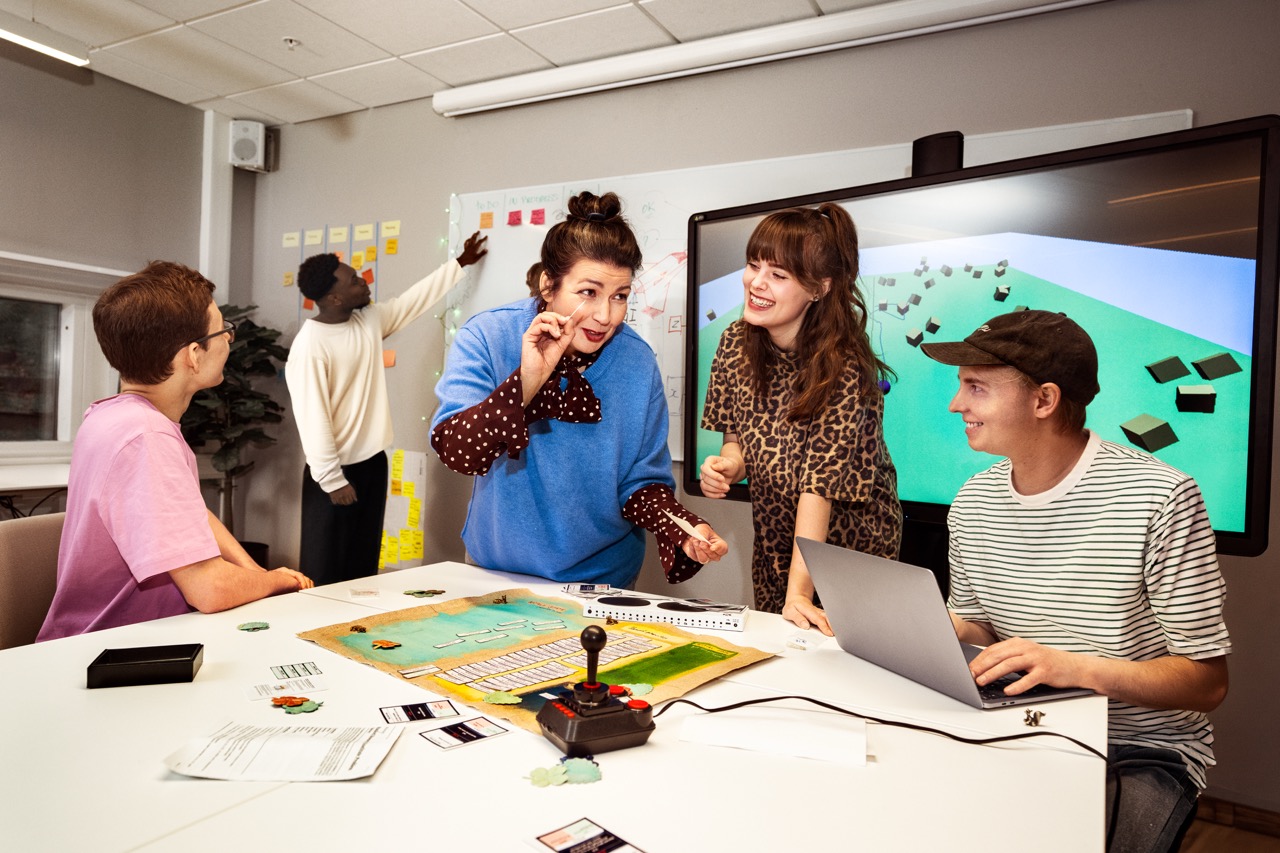
– In the world of games, the player is the protagonist making their own choices in encounters with others, without being bound by the roles they have in their family, among friends or at school. As a player you can start noticing patterns in repeated encounters with others. In doing so, you can see more clearly what is happening in a relationship, and your own responses. It’s like a digital role-play.
How can games help?
– I’m exploring the field of games as therapy and recovery. This includes, for instance, social self-help apps and games designed for therapy and rehabilitation. There are apps with game elements that can be prescribed as part of a treatment. It’s an area that really interests me as a researcher. How can game mechanics help people with different challenges?
– In this kind of technology storytelling is really important. It’s not only about playing and collecting things, but about exploring alternative scenarios for how you might deal with things in everyday life.
Who are you as a researcher?
– As a literary scholar with dreams of becoming a writer, I became completely obsessed with the extra layer of choice that games offer: the chance to take part in the storytelling myself.
– What excites me most about this field is the blend of theory and practice: studying games in theory and then having the opportunity to test how things work in practice. The combination of design work and research, when the two come together, is the most enjoyable part. It can be difficult to distinguish between research and artistic work in games. The two are intertwined.
Recommended study options
What do you research?
– My speciality is so-called AI-based game design, where AI constitutes an essential part of the game itself. In one of my prototypes, there are so-called intelligent agents that behave like humans, with emotions and moods. When these characters are used in the game, they are ready to respond to what happens.
– It’s about designing virtual human beings. That requires not only knowledge of storytelling but also behavioural science and an understanding of psychology. It is a truly interdisciplinary field of research.
What does meeting students mean to you?
– I feel hopeful about the future when I meet young people who also love games. What drives me is curiosity about how games can be made even better. It makes me happy when I can contribute to the creation of even more meaningful games in the future together with our students.
Why should students choose Stockholm University?
– Our students learn not only the craft of creating games, but also why they matter. Above all, they gain a solid foundation in computer science, regardless of whether they go on to work in the gaming sector or not. They gain knowledge in information systems and computer science from first principles.
Mirjam Palosaari Eladhari is Associate Professor at the Department of Computer and System Sciences, mainly teaching game design and game research methods. She is an independent game designer under the label Otter Play. In addition to being a researcher and teacher, she is also a game designer and a lifelong fellow of HEVGA, an international organisation that promotes quality and collaboration in higher education in games.
Last updated: 2026-03-05
Source: Kommunikationsavdelningen