


Love and genes: how evolution shapes the choice of partner
What determines our choice of romantic partner? Zoologist John Fitzpatrick at Stockholm University studies this question by looking at fish.
%20IMG_2172_mindre.jpg)
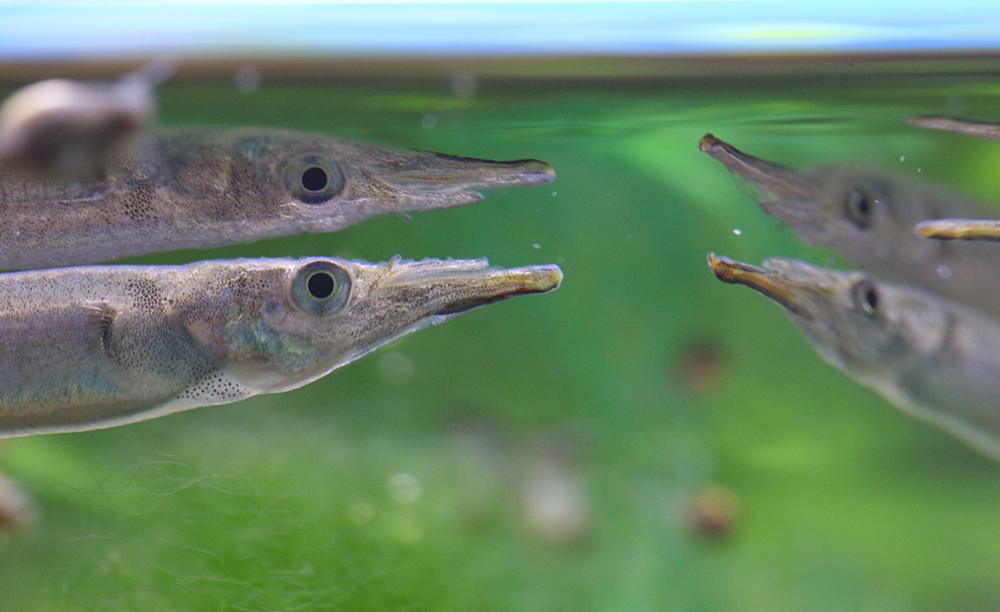
The halfbeak fish mates at the water's surface, using its long, distinctive lower jaw to catch insects that land nearby. Photo: Charel Reuland
Mate choice is never simple
"We often think that animals make simpler choices than humans do. Our choice is based on smell, appearance, behaviour and other signals. Animals do the same thing. In my lab, we try to understand all the factors that determine how animals choose their partners. This gives us important insights into evolution,' says John Fitzpatrick, a behavioural ecologist and professor at the Department of Zoology at Stockholm University.
His area of expertise is how different species choose and compete for a particular partner.
“My interest began with sperm competition. When a female mates with several males, sperm from different males compete to fertilise the egg,” he says.
His research shows that this competition leads to evolutionary changes in males, such as producing more sperm, having larger testes and longer sperm, and producing sperm that swim faster.
There is more to mating than competition
“But competition between sperm is only one part of reproduction. Animals also spend a great deal of time choosing their partner. This makes it crucial to determine when mate choice occurs and who determines the outcome, whether females or males.”
According to Fitzpatrick, a full understanding of reproduction requires an understanding of the entire process, from how individuals ‘market’ themselves, to how sperm compete to reach the egg. The evolutionary stakes are high, leading to great variation and diversity in the strategies that different species use to increase their reproductive success.
The egg can influence the outcome
In a study of humans, John Fitzpatrick and his research group demonstrated that the egg itself can influence which sperm reaches it first.
“We observed that human eggs release chemical signals that favour one sperm over another, meaning that mate choice continues long after mating, even at a microscopic level.”
Why do you study fish?
“Fish are an excellent model for all vertebrates. Half of all vertebrates on Earth are fish. They also reproduce in almost every imaginable way. We study both marine and freshwater fish. Different types of fish can provide answers to different questions.”
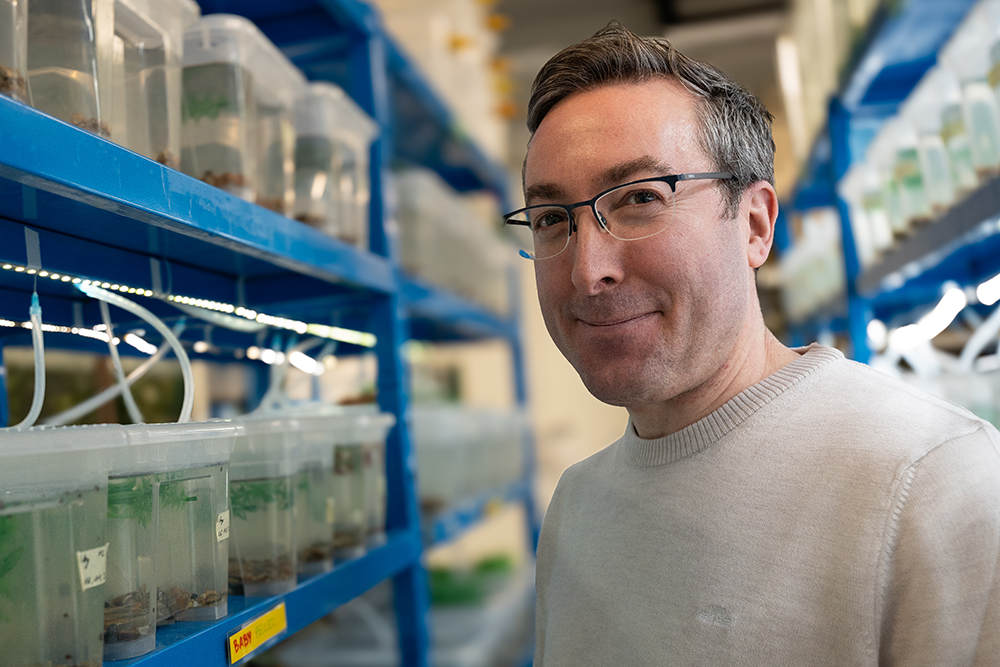
John Fitzpatrick, Stockholm University's fish laboratory. Photo: Anette Gärdeklint Sylla
Research on six continents
The search for answers has taken John Fitzpatrick to field studies on six of the world’s continents. He spends about one month per year in the field with his research group, collecting material to study in the lab later on.
“It’s the combination of fieldwork and controlled laboratory experiments that makes this work so exciting: learning from real-world conditions in the field and then testing new insights in a laboratory. In nature, animals are influenced by many factors, such as the risk of being eaten by predators, mate choice and whether it’s sunny or cloudy.”
In the lab, the research group studies how fish respond to heatwaves when temperatures rise from the normal 26°C to 31°C. The group also examines how fast-flowing water affects the fish’s reproductive behaviours.
“All of these factors influence how evolutionary choices are made. If we understand how it works in the wild, we can then use laboratory experiments, in which we control the environment, to examine the impact of the different factors on behaviour.”
How do you choose the location?
“It always starts with a question. What are we interested in knowing? That leads us to the animal. Sometimes we end up at a lake in Central Africa, and sometimes in Southeast Asia. We work from both the outside in and the inside out. Different animals teach us different things. Where we go depends on the questions.”
In Singapore and Malaysia, the research group is currently trying to understand how female halfbeak fish attract males. This species mates at the water’s surface. It has a long, distinctive lower jaw that is constantly ready to catch insects that land in the water. The mating process is so quick, that it is barely observable with the naked eye.
“The females, which give birth to live young, have an orange spot on their bellies, that the males find very attractive. It turns out that the males are most attracted when the spot is large and extended, which occurs when the female is pregnant. But what makes this spot so attractive to the males? That’s what we’re trying to find out.”
AI creates new opportunities
Researching animal behaviour often requires long, time-consuming studies, whereas the important moment being studied sometimes happens so quickly that it is difficult to distinguish each step. Here, access to new AI technology has made it possible to ask questions in new ways, collect data faster and analyse it more efficiently.
“Previously, we had to observe and record everything manually. It could take us several months to gather data from an experiment. But with the help of new AI tools, we can collect and analyse behavioural data much more quickly.”
AI-based software can use high-resolution video recordings of fish and is capable of learning to recognise individual animals to provide detailed information about the behaviour of each one. John Fitzpatrick believes these methods will help evolutionary research move forward.
“Evolution is the most fascinating and complex phenomenon in existence. As a biologist, I am constantly challenged by the task of trying to understand how evolution has created the incredible world around us. We only need to step outside to be reminded of that.”
Read more about the research of John Fitzpatrick
The impact of evolution on sexual selection (KAW)
About John Fitzpatricks' research
Research results
Last updated: 2026-02-09
Source: Communications Office