Maria Wendt Senior lecturer, Associate professor

Contact

Name and title: Maria WendtSenior lecturer, Associate professor

Workplace: Department of Economic History and International Relations Länk till annan webbplats.

Visiting address Room A 920Universitetsvägen 10 A, plan 9

Postal address Institutionen för ekonomisk historia och internationella relationer106 91 Stockholm

About me

Maria Wendt is Senior lecturer and Associate Professor at the Department of Economic History and International Relations. Her research focus on war, militarism, security, cultural heritage, nationalism and gender.

She is currently working with the research project "Cultural heritage transformations in times of insecurity and war preparedness". The project unites researchers from international relations, ethnology, gender studies and art-and architechtural history. The  aim is to examine how cultural heritage becomes a means to prepare citizens for war and strengthen national resilience. Specifically, it examines the uses of Sweden's military heritage in times of increasing insecurity. What new meanings are accorded military history and heritage? How is military history mobilised as a national security resource? 


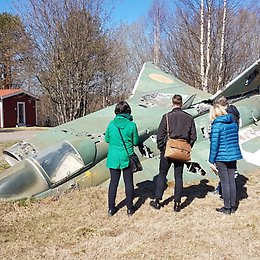
Previously she was working within the multidisciplinary research project "Making a Military Heritage: Gender and Nation in Sweden’s Cold War History". The project investigated how the Cold War was preserved as a national military heritage in Sweden, and problematised the relation between security and societal memory. The research team visited military museums and "experience centers" (focusing on children and families) all around Sweden, and visited a residential area in Gotland where Cold War bunkers have been turned into exclusive summer homes. 

She has also done research on military death and gendered heroism in relation to the ISAF-mission in Afghanistan. The project "The politics of military loss in contemporary Europe", compared societal justifications and meaningmaking in relation to soldiers' deaths in six European countries. In this project, political and media discourses, symbolic and ritual dimensions as well as monuments and artistic interventions were analyzed. 

Wendt has also conducted research on media and nationalism, men's violence against women, and has been involved with several pedagogical research projects. For example, she has investigated students' difficulties in writing independent essays, and the challenges pertaining to the teaching of emotionally and politically charged subjects. 

Maria Wendt's research interests are  feminist international relations (IR); gendered security, cultural heritage, war memory, nationalism and gender, teaching/learning political science/IR.

Current research projects


Cultural heritage transformations in times of insecurity and war preparedness

The war in Ukraine and the military build-up in Europe have drawn attention to the role of cultural heritage for Sweden’s defence strategy. Security discourse now emphasizes the significance of collective memory for national defence, and heritage and security actors launch joint outreach activities. When preserving the past is framed as a matter of security, heritage institutions gain a new role. This raises fundamental questions about cultural institutions’ autonomy as well as about the purpose of heritage and how it should be displayed and narrated.

This transdisciplinary project explores how cultural heritage becomes a means to prepare citizens for war and strengthen national unity and resilience. It specifically aims to examine the uses of Sweden’s military heritage in times of increasing insecurity. How is military heritage mobilised as a national security resource? What new meanings are accorded military heritage and history? The project unites researchers from international relations, ethnology, gender studies, and art- and architectural history. We examine reformulations of heritage as a matter for war preparedness and how this is motivated in policy and by heritage and security actors. Through comparing fieldwork materials and documentation of military heritage sites from before and after the Russian invasion, we will be able to identify changes in exhibitions and in how actors make sense of the nation’s past, particularly its legacy of neutrality and gender equality.


Previous research projects

Making a Military Heritage. Gender and Nation in Sweden’s Cold War History

In Europe, increased geopolitical tensions as well as neo-nationalism, growing populism and the migrant situation draw political attention to issues of national belonging, borders and gender relations. At stake are understandings of national identity – of who we are, and what history and values that define us.

In this context, constructions of national heritage and collective memories are increasingly controversial. The aim of this transdisciplinary project is to investigate how Sweden’s Cold War history is given societal meaning in the creation of a military heritage. How is national identity and gender negotiated when experiences of geopolitical threats and memories of fear and insecurity are framed as heritage? The project’s design is based on joint fieldwork at military heritage sites, including official exhibitions, commercialized tourist establishments and informal uses of military structures.

The project combines two research fields – critical heritage studies and feminist international relations (IR). Contributions concern how a “dark” heritage is constructed and commercialized in a national context of prominent peace narratives. Recognizing that women’s agency and experiences tend to be omitted in military memorializations, this project addresses the gender implications of military heritagization. The research also provides new knowledge on how Swedish cultural self-understanding connects to the military.

More about the project.

Genus och nation I kalla krigets spår: Skapandet av ett svenskt militärt kulturarv

Samtida nynationalistiska strömningar, populism och ökande migration aktualiserar frågor om tillhörighet, nationsgränser och medborgarskap. Europa präglas därtill av starkare geopolitiska spänningar och höjd försvarsberedskap i vad som har kallats ett nytt kallt krig. Frågor om nationell identitet ställs nu på sin spets. Vilka är vi, vilken historia delar vi och vilka värderingar ska vi skydda?

I denna politiska situation får konstruktioner av nationella kulturarv och kollektiva minnen av krig och konflikt en stark laddning. I det här projektet undersöks senare års initiativ att bevara minnet av kalla kriget i Sverige. Det övergripande syftet är att undersöka hur nationell tillhörighet, medborgarskap och genus förhandlas när minnen av geopolitiska hot och rädsla etableras som kulturarv.

Projektet utgår från fältarbeten på militära kulturarvsplatser som inkluderar offentliga muséer, turistanläggningar och informella bruk av övergivna militära inrättningar. Två forskningsfält, kritiska kulturarvsstudier och feministiska internationella relationer, kombineras. Kunskapsbidraget rör hur ett ”mörkt” kulturarv etableras och kommersialiseras i en nationell kontext präglad av fredssträvanden och konfliktlösning. Med utgångspunkt i att kvinnors erfarenheter ofta utelämnats i militära historieskrivningar, analyserar detta projekt vilken roll genus spelar i ett militärt kulturarvsskapande. Forskningen ger även kunskap om hur svensk nationell självförståelse länkas till militären.
När soldater dör tystnar det demokratiska samtalet, Essä i Dagens Arena, 13/12 2018.


The politics of military loss in contemporary Europe

Since 2001, more than 700 European soldiers have been killed in the NATO-led ISAF operation in Afghanistan. In this war universal international values, rather than national territory, are said to be at stake. As the fallen soldiers are brought home, however, gendered representations of heroism are actualized and grief and compassion rooted in national narratives. It appears that while sending troops to fight for human rights and international institutions can be justified, the same values might be insufficient to carry the symbolic weight of legitimizing the deaths of European soldiers.

The aim of this comparative project is to examine how deaths of European soldiers in Afghanistan are given societal meanings and justifications and how these losses are politically framed and handled. Six countries with different war histories, geopolitical positions and gender regimes (Denmark, Estonia, Germany, Italy, Sweden and the UK) will be investigated. Analysis of media narratives, parliamentary debates, official policies and commemoration rituals is included.

The project proceeds from the idea that these new military deaths transform established understandings of national belonging and ideas of women´s and men´s ultimate obligations in democracies. The research investigates, firstly how the losses in Afghanistan restructure relations between war, national identity and gender, and, secondly, how these reshaped national identities influence democratic discussions and practices.


Forskningsprojekt

Contact

Name and title: Maria WendtSenior lecturer, Associate professor

Workplace: Department of Economic History and International Relations Länk till annan webbplats.

Visiting address Room A 920Universitetsvägen 10 A, plan 9

Postal address Institutionen för ekonomisk historia och internationella relationer106 91 Stockholm