


Research project Symptom-networks for depression/anxiety in patients at the start of psychotherapy
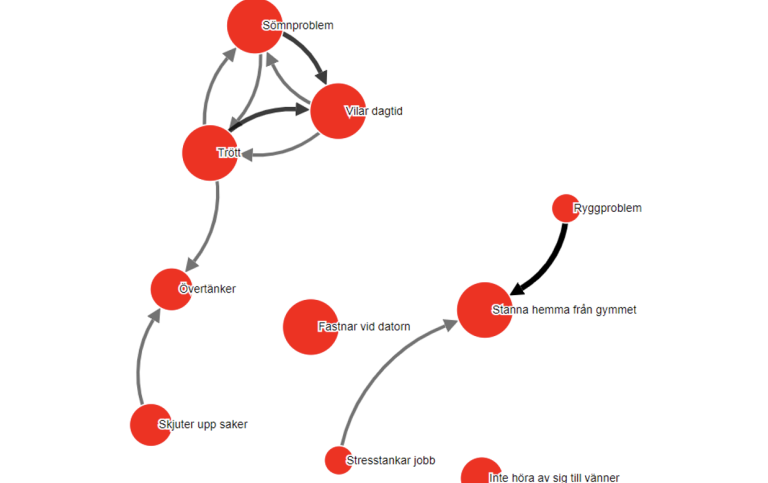
An example of a symptom network from a person in the pilot-study. The red dots are symptoms and the arrows illustrate how the symptoms affect each other.
The diagnostic criteria for depression consist of nine emotional/behavioral criteria, five of which must be met to receive a diagnosis. This means that two individuals diagnosed with depression may have completely different patterns of symptoms. This variation (heterogeneity and comorbidity) in patients may underlie the modest treatment results in depression.
A possible solution to this is to see individual symptoms as involved in "causal networks", where the symptoms influence and reinforce each other. Some symptoms can be more central than others, i.e. they affect several other symptoms and perpetuate them, and are therefore a good target in treatment. Through an individual analysis of these causal networks, a kind of structured form of case conceptualization within CBT, it becomes irrelevant which diagnostic category the patient belongs to, but instead the treatment is designed based on how the symptoms affect each other for the particular patient.
The project aims to develop and evaluate the symptom network method at the Psychological Clinic where students practice CBT.
The project investigates whether daily estimations of symptoms and how they influence each other can be added to create an average network over several weeks. The idea is that this will give a more reliable picture of the patient's problems, how they affect each other, and which problems are central.
The aim is for this instrument to be used by the therapists to make the start of therapy more effective- and possibly also predict which patients respond best to treatment. We call the new method MAPPIT (The Momentary Assessment of Perceived Problem Influences Tool).
The research project has three main aims:
- to identify how many days of measurements are needed to create a stable symptom network (reliability)
- to investigate how patients and therapists perceive the method, and how it can be improved (face-validity)
- to investigate whether characteristics of the patients' symptom network (foremost number of feedback loops) can predict treatment outcome in therapy (predictive validity).
Student Thesis, 2022:
Andikkhash, V., & Jäger, N. (2022). MAPPI: Nätverksanalys som fallkonceptualisering – en explorativ studie av reliabilitet och användarupplevelse i dagliga skattningar för att skapa problemnätverk. Student thesis, Department of Psychology, Stockholm University.
Student Thesis, 2023:
Koernig. F., & Lönnros, A. (2023). Självskattade symptomnätverk. Utvärdering av en förbättrad metod med individualiserade respektive kontextuella problem. Student thesis, Department of Psychology, Stockholm University.
Other members of the project
Students from the department of Psychology, Stockholm University:
- Vida Andikkhash
- Nelly Jäger
- Alexandra Lönnros
- Frida Koernig
- Gustav Almelöv
- Olivia Wideroth