


Research project A new epoch for applied stellar spectroscopy
The spectral signatures of stars offer a roadmap to cosmic nature and history. In recent years, stellar spectroscopy has seen revolutionary progress both on the modelling and theory side. In this project, we build upon the advances to address astrophysical problems with novel techniques.
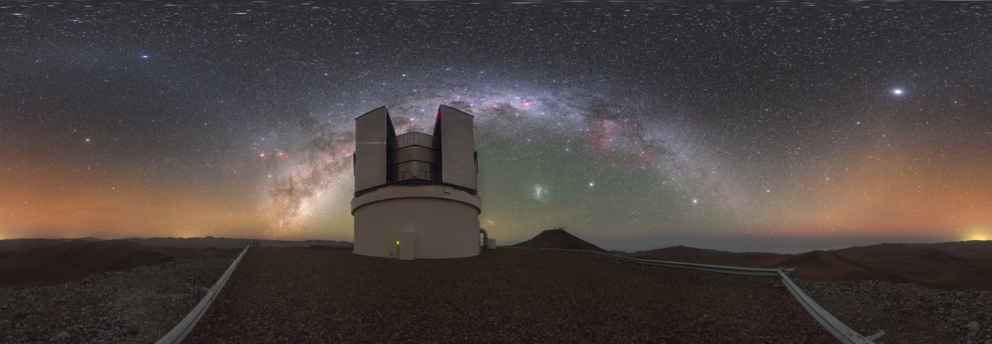
The image shows the VISTA telescope at Paranal Observatory in Chile, where the 4MOST instrument has been installed. The Milky Way disk is glowing in the background.
The light we observe from stars is emitted from a very thin outer layer of gas known as the stellar atmosphere. The layer experiences constant large-scale motions and matter and radiation are not in equilibrium. Accounting for both these effects properly can be done with so-called 3D non-LTE modelling of the stellar spectrum. This is numerically very expensive, but has been shown to successfully remove large systematic uncertainties in inferred stellar properties associated with traditional modelling.
Stellar surveys can nowadays routinely record data with high spectral resolving power for thousands of stars simultaneously. The assembly of million-star data sets with instruments like 4MOST is a major regime change that can be mastered by introducing elements of machine learning in the analysis and scientific exploitation. The main goal of this project is to develop efficient and automated analysis tools for parameter and abundance analysis of stars that leverage the developments on the theory side.
Equipped with survey data and world-leading stellar models, this project is designed to address a range of astrophysical problems with novel techniques; tracing the creation channels of chemical elements from nucleosynthesis in the Big Bang to stellar interiors and explosions, disentangling the vast mixture of stars in our Galaxy into discrete populations and formation events, and studying the link between stars and exoplanets.