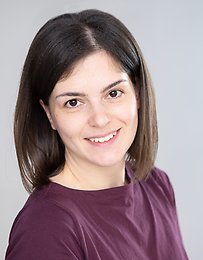
Milka Doktorova Biträdande lektor

Kontakt

Namn och titel: Milka DoktorovaBiträdande lektor

Telefon: +468161007

ORCID0000-0003-4366-2242 Länk till annan webbplats.

Arbetsplats: Institutionen för biokemi och biofysik Länk till annan webbplats.

Besöksadress Svante Arrhenius väg 16

Postadress Institutionen för biokemi och biofysik106 91 Stockholm


  • Caveolin assemblies displace one bilayer leaflet to organize and bend membranes

    Artikel
    2025. Milka Doktorova, Sebastian Daum, Tyler R. Reagle, Hannah I. Cannon, Jan Ebenhan, Sarah Neudorf, Bing Han, Satyan Sharma, Peter Kasson, Kandice R. Levental, Kirsten Bacia, Anne K. Kenworthy, Ilya Levental.

    Caveolin is a monotopic integral membrane protein, widely expressed in metazoans and responsible for constructing enigmatic membrane invaginations known as caveolae. Recently, the high-resolution structure of a purified human caveolin assembly, the CAV1-8S complex, revealed a unique organization of 11 protomers arranged in a tightly packed, radially symmetric spiral disc. One face and the outer rim of this disc are hydrophobic, suggesting that the complex incorporates into membranes by displacing hundreds of lipids from one leaflet. The feasibility of this unique molecular architecture and its biophysical and functional consequences are currently unknown. Using Langmuir film balance measurements, we find that CAV1-8S is highly surface active, intercalating into lipid monolayers of various compositions. CAV1-8S can also incorporate into preformed bilayers, but only upon removal of phospholipids from the outer-facing leaflet. Atomistic and coarse-grained simulations of biomimetic bilayers support this “leaflet replacement” model and also reveal that CAV1-8S accumulates 40 to 70 cholesterol molecules into a disordered monolayer between the complex and its distal lipid leaflet. We find that CAV1-8S preferentially associates with positively curved membrane surfaces due to its influence on the conformations of distal leaflet lipids, and that these effects laterally sort lipids. Large-scale simulations of multiple caveolin assemblies confirmed their association with large, positively curved membrane morphologies consistent with the shape of caveolae. Further, association with curved membranes regulates the exposure of caveolin residues implicated in protein–protein interactions. Altogether, the unique structure of CAV1-8S imparts unusual modes of membrane interaction with implications for membrane organization, morphology, and physiology.

    Läs mer om Caveolin assemblies displace one bilayer leaflet to organize and bend membranes
  • Cell membranes sustain phospholipid imbalance via cholesterol asymmetry

    Artikel
    2025. Milka Doktorova, Jessica L. Symons, Xiaoxuan Zhang, Hong-Yin Wang, Jan Schlegel, Joseph H. Lorent, Frederick A. Heberle, Erdinc Sezgin, Edward Lyman, Kandice R. Levental, Ilya Levental.

    Membranes are molecular interfaces that compartmentalize cells to control the flow of nutrients and information. These functions are facilitated by diverse collections of lipids, nearly all of which are distributed asymmetrically between the two bilayer leaflets. Most models of biomembrane structure and function include the implicit assumption that these leaflets have similar abundances of phospholipids. Here, we show that this assumption is generally invalid and investigate the consequences of lipid abundance imbalances in mammalian plasma membranes (PMs). Using lipidomics, we report that cytoplasmic leaflets of human erythrocyte membranes have >50% overabundance of phospholipids compared with exoplasmic leaflets. This imbalance is enabled by an asymmetric interleaflet distribution of cholesterol, which regulates cellular cholesterol homeostasis. These features produce unique functional characteristics, including low PM permeability and resting tension in the cytoplasmic leaflet that regulates protein localization.

    Läs mer om Cell membranes sustain phospholipid imbalance via cholesterol asymmetry
  • Cholesterol modulates membrane elasticity via unified biophysical laws

    Artikel
    2025. Teshani Kumarage, Sudipta Gupta, Nicholas B. Morris, Fathima T. Doole, Haden L. Scott, Laura-Roxana Stingaciu, Sai Venkatesh Pingali, John Katsaras, George Khelashvili, Milka Doktorova, Michael F. Brown, Rana Ashkar.

    Cholesterol and lipid unsaturation underlie a balance of opposing forces that features prominently in adaptive cell responses to diet and environmental cues. These competing factors have resulted in contradictory observations of membrane elasticity across different measurement scales, requiring chemical specificity to explain incompatible structural and elastic effects. Here, we demonstrate that - unlike macroscopic observations - lipid membranes exhibit a unified elastic behavior in the mesoscopic regime between molecular and macroscopic dimensions. Using nuclear spin techniques and computational analysis, we find that mesoscopic bending moduli follow a universal dependence on the lipid packing density regardless of cholesterol content, lipid unsaturation, or temperature. Our observations reveal that compositional complexity can be explained by simple biophysical laws that directly map membrane elasticity to molecular packing associated with biological function, curvature transformations, and protein interactions. The obtained scaling laws closely align with theoretical predictions based on conformational chain entropy and elastic stress fields. These findings provide unique insights into the membrane design rules optimized by nature and unlock predictive capabilities for guiding the functional performance of lipid-based materials in synthetic biology and real-world applications.

    Läs mer om Cholesterol modulates membrane elasticity via unified biophysical laws
  • Exploring the sensitivities of experimental techniques to various types of membrane asymmetry using atomistic simulations

    Artikel
    2025. Frederick A. Heberle, Milka Doktorova.

    Biological membranes have two leaflets that can differ in both lipid composition and total lipid abundance. These different types of asymmetries play a major role in determining the biophysical properties of the membrane; however, they have proven challenging to assay experimentally even in simpler model systems. Molecular dynamics simulations offer the means for detailed computational investigation of systematically varied interleaflet lipid distributions, but opportunities for critical validation with wet lab experiments are scarce. To help address this problem, here we use atomistic simulations of asymmetric bilayers to generate synthetic experimental data and thus investigate the sensitivity of various approaches to changes in relative lipid composition, number, and cholesterol distribution. Contrary to trends in symmetric bilayers, the simulations showed a decrease in lipid packing with increasing cholesterol in differentially stressed asymmetric bilayers, with more pronounced changes in the more loosely packed leaflet. Representative experimental data computed from the simulation trajectories indicated that the detection of asymmetry-induced changes in leaflet properties should be possible with environment-sensitive fluorescent probes and NMR observables, but may require optimization of sample preparation conditions. On the other hand, small-angle scattering data are already experimentally accessible and can reveal differential leaflet packing densities through a model-free analysis. We further show that computationally generated cryo-EM intensity profiles are highly sensitive to phospholipid imbalance between membrane leaflets. Together, these findings provide a roadmap for developing targeted applications of the in vitro techniques and obtaining experimental data critical for validating computationally derived principles related to membrane asymmetry.

    Läs mer om Exploring the sensitivities of experimental techniques to various types of membrane asymmetry using atomistic simulations
  • Immune cell activation produces locally scrambled foci of plasma membrane lipids

    Artikel
    2025. Daryna Sputay, Milka Doktorova, Sze Ham Chan, Emma Han Guo, Hong-Yin Wang, Joseph H. Lorent, Ilya Levental, Kandice R. Levental.

    Most eukaryotic cells maintain a large disparity in lipid compositions between the cytosolic and external leaflets of the plasma membrane (PM) bilayer. This lipid asymmetry is maintained by energy-consuming flippase enzymes that selectively drive phospholipids into the cytosolic leaflet, often against large concentration gradients. Scramblases, activated by intracellular Ca2+ or apoptotic signaling, shuttle phospholipids down their concentration gradient to release lipid asymmetry. Such scrambling is typically evidenced by exposure of phosphatidylserine (PS) to the external leaflet and is associated with many physiological processes, most notably blood clotting and cell death, but also activation of immune cells. Here, we show that both PS and phosphatidylethanolamine (PE) appear on the PM external leaflet following immune receptor-mediated activation of mast cells. We also observe similar effects in T cells. Importantly, in contrast to wholesale release of PM asymmetry induced by calcium ionophores or apoptosis, we show that scrambling in activated immune cells is focal, with small, stable regions of surface exposed PS. These scrambled foci are calcium dependent, have lower lipid packing than their surrounding outer leaflet, and are reversible. These observations of local, transient scrambling during physiological activation of healthy immune cells suggest important roles for the lateral and transbilayer organization of membrane lipids.

    Läs mer om Immune cell activation produces locally scrambled foci of plasma membrane lipids

Kontakt

Namn och titel: Milka DoktorovaBiträdande lektor

Telefon: +468161007

ORCID0000-0003-4366-2242 Länk till annan webbplats.

Arbetsplats: Institutionen för biokemi och biofysik Länk till annan webbplats.

Besöksadress Svante Arrhenius väg 16

Postadress Institutionen för biokemi och biofysik106 91 Stockholm