Annica Ekman Professor i meteorologi

Kontakt

Namn och titel: Annica EkmanProfessor i meteorologi

Telefon: +468162397

Arbetsplats: Meteorologiska institutionen (MISU) Länk till annan webbplats.

Besöksadress Rum C 648Svante Arrhenius väg 16 C

Postadress Meteorologiska institutionen (MISU)106 91 Stockholm


  • East Asian aerosol cleanup has likely contributed to the recent acceleration in global warming

    Artikel
    2025. Bjørn H. Samset, Laura J. Wilcox, Robert J. Allen, Camilla W. Stjern, Marianne T. Lund, Sharar Ahmadi, Annica Ekman, Maxwell T. Elling, Luke Fraser-Leach, Paul Griffiths, James Keeble, Tsuyoshi Koshiro, Paul Kushner, Anna Lewinschal, Risto Makkonen, Joonas Merikanto, Pierre Nabat, Larissa Narazenko, Declan O’Donnell, Naga Oshima, Steven T. Rumbold, Toshihiko Takemura, Kostas Tsigaridis, Daniel M. Westervelt.

    Global surface warming has accelerated since around 2010, relative to the preceding half century. This has coincided with East Asian efforts to reduce air pollution through restricted atmospheric aerosol and precursor emissions. A direct link between the two has, however, not yet been established. Here we show, using a large set of simulations from eight Earth System Models, how a time-evolving 75% reduction in East Asian sulfate emissions partially unmasks greenhouse gas-driven warming and influences the spatial pattern of surface temperature change. We find a rapidly evolving global, annual mean warming of 0.07 ± 0.05 °C, sufficient to be a main driver of the uptick in global warming rate since 2010. We also find North-Pacific warming and a top-of-atmosphere radiative imbalance that are qualitatively consistent with recent observations. East Asian aerosol cleanup is thus likely a key contributor to recent global warming acceleration and to Pacific warming trends.

    Läs mer om East Asian aerosol cleanup has likely contributed to the recent acceleration in global warming
  • From Molecules to Droplets

    Artikel
    2025. Almuth Neuberger, Stefano Decesari, Andreas Aktypis, Hendrik Andersen, Darrel Baumgardner, Federico Bianchi, Maurizio Busetto, Jing Cai, Jan Cermak, Sudhakar Dipu, Annica M. L. Ekman, Sandro Fuzzi, Yvette Gramlich, Sophie L. Haslett, Liine Heikkinen, Jorma Joutsensaari, Christos Kaltsonoudis, Juha Kangasluoma, Radovan Krejci, Angelo Lupi, Angela Marinoni, Angeliki Matrali, Fredrik Mattsson, Claudia Mohr, Athanasios Nenes, Marco Paglione, Spyros N. Pandis, Anil Patel, Ilona Riipinen, Matteo Rinaldi, Sarah S. Steimer, Dominik Stolzenburg, Juha Sulo, Christina N. Vasilakopoulou, Paul Zieger.

    The Italian Po Valley is one of the most polluted regions in Europe. During winter, meteorological conditions favor long and dense fogs, which strongly affect visibility and human health. In spring, the frequency of nighttime fogs reduces while daytime new particle formation events become more common. This transition is likely caused by a reduction in particulate matter (PM2.5), leading to a decrease in the relevant condensation sink. The physics and chemistry of fog and aerosol have been studied at the San Pietro Capofiume site since the 1980s, but the detailed processes driving the observed trends are not fully understood. Hence, during winter and spring 2021/22, the Fog and Aerosol Interaction Research Italy (FAIRARI) campaign was carried out, using a wide spectrum of approaches, including in situ measurements, outdoor chamber experiments, and remote sensing. Atmospheric constituents and their properties were measured ranging from gas molecules and molecular clusters to fog droplets. One unique aspect of this study is the direct measurement of the aerosol composition inside and outside of fog, showing a slightly greater dominance of organic compounds in the interstitial compared to the droplet phase. Satellite observations of fog provided a spatial context and agreed well with in situ measurements of droplet size. They were complemented with in situ chamber experiments, providing insights into oxidative processes and revealing a large secondary organic aerosol-forming potential of ambient air upon chemical aging. The oxidative potential of aerosol and fog water inferred the impact of aerosol–fog interactions on particle toxicity.

    Läs mer om From Molecules to Droplets
  • High sensitivity of cloud formation to aerosol changes

    Artikel
    2025. Annele Virtanen, Jorma Joutsensaari, Harri Kokkola, Daniel G. Partridge, Sara Blichner, Øyvind Seland, Eemeli Holopainen, Emanuele Tovazzi, Antti Lipponen, Santtu Mikkonen, Ari Leskinen, Antti-Pekka Hyvärinen, Paul Zieger, Radovan Krejci, Annica M. L. Ekman, Ilona Riipinen, Johannes Quaas, Sami Romakkaniemi.

    The susceptibility of cloud droplet number to cloud condensation nuclei number is one of the major factors controlling the highly uncertain change in the amount of solar radiation reflected by clouds when aerosol emissions are perturbed (the radiative forcing due to aerosol–cloud interactions). We investigate this susceptibility in low-level stratiform clouds using long-term (3–10-yr) in situ observations of aerosols and clouds at three high-latitude locations. The in situ observations show higher susceptibility for low-level stratiform clouds than values reported for satellite data. We estimate −1.16 W m−2 for the aerosol indirect radiative forcing on the basis of our observations, which is at the higher end of satellite-derived forcing estimates and the uncertainty range of the most recent Intergovernmental Panel on Climate Change report. We evaluate four Earth system models against the observations and find large inter-model variability in the susceptibility. Our results demonstrate that, even if the susceptibility in some of the models is relatively close to observations, the underlying physics in the models is unrealistic when compared with observations. We show that the inter-model variability is driven by differences in sub-grid-scale updraught velocities and aerosol size distributions, raising a need to improve these aspects in models.

    Läs mer om High sensitivity of cloud formation to aerosol changes
  • An Arctic Marine Source of Fluorescent Primary Biological Aerosol Particles During the Transition from Summer to Autumn at the North Pole

    Artikel
    2024. Julia Asplund, Gabriel Pereira Freitas, Morven Muilwijk, Mats A. Granskog, Tuomas Naakka, Annica M. L. Ekman, Benjamin Heutte, Julia Schmale, Anderson Da Silva, Rémy Lapere, Louis Marelle, Jennie L. Thomas, Christian Melsheimer, Benjamin J. Murray, Paul Zieger.

    Studying primary biological aerosol particles in the Arctic is crucial to understanding their role in cloud formation and climate regulation at high latitudes. During the Arctic Ocean 2018 expedition, fluorescent primary biological aerosol particles (fPBAPs) were observed, using a multiparameter bioaerosol spectrometer, near the North Pole during the transition from summer to early fall. The fPBAPs showed a strong correlation with the occurrence of ice nucleating particles (INPs) and had similar concentration levels during the first half of the expedition. This relationship highlights the potential importance of biological sources of INPs in the formation of mixed-phase clouds during the central Arctic’s summer and early fall seasons.Our analysis shows that the observed fPBAPs were independent of local wind speed and the co-occurrence of other coarse mode particles, suggesting sources other than local sea spray from leads, melt ponds, re-suspension of particles from the surface, or other wind-driven processes within the pack ice. In contrast, other fluorescent particles were correlated with wind speed and coarse mode particle concentration.A multi-day event of high concentrations of fPBAPs was observed at the North Pole, during which the contribution of fPBAPs to the total concentration of coarse mode aerosol increased dramatically from less than 0.1% up to 55%. Analysis of chemical composition and particle size suggested a marine origin for these fPBAPs, a hypothesis further supported by additional evidence. Air parcel trajectory analysis coupled with ocean productivity reanalysis data, as well as analysis of large-scale meteorological conditions, all linked the high concentrations of fPBAPs to biologically active, ice-free areas of the Arctic Ocean.

    Läs mer om An Arctic Marine Source of Fluorescent Primary Biological Aerosol Particles During the Transition from Summer to Autumn at the North Pole
  • Asian Anthropogenic Aerosol Forcing Played a Key Role in the Multidecadal Increase in Australian Summer Monsoon Rainfall

    Artikel
    2024. Nora L. S. Fahrenbach, Massimo A. Bollasina, Bjorn H. Samset, Tim Cowan, Annica M. L. Ekman.

    Observations show a significant increase in Australian summer monsoon (AUSM) rainfall since the mid-twentieth century. Yet the drivers of this trend, including the role of anthropogenic aerosols, remain uncertain. We addressed this knowledge gap using historical simulations from a suite of Coupled Model Intercomparison Project phase 6 (CMIP6) models, the CESM2 Large Ensemble, and idealized single-forcing simulations from the Precipitation Driver Response Model Intercomparison Project (PDRMIP). Our results suggest that Asian anthropogenic aerosol emissions played a key role in the observed increase in AUSM rainfall from 1930 to 2014, alongside the influence of internal variability. Sulfate aerosol emissions over Asia led to regional surface cooling and strengthening of the climatological Siberian high over eastern China, which altered the meridional temperature and sea level pressure gradients across the Indian Ocean. This caused an intensification and southward shift of the Australian monsoonal westerlies (and the local Hadley cell) and resulted in a precipitation increase over northern Australia. Conversely, the influence of increased greenhouse gas concentrations on AUSM rainfall was minimal due to the compensation between thermodynamically induced wettening and transient eddy-induced drying trends. At a larger scale, aerosol and greenhouse gas forcing played a key role in the climate response over the Indo-Pacific sector and eastern equatorial Pacific, respectively (coined the tropical Pacific east- west divide). These findings contribute to an improved understanding of the drivers of the multidecadal trend in AUSM rainfall and highlight the need to reduce uncertainties in future projections under different aerosol emission trajectories, which is particularly important for northern Australia's agriculture.

    Läs mer om Asian Anthropogenic Aerosol Forcing Played a Key Role in the Multidecadal Increase in Australian Summer Monsoon Rainfall

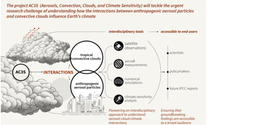
AC3S: Aerosoler, konvektion, moln och klimatkänslighet

Interaktioner mellan aerosolpartiklar och tropiska konvektiva moln är en stor källa till osäkerhet i den vetenskapliga förståelsen av klimatförändringar. AC3S kommer att använda nya observationsdata och numeriska modeller för att möta denna utmaning.

CRiceS

CRiceS - Climate Relevant interactions and feedbacks: the key role of sea ice and Snow in the polar and global climate system

Återkopplingar mellan ett förändrat klimat och vegetation (CLIVE)

Återkopplingar mellan ett förändrat klimat och vegetation (CLIVE): Den flyktiga organiska föreningarnas och de biogena aerosolernas roll. CLIVE syftar till att undersöka hur skogar, särskilt i boreala och tropiska regioner, påverkar klimatförändringar genom sina interaktioner med kol- och vattenkretsloppen.

FORCeS

FORCeS - Constrained aerosol forcing for improved climate projections

Arktis klimat i flera skalor

Polarområdena är särskilt känsliga för klimatförändringar och uppvärmningen i Arktis sker mer än dubbelt så snabbt som på resten av jorden. Effekterna av uppvärmningen är tydliga, exempelvis sker en dramatisk minskning av havsisens yta och tjocklek.

Kontakt

Namn och titel: Annica EkmanProfessor i meteorologi

Telefon: +468162397

Arbetsplats: Meteorologiska institutionen (MISU) Länk till annan webbplats.

Besöksadress Rum C 648Svante Arrhenius väg 16 C

Postadress Meteorologiska institutionen (MISU)106 91 Stockholm