Sarah Steimer Biträdande lektor

Kontakt

Namn och titel: Sarah SteimerBiträdande lektor

Telefon: +4686747171

ORCID0000-0002-1955-9467 Länk till annan webbplats.

Arbetsplats: Institutionen för miljövetenskap Länk till annan webbplats.

Besöksadress Rum V211Svante Arrheniusväg 8 C, Geohuset

Postadress Institutionen för miljövetenskap106 91 Stockholm

Om mig

I min forskning fokuserar jag på att undersöka källor, omvandlingsprocesser och hälsoeffekter av luftföroreningar i utomhusluft. Jag är särskilt intresserad av vilka luftburna partiklar som är mest skadliga för människors hälsa och hur detta hänger samman med deras kemiska sammansättning.

Det är väl känt att exponering för partiklar i omgivningsluften kan leda till negativa hälsoeffekter. Däremot är de bakomliggande mekanismerna fortfarande inte helt klarlagda, och det råder stor osäkerhet kring vilka partiklar som är mest toxiska och varför. För att studera detta jämför vi inte bara partiklar från olika källor, utan undersöker även hur atmosfäriska processer förändrar partiklarnas egenskaper, inklusive deras toxicitet.

Ett av de viktigaste verktygen jag använder i min forskning är acelullära analyser, som har utvecklats som ett cellfritt alternativ till traditionella in vitro-metoder. Jag använder även olika avancerade masspektrometrar för att bestämma partiklarnas sammansättning. Mer detaljerad information om pågående projekt finns under fliken ”Forskning” nedan.
Om du vill veta mer om mitt arbete, eller är intresserad av att göra ett examensarbete eller forskningspraktik i min grupp är du varmt välkommen att höra av dig via e-mail.

 
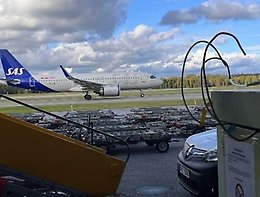
Några bilder från olika mätkampanjer och labexperiment

För närvarande ansvarar jag för kurserna "Atmospheric Chemistry and Physics" (Atmosfärens fysik och kemi) och "Air Quality from Emission to Impacts" (Luftkvalitet - från utsläpp till effekter).

Dessutom undervisar jag om luftkvalitetshantering på kursen "Miljöskyddsteknik", och jag ansvarar för atmosfärrelaterade fältstudier på kursen "Environmental Field Studies" (Miljövetenskapliga fältstudier).

Just nu fokuserar min forskning mycket på utsläpp från olika typer av slitage, särskilt bromsslitage. På grund av förbättrad avgasrening och den pågående elektrifieringen av fordonsflottan minskar utsläppen av fordonsavgaser. Däremot finns utsläpp från broms-, däck- och vägslitage kvar. Pågående forskning i min grupp inom detta område inkluderar:

  • Utsläpp av gasformiga föreningar från bromsslitage och deras potential att bilda sekundära aerosoler. Här använder vi toppmoderna on-line masspektrometrar för att identifiera de gaser som frigörs vid bromsning. Dessutom använder vi en oxidationsflödesreaktor för att studera effekterna av åldring via oxidation och uv-ljus.
  • Organiska föreningar i bromsslitagepartiklar. Många studier har undersökt metallinnehållet i bromsslitagepartiklar, medan mycket mindre är känt om de organiska komponenterna.
  • Oxidativ potential av slitagepartiklar
  • Utsläpp från smörjmedel
  • Kvantifiering av däckslitagepartiklar (Masterprojekt)

Dessutom samarbetar jag för närvarande med kollegor från SU, KI och KTH i ett projekt där vi studerar utsläpp, sammansättning och toxicitet hos ultrafina partiklar från flygplatser. Vi avslutade nyligen en fältkampanj på Arlanda flygplats, där vi inte bara mätte koncentrationerna av ultrafina partiklar in-situ, utan också samlade partiklar för senare kemisk och toxikologisk analys.

Jag handleder för närvarande även ett andra masterprojekt om termiska nedbrytningsprodukter av högpresterande polymerer.


  • An interlaboratory comparison to quantify oxidative potential measurement in aerosol particles

    Artikel
    2025. Pamela A. Dominutti, Anil Patel, Sarah Steimer, Gaëlle Uzu.

    This paper presents the findings from a collaborative interlaboratory comparison exercise designed to assess oxidative potential (OP) measurements conducted by 20 laboratories worldwide. This study represents an innovative effort as the first exercise specifically aimed at harmonising this type of OP assay, setting a new benchmark in the field. Over the last decade, there has been a noticeable increase in OP studies, with numerous research groups investigating the effects of exposure to air pollution particles through the evaluation of OP levels. However, the absence of standardised methods for OP measurements has resulted in variability in results across different groups, rendering meaningful comparisons challenging. To address this issue, this study engages in an international effort to compare OP measurements using a simplified method (with a dithiothreitol (DTT) assay). Here, we quantify the OP in liquid samples to focus on the protocol measurement itself, while future international OP interlaboratory comparisons (ILCs) should aim to assess the whole chain process, including the sample extraction. We analyse the similarities and discrepancies observed in the results, identifying the critical parameters (such as the instrument used, the use of a simplified protocol, the delivery and analysis time) that could influence OP measurements and provide recommendations for future studies and interlaboratory comparisons even if other crucial aspects, such as sampling PM methods, sample storage, extraction methods and conditions, and the evaluation of other OP assays, still need to be standardised. This collaborative approach enhances the robustness of the OP DTT assay and paves the way for future studies to build on a unified framework. This pioneering work concludes that interlaboratory comparisons provide essential insights into the OP metric and are crucial to move toward the harmonisation of OP measurements.

    Läs mer om An interlaboratory comparison to quantify oxidative potential measurement in aerosol particles
  • Diesel particle filter regeneration

    Artikel
    2025. Georgios Tsakonas, Rodopi Stamatiou, Ilias Vouitsis, Christos Sainidis, Ana Teresa Juárez Facio, Micol Introna, Sarah Steimer, Karine Elihn, Athanasios Besis, Athanasios Kouras, Constantini Samara, Antigone Lazou, Zissis Samaras.

    This study investigated the impact of Diesel Particulate Filter (DPF) regeneration on the composition and toxicity of exhaust emissions from a Euro 6d diesel passenger vehicle. Multiple real-world–simulated driving cycles were performed under two DPF conditions: normal operation and active regeneration. Exhaust emissions were characterized in real time for gaseous and particulate pollutants, while the nanoparticle fraction of the particulate mass was chemically analyzed for its organic and inorganic components. The toxicological effects of DPF regeneration were evaluated using an in vitro Air–Liquid Interface (ALI) exposure system with human lung cells. The results indicate that DPF regeneration accounted for more than 95 % of total particle number emissions, while significant amounts of carbon monoxide and methane were emitted as well. Exposures in the absence of particles led to similar reductions in cell viability and inflammatory responses, regardless of the DPF condition. In contrast, when particles were present, the cellular response became significantly stronger, indicating that the increased toxicity is primarily driven by the particulate fraction. Chemical analyses of nanoparticle mass revealed higher concentrations of water-soluble elements and oxygenated polycyclic aromatic hydrocarbons during regeneration. Overall, DPF regeneration transiently but substantially alters emission characteristics and significantly increases their toxicological potential.

    Läs mer om Diesel particle filter regeneration
  • Emission rates and composition of particulate matter from a large waste fire in Stockholm, Sweden

    Artikel
    2025. Sarah S. Steimer, Max Elmgren, Alexander Håland, Christer Johansson, Tomas Mikoviny, Michael Norman, Felix Piel, Ioannis Sadiktsis, Daniel Schlesinger, Sanna Silvergren, Armin Wisthaler, Karine Elihn.

    Uncontrolled waste burning and accidental waste fires are an important source of emissions into the air. However, there are currently only few field studies providing data on these emissions. In this study, we investigated the emission rates, pollutant dispersion and particle composition for a large waste fire in Stockholm county, Sweden. Our results show that the waste fire, while burning, may have contributed as much as 5 times the mean PM10 emissions from road traffic of the municipality it was located in (ca 95 000 inhabitants), which highlights the potential impact of temporary events such as waste fires on air quality. Gaussian dispersion calculations were used to model the spatial distribution of measured PM10 data, demonstrating its use for assessment of exposure and deposition. Particles impacted by the waste fire were enriched in several potentially toxic metals and metalloids including arsenic, copper, cadmium and, in particular, lead when compared to particles collected after the fire. In addition, they may also pose an increased cancer risk on a per-mass basis compared to the post-fire period due to the larger mass fraction of relevant PAHs.

    Läs mer om Emission rates and composition of particulate matter from a large waste fire in Stockholm, Sweden
  • From Molecules to Droplets

    Artikel
    2025. Almuth Neuberger, Stefano Decesari, Andreas Aktypis, Hendrik Andersen, Darrel Baumgardner, Federico Bianchi, Maurizio Busetto, Jing Cai, Jan Cermak, Sudhakar Dipu, Annica M. L. Ekman, Sandro Fuzzi, Yvette Gramlich, Sophie L. Haslett, Liine Heikkinen, Jorma Joutsensaari, Christos Kaltsonoudis, Juha Kangasluoma, Radovan Krejci, Angelo Lupi, Angela Marinoni, Angeliki Matrali, Fredrik Mattsson, Claudia Mohr, Athanasios Nenes, Marco Paglione, Spyros N. Pandis, Anil Patel, Ilona Riipinen, Matteo Rinaldi, Sarah S. Steimer, Dominik Stolzenburg, Juha Sulo, Christina N. Vasilakopoulou, Paul Zieger.

    The Italian Po Valley is one of the most polluted regions in Europe. During winter, meteorological conditions favor long and dense fogs, which strongly affect visibility and human health. In spring, the frequency of nighttime fogs reduces while daytime new particle formation events become more common. This transition is likely caused by a reduction in particulate matter (PM2.5), leading to a decrease in the relevant condensation sink. The physics and chemistry of fog and aerosol have been studied at the San Pietro Capofiume site since the 1980s, but the detailed processes driving the observed trends are not fully understood. Hence, during winter and spring 2021/22, the Fog and Aerosol Interaction Research Italy (FAIRARI) campaign was carried out, using a wide spectrum of approaches, including in situ measurements, outdoor chamber experiments, and remote sensing. Atmospheric constituents and their properties were measured ranging from gas molecules and molecular clusters to fog droplets. One unique aspect of this study is the direct measurement of the aerosol composition inside and outside of fog, showing a slightly greater dominance of organic compounds in the interstitial compared to the droplet phase. Satellite observations of fog provided a spatial context and agreed well with in situ measurements of droplet size. They were complemented with in situ chamber experiments, providing insights into oxidative processes and revealing a large secondary organic aerosol-forming potential of ambient air upon chemical aging. The oxidative potential of aerosol and fog water inferred the impact of aerosol–fog interactions on particle toxicity.

    Läs mer om From Molecules to Droplets
  • Short-lived reactive components substantially contribute to particulate matter oxidative potential

    Artikel
    2025. Steven J. Campbell, Battist Utinger, Alexandre Barth, Zaira Leni, Zhi-Hui Zhang, Julian Resch, Kangwei Li, Sarah S. Steimer, Catherine Banach, Benjamin Gfeller, Francis P.H. Wragg, Joe Westwood, Kate Wolfer, Nicolas Bukowiecki, Mika Ihalainen, Pasi Yli-Pirilä, Markus Somero, Miika Kortelainen, Juho Louhisalmi, Martin Sklorz, Hendryk Czech, Sebastiano di Bucchianico, Thorsten Streibel, Mathilde N. Delaval, Christopher Ruger, Nathalie Baumlin, Matthias Salathe, Zheng Fang, Michal Pardo, Sara D’Aronco, Chiara Giorio, Zongbo Shi, Roy M. Harrison, David C. Green, Frank J. Kelly, Yinon Rudich, Suzanne E. Paulson, Olli Sippula, Ralf Zimmermann, Marianne Geiser, Markus Kalberer.

    Exposure to airborne particulate matter (PM) has been attributed to millions of deaths annually. However, the PM components responsible for observed health effects remain unclear. Oxidative potential (OP) has gained increasing attention as a key property that may explain PM toxicity. Using online measurement methods that impinge particles for OP quantification within seconds, we reveal that 60 to 99% of reactive oxygen species (ROS) and OP in secondary organic aerosol and combustion-generated PM have a lifetime of minutes to hours and that the ROS activity of ambient PM decays substantially before offline analysis. This implies that current offline measurement methods substantially underestimate the true OP of PM. We demonstrate that short-lived OP components activate different toxicity pathways upon direct deposition onto reconstituted human bronchial epithelia. Therefore, we suggest that future air pollution and health studies should include online OP quantification, allowing more accurate assessments of links between OP and health effects.

    Läs mer om Short-lived reactive components substantially contribute to particulate matter oxidative potential

Kontakt

Namn och titel: Sarah SteimerBiträdande lektor

Telefon: +4686747171

ORCID0000-0002-1955-9467 Länk till annan webbplats.

Arbetsplats: Institutionen för miljövetenskap Länk till annan webbplats.

Besöksadress Rum V211Svante Arrheniusväg 8 C, Geohuset

Postadress Institutionen för miljövetenskap106 91 Stockholm